The Gaslit Allure of a Door That Should Not Exist
Few images feel more perfectly Victorian than Sherlock Holmes standing in a dim hallway, candlelight catching the edge of a polished walking stick, while a seemingly ordinary wall waits to betray its secret. A hidden door is more than a trick of carpentry. In a mystery, it is a challenge to reality itself. It tells the reader that the room has been lying, the house has been performing, and the truth has been waiting behind varnish, wallpaper, oak paneling, or a row of books no one thought to pull. Sherlock Holmes and Victorian hidden door mysteries belong together because both depend on observation. A concealed entrance is not magic; it is evidence disguised as emptiness. Holmes, with his famously precise eye, turns the invisible into the obvious. Where others see a respectable study, he notices dust disturbed along a skirting board, a draft where no window stands, a bookcase too shallow for its wall, or a fireplace oddly placed between rooms. In the Victorian imagination, the home was meant to represent order, privacy, inheritance, and social rank. A hidden door suggested that beneath that polished order lay something dangerous, intimate, and unresolved.
A: They turn architecture into evidence and reward the detective’s talent for noticing what others miss.
A: Dark wood paneling, libraries, fireplaces, heavy curtains, servants’ passages, and gaslit atmosphere.
A: Yes, especially in large homes with service corridors, built-ins, cellars, attics, and layered room plans.
A: A draft, a clean line in dust, mismatched molding, hollow sound, fresh oil, or unusual wall depth.
A: Absolutely. It can provide an unseen entrance or exit that changes the entire timeline.
A: The bookcase door, because it feels elegant, intelligent, and perfectly suited to detective fiction.
A: Plant subtle clues early so the reveal feels surprising but logical.
A: Foggy streets, quiet halls, polished wood, low firelight, and a sense that the house is hiding something.
A: No. They can also hide letters, heirlooms, secret studies, forbidden rooms, or family history.
A: They make ordinary rooms feel deeper, stranger, and full of discoverable truth.
Victorian London: A City Built for Secrets
Victorian London was not merely a backdrop for mystery; it was a machine for producing it. The city expanded rapidly, creating a maze of townhouses, warehouses, clubs, banks, theaters, boarding rooms, and private estates. Behind their public fronts, many buildings contained service corridors, concealed stairways, coal cellars, storage rooms, and back entrances. These features were often practical, but in detective fiction they became instruments of suspense. The Victorian imagination loved the contrast between appearance and reality. A drawing room could hide scandal. A respectable gentleman could keep a criminal correspondence. A quiet house in Kensington could contain a passage to a locked laboratory. This tension makes hidden doors especially powerful in Sherlockian storytelling. They turn architecture into evidence. A wall is not just a wall. It is a witness.
Holmes, Observation, and the Architecture of Clues
Sherlock Holmes does not discover hidden doors through luck. He reads rooms as if they were written pages. Dust patterns, floor scratches, shifted rugs, uneven candle soot, disturbed books, and mismatched moldings all become part of his language. Where others see decoration, Holmes sees behavior. Where others see furniture, he sees movement.
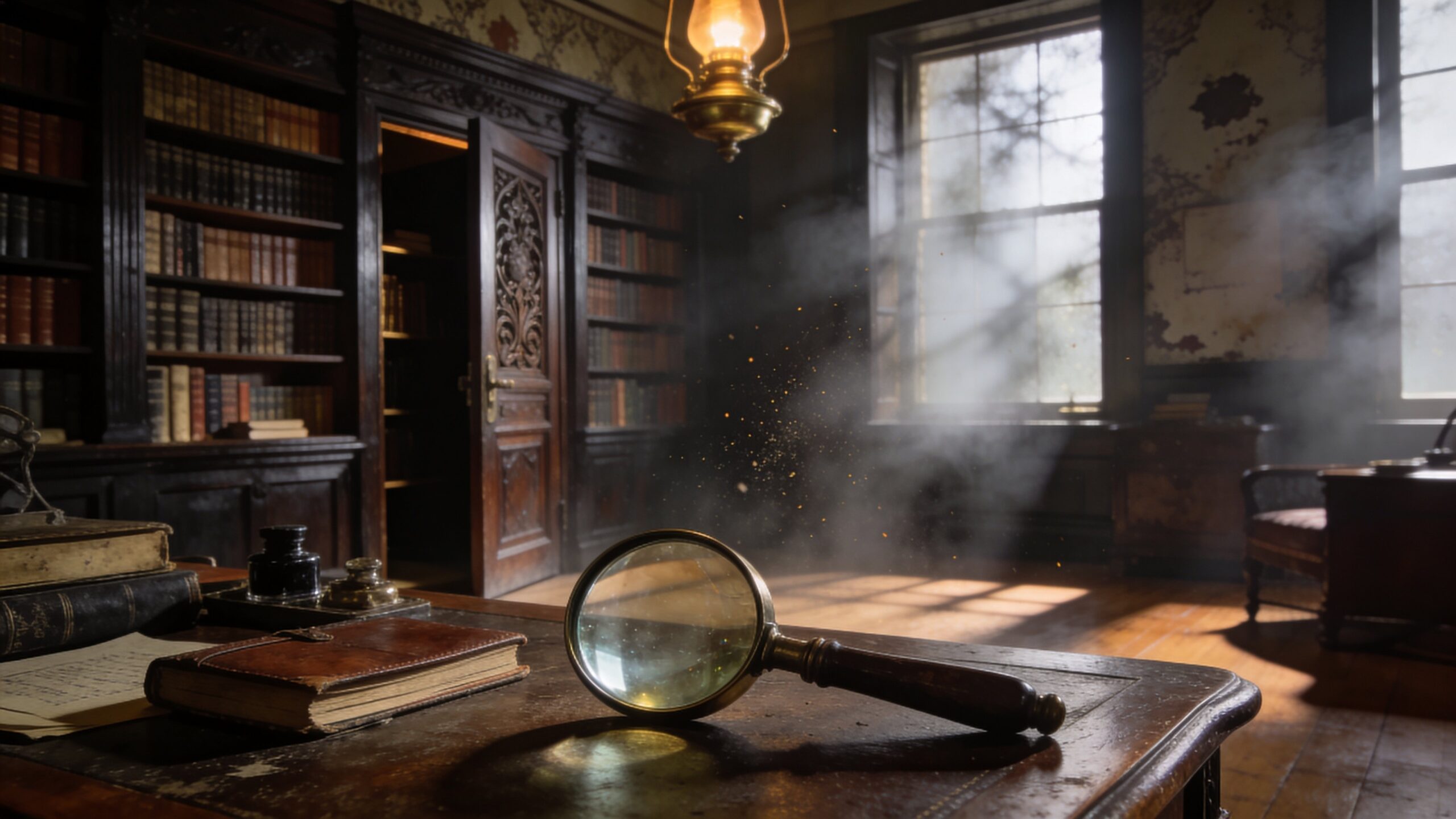
A hidden door mystery gives Holmes the perfect stage for his method. It allows the detective to move from tiny details to astonishing conclusions. A brass hinge lightly oiled in an otherwise neglected room may imply recent use. A bookcase with no dust behind one row of volumes may imply motion. A servant who claims never to enter the library may be betrayed by coal dust near a concealed latch. The drama comes not from the door alone, but from the chain of reasoning that reveals it.
Why Hidden Doors Feel So Victorian
Hidden doors feel Victorian because the period prized both privacy and theatricality. Middle- and upper-class homes were designed around social boundaries: public rooms for guests, private rooms for family, and service areas for staff. The architecture itself divided people by status, gender, duty, and reputation. A concealed entrance could protect privacy, conceal labor, or preserve the illusion of effortless domestic order.
At the same time, Victorian taste often favored rich visual surfaces. Dark wood paneling, patterned wallpaper, built-in cabinets, ornamental screens, and heavy drapery all made concealment easier. A secret panel could vanish within decorative complexity. A bookshelf could become a door without disturbing the dignity of the room. In the world of Holmes, this elegance becomes suspicious. Beauty may hide mechanism. Respectability may hide crime.
The Bookcase Door: A Classic Holmesian Device
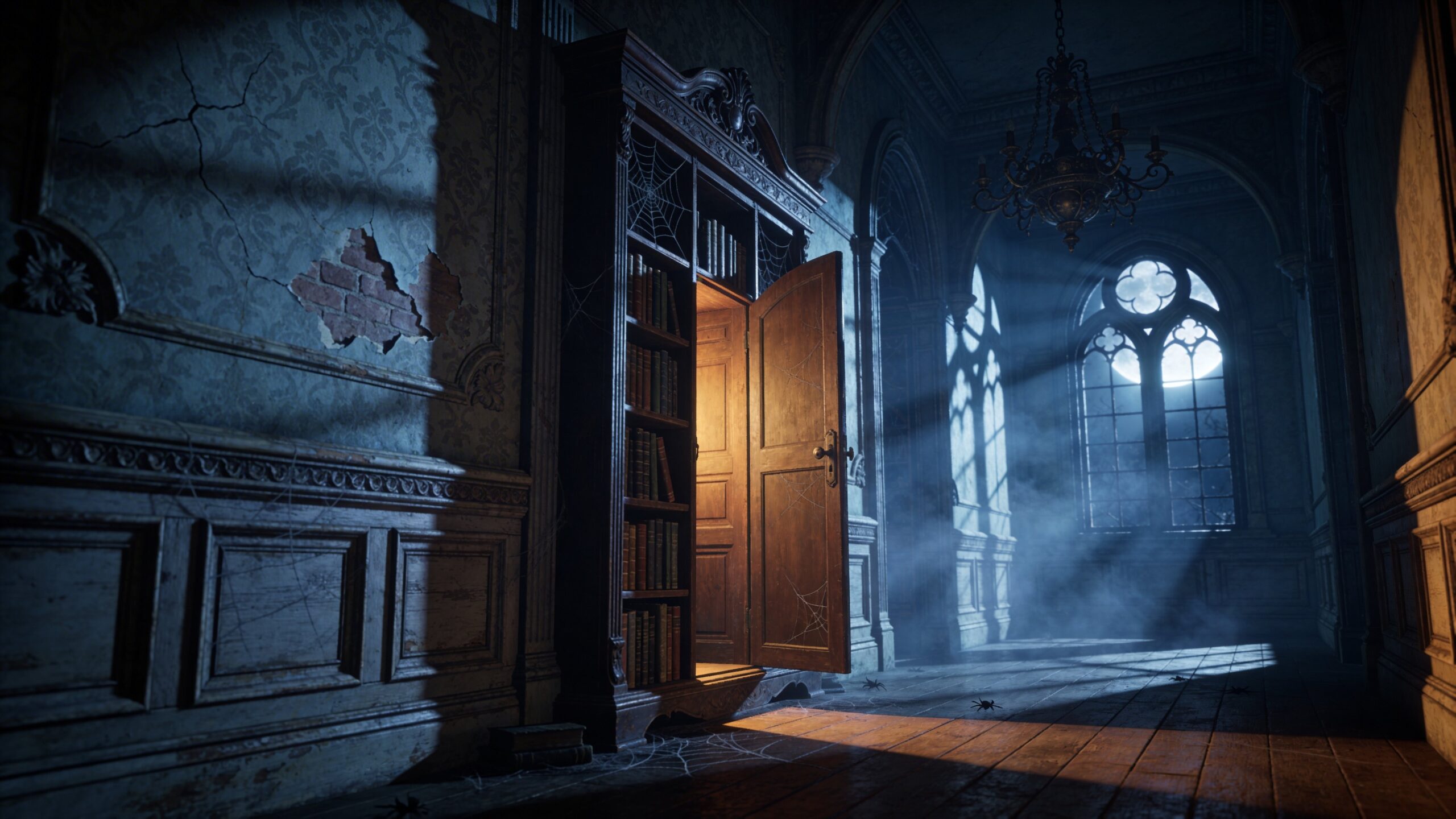
The bookcase door is perhaps the most iconic hidden entrance in detective fiction. In a Sherlock Holmes setting, it feels especially appropriate because books represent knowledge, order, and intellect. A criminal who hides behind books is making a bold statement, whether intentionally or not. He is concealing action behind learning, danger behind civilization.
Imagine Holmes entering a private library after a mysterious disappearance. The shelves are filled with law books, scientific journals, and travel volumes. Watson admires the collection. Holmes ignores the titles and studies the floor. There, beneath the third shelf, are faint crescent marks where a heavy case has swung open. One volume is slightly warmer than the others because it has been handled often. A decorative bust sits not for beauty, but to conceal a spring catch. In a moment, the library ceases to be a room of thought and becomes a doorway to action.
Secret Panels and the Language of Wood
Victorian interiors often used wood paneling to signal wealth and seriousness. Mahogany, walnut, oak, and dark-stained trims created rooms that felt permanent and dignified. For mystery writers, paneling offered endless possibilities. A panel could slide, swing, lift, or conceal a safe. Its grain could hide cuts. Its shadows could disguise seams.
Holmes would approach such a wall with patience. He might tap lightly, listening for the hollow note behind one section. He might examine wax buildup near a carved edge or notice that one panel lacks the fine cracks found in its neighbors. He might detect fingerprints in polish or a faint smell of tobacco from behind the wall. Every hidden panel creates a question: who built it, who uses it, and why?
Disguised Doors and Social Deception
A hidden door is more than a clever object. It is a symbol of deception. In Victorian mystery, the person who owns a hidden door is rarely innocent of secrecy, even if not guilty of murder. The door suggests divided lives. One life is visible to society; the other moves unseen through private corridors.
This is where Sherlock Holmes thrives. He understands that crimes are often staged for appearances. A locked-room mystery may not truly be locked. A nobleman may not truly be absent. A victim may not have been alone. A hidden door allows the impossible to become possible, and Holmes’s genius lies in restoring the physical truth beneath the social performance.
The Locked Room and the Invisible Exit
The locked-room mystery becomes especially exciting when a hidden door is involved. A victim is found in a sealed study. The windows are bolted from within. The door is locked. No weapon is visible. Witnesses swear no one entered or left. To the police, the case appears supernatural or unsolvable. To Holmes, it is merely incomplete.
The hidden exit changes everything. A rotating fireplace screen, a concealed stair behind wainscoting, or a panel masked by a tapestry can transform the impossible into a meticulously planned crime. Yet Holmes would never accept the hidden door as the entire explanation. He would ask why the murderer chose that route, how they knew of it, whether the victim knew of it, and what trace the passage left behind. The door opens, but the mystery deepens.
Fog, Footsteps, and Secret Passageways
Victorian hidden door mysteries are not limited to elegant interiors. Secret routes might lead to alleys, gardens, mews houses, river stairs, tunnels, or abandoned cellars. London’s fog adds atmosphere and confusion. A suspect may vanish through a hidden garden gate, cross a courtyard unseen, and reappear miles away with a convincing alibi. In Holmes’s world, the city itself can become a network of concealed exits.
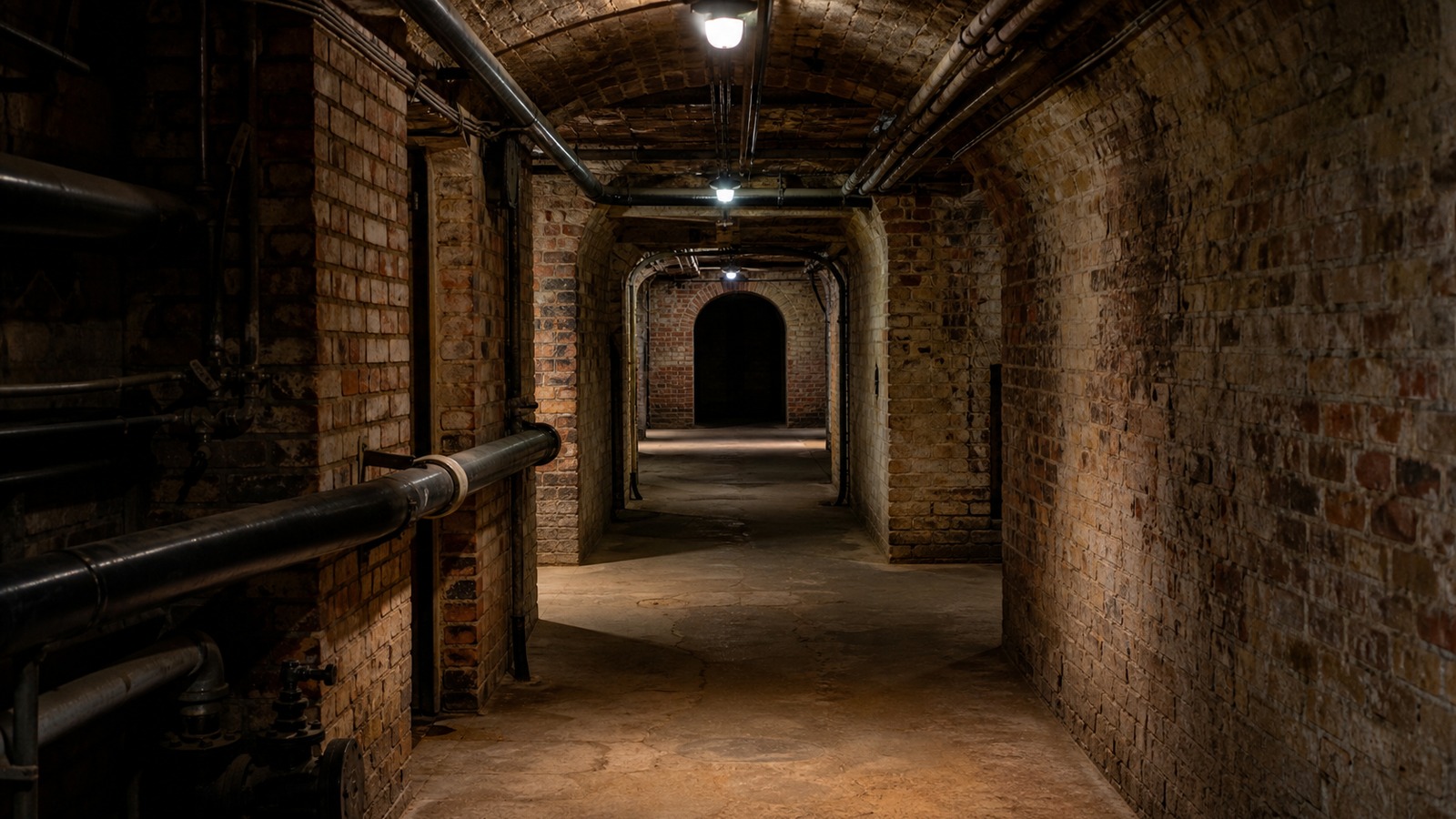
A hidden passageway also creates sensory drama. Watson might describe cold brick walls, dripping water, lantern light trembling on curved ceilings, and the muffled thunder of traffic overhead. Holmes would remain focused, measuring footprints, ash, mud, and cobwebs. Where Watson feels the romance of danger, Holmes sees the grammar of movement.
The Role of Servants’ Corridors
Many Victorian homes were organized around invisible labor. Servants moved through back stairs, pantry doors, and service corridors designed to keep household work out of sight. These routes were not always secret, but they were often hidden from guests. In detective fiction, such corridors become vital. A servant may know more about a household than anyone else. A maid may hear whispers through a concealed door. A footman may notice that a passage supposedly unused has fresh mud on the floor. A butler may understand the old house better than its new master. Holmes, unlike many Victorian gentlemen, pays close attention to servants’ observations. He knows that those who move unseen often see the most.
Hidden Doors in Country Houses
While London offers fog and urban complexity, the Victorian country house offers scale, inheritance, and old secrets. Ancient estates may contain priest holes, blocked wings, family vaults, concealed chapels, or forgotten corridors from earlier centuries. By Holmes’s era, these features could be half-remembered legends or deliberately preserved tools.
A country house hidden door mystery often carries the weight of family history. The secret entrance may have been built for political danger, religious persecution, smuggling, or romantic scandal. By the time Holmes arrives, its original purpose may be gone, but its usefulness remains. A modern crime hides inside an old mechanism, proving that architecture can outlive morality.
Mechanisms Worthy of Moriarty
A simple secret door might swing open with pressure, but a Holmesian hidden door can become far more elaborate. Counterweights, spring latches, rotating shelves, hidden buttons, false locks, weighted panels, and disguised handles all provide opportunities for criminal ingenuity. A brilliant villain does not merely hide a door; he makes its discovery unlikely, its use quiet, and its purpose deniable.
Professor Moriarty, or any criminal of comparable intelligence, would understand the strategic value of architecture. A hidden door can create an escape route, a surveillance point, a smuggling path, or a trap. It can allow a villain to appear omniscient, moving through a house like a ghost. For Holmes, exposing the mechanism is not just technical success. It is intellectual combat.
Watson’s Wonder and the Reader’s Delight
Dr. Watson plays an essential role in hidden door mysteries. He represents the intelligent observer who sees the room as most readers would see it. He notices mood, danger, and human emotion. Holmes notices the impossible detail. When the hidden door opens, Watson’s surprise becomes our own.
This dynamic makes the reveal satisfying. The reader feels astonishment, but not cheated, because the clues were there. The scratch on the floor, the misplaced umbrella stand, the odd echo, the draft near the mantel, the missing dust on a shelf—all were available. Holmes did not invent the answer. He noticed what others dismissed.
The Psychology of Secret Rooms
Hidden doors fascinate us because they suggest another life just beyond the visible one. A secret room may contain treasure, evidence, a fugitive, a forbidden experiment, a stolen document, or a memory someone tried to bury. In Victorian fiction, it often represents repression. The era’s polished surfaces concealed anxieties about class, empire, science, sexuality, money, inheritance, and reputation.
Holmes approaches these psychological depths without sentimentality, yet the stories often reveal human vulnerability. A hidden door may protect someone innocent as easily as conceal someone guilty. A frightened witness may hide behind a panel. A victim may leave a message in a secret chamber. A family may preserve a door not for crime, but for shame. The best mysteries understand that secrecy has many motives.
Scientific Detection in a Romantic Setting
One reason Sherlock Holmes remains so compelling is that he brings scientific discipline into romantic environments. A foggy street, a candlelit room, and a secret panel create atmosphere. Holmes brings chemistry, logic, measurement, and experiment. He may test plaster dust, compare boot impressions, examine fibers, identify cigar ash, or reconstruct the movement of a concealed mechanism.
This combination makes Victorian hidden door mysteries especially rich. The setting feels theatrical, but the solution feels earned. Holmes does not defeat superstition by denying atmosphere; he moves through atmosphere with sharper senses. The hidden door may feel Gothic, but its proof lies in physics, carpentry, timing, and motive.
Designing a Sherlockian Hidden Door Mystery
A strong Sherlock Holmes hidden door mystery begins with contradiction. Someone vanishes from a closed room. A priceless document disappears from a locked cabinet. A witness hears footsteps inside a wall. A dead man is found where no intruder could have entered. The hidden door must solve the physical puzzle while opening a deeper human one.
The best version of this mystery does not reveal the secret too early. The door should be foreshadowed through ordinary details. Perhaps the room is colder than expected. Perhaps the wallpaper pattern breaks near the corner. Perhaps a servant refuses to stand near one wall. Perhaps a dog growls at a bookcase. When Holmes finally touches the latch, the reader should feel both surprise and inevitability.
The Elegance of the Reveal
The reveal of a hidden door is one of the great pleasures of mystery storytelling. It is visual, dramatic, and intellectual all at once. A panel glides open. A shelf swings outward. A mirror pivots. Behind it lies a narrow stair, a forgotten room, or a passage black as ink. In that instant, the entire geography of the story changes.
For Holmes, the reveal is rarely theatrical for its own sake. He may allow himself a thin smile, but his mind has already moved ahead. The hidden door proves access. Access suggests opportunity. Opportunity narrows the suspects. The true climax is not the opening of the door, but the closing of the logical net.
Why These Mysteries Still Captivate Us
Sherlock Holmes and Victorian hidden door mysteries endure because they speak to a universal suspicion: the world has more layers than we are shown. Every house may contain a story behind its walls. Every polished room may have a second purpose. Every locked door may be less final than it appears.
In modern storytelling, hidden doors still thrill because they combine design, danger, and discovery. They promise that intelligence can uncover what power tries to conceal. Holmes remains the ideal guide because he teaches us to look again. The seam in the panel, the dust on the sill, the quiet draft from nowhere—these are invitations. The mystery is not hidden from us completely. It is waiting for a mind patient enough to see.
Conclusion: Behind the Panel, the Truth
A Sherlock Holmes hidden door mystery is more than a puzzle about secret architecture. It is a story about perception. Victorian rooms are full of curtains, cabinets, etiquette, and silence, but Holmes cuts through them with observation. He understands that the built world carries evidence of every touch, every habit, every lie. That is why the image remains so powerful: Holmes in the lamplight, Watson at his shoulder, a respectable room suddenly trembling with possibility. A hand moves toward the carved wood. A latch gives way. The hidden door opens. Beyond it waits not merely a passage, but the truth.