The Park Has to Hide Its Own Machinery
Secret entrances in amusement parks are not only for mystery-themed rides or storybook castles. They are part of how parks keep imaginary worlds intact while thousands of practical tasks happen behind the scenes. Staff need routes, performers need access, ride teams need maintenance doors, food service needs supplies, and safety teams need clear paths. A well-hidden entrance lets the public experience stay immersive without pretending the work does not exist. The best park doors are therefore both theatrical and operational: they protect the story while keeping the park running.
A: They hide staff movement, maintenance, service, safety access, and performer routes inside themed spaces.
A: No. They can appear in queues, restaurants, shops, facades, storage areas, and performance zones.
A: No. Backstage and staff-only doors should be respected for safety and operations.
A: They use scenery, props, rockwork, facades, paint, and story logic.
A: They must support safety, not interfere with emergency or maintenance access.
A: Large attractions need control rooms, evacuation routes, storage, and technical maintenance.
A: It belongs to the themed world while remaining durable and easy for staff.
A: Theme park guests often study details closely and enjoy understanding the design.
A: Chipped paint, awkward hardware, modern-looking panels, or visible backstage clutter.
A: A hidden entrance should support both story and operations.
Themed Worlds Need Backstage Doors
An amusement park is full of boundaries between guest space and backstage space. The public sees facades, streets, queues, rides, gardens, food stands, and show scenes. Behind those surfaces are workshops, storage rooms, break areas, control rooms, kitchens, costuming spaces, and service roads. Secret entrances help those two worlds sit next to each other without constantly colliding.
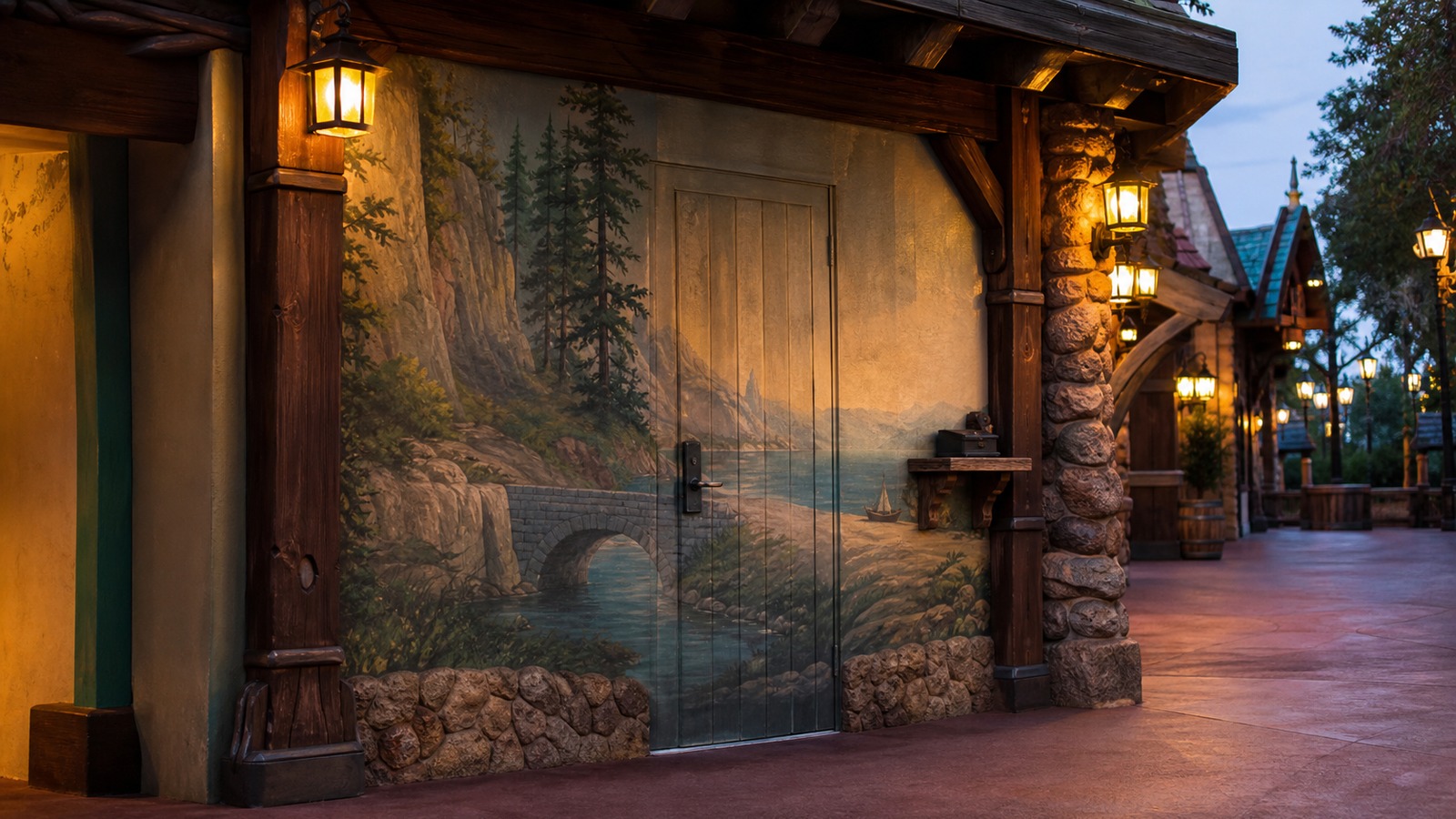
The goal is not perfect invisibility. It is believable integration. A staff door can look like part of a castle wall, a warehouse bay, a jungle gate, a seaside shed, or a futuristic panel depending on the land around it. The entrance hides by speaking the visual language of the story.
That is why amusement park doors are so interesting. They are designed for some of the most observant guests in the world. Fans study surfaces, photograph corners, and notice details. The hidden door has to serve real operations while surviving that attention.
Queues Are Full of Controlled Access
Ride queues often contain discreet doors for staff, emergency movement, show control, maintenance, accessibility routing, or storage. These doors may be tucked into themed walls, disguised as props, or integrated into scene breaks. A queue is both a story space and an operational system.
Good queue design makes these doors feel natural. If the setting is a mine, a service door might look like a timber utility panel. If the story is a laboratory, a door might look like a clean technical hatch. The disguise works because it belongs to the world the guest has already accepted.
Safety Routes Have to Win
Amusement parks depend on safety, and hidden entrances must respect that priority. Emergency access, evacuation routes, first-aid movement, ride maintenance, and staff response paths cannot be sacrificed for a perfect visual trick. A door may blend into scenery, but authorized teams must be able to find and use it immediately.
Backstage Movement Protects the Illusion
Performers, characters, technicians, custodial teams, food service workers, and ride operators often need to move without breaking the guest experience. Discreet entrances let them appear and disappear in ways that support the park’s rhythm. The magic is not that staff are absent. It is that their movement is choreographed.
This choreography can be subtle. A performer may enter through a themed gate at the right moment. A technician may access a panel between ride cycles. A food team may restock through a door guests read as part of the set. Each entrance supports a small piece of the larger illusion.
When the system works, guests feel continuity. The land does not constantly reveal its service layer. That continuity is one reason well-designed parks feel so complete.
Ride Buildings Hide the Most
Large ride buildings are often bigger and more complex than they appear from guest areas. A charming exterior may hide maintenance bays, evacuation stairs, projection rooms, control spaces, catwalks, storage, and mechanical systems. Secret entrances help staff reach these areas without making the ride facade feel industrial.
Those entrances must be durable. Park doors face heavy use, weather, crowds, cleaning, vibration, and repeated inspections. A scenic finish has to survive daily operations, not only opening day photographs.
Props Can Become Doors
Amusement parks are good at turning props into access points. A crate, bookshelf, painted wall, rockwork seam, shopfront, or service cart bay can conceal a door. The trick works when the object already belongs to the environment and when the movement does not call attention to itself.
Guest Curiosity Has Limits
Theme park fans enjoy finding hidden details, but backstage doors should be respected. They may lead to ride areas, safety systems, employee spaces, kitchens, or technical rooms. Opening them without permission can create hazards and disrupt operations.
The better way to enjoy these entrances is to notice the design without testing it. Parks often reward careful looking through show details, themed seams, and intentional storytelling. Curiosity can stay on the guest side of the threshold.
Maintenance Keeps the Story Alive
A hidden park entrance has to be maintained like both a door and a piece of scenery. Hinges, closers, access hardware, paint, texture, weatherproofing, and surrounding props all need care. If the door sags, chips, or rattles, the illusion weakens.
This work is never finished. Parks operate in sun, rain, crowds, and constant use. Scenic doors may need touch-ups, hardware adjustments, and replacement parts more often than residential hidden doors. The best designs anticipate that future work.
Maintenance access itself can require additional hidden panels. The park becomes a layered puzzle of doors serving doors, each one helping the public story remain smooth.
Designers Balance Story and Operations
For themed entertainment designers, a secret entrance is successful when it satisfies operations and story at the same time. The operations team needs safety, access, durability, and clarity. The creative team needs visual coherence, immersion, and timing. The final door has to answer both.
That balance is why simple solutions often win. A well-painted staff door aligned with scenic joints may outperform a complex mechanism that is hard to maintain. A door guests never notice is often more successful than one they admire.
The Real Magic Is Coordination
Secret entrances in amusement parks prove that immersion is built from coordination. Architecture, scenic art, operations, safety, performance, maintenance, and guest psychology all meet at the threshold. The door may be small, but it carries a large agreement about how the park should work.
That makes amusement park secret doors especially useful for hidden-door design in other settings. A concealed opening should not be judged only by how well it disappears. It should be judged by how well it supports the experience on both sides.
That support has to last through crowds, weather, staffing changes, and long operating days. A beautiful hidden door that only works under perfect conditions is not a park solution. The strongest examples are boringly dependable for employees and visually persuasive for guests. They prove that fantasy depends on infrastructure as much as imagination.
The Park Door Has Two Audiences
A secret park entrance always has two audiences. Guests need it to belong to the story, while staff need it to work quickly and safely. The strongest doors respect both groups. They hide the labor of the park without making that labor harder.
When that balance holds, the park feels effortless. Guests see a world, not a service plan. Staff use a functional system, not a fragile illusion. The hidden entrance becomes one of the quiet tools that lets fantasy and operations share the same street.
Hidden Access Is Part of the Show
Amusement parks reveal a useful truth about secret doors: concealment is not always about secrecy in the strictest sense. Many guests know that backstage areas exist. They know performers need entrances and ride teams need access. The illusion works anyway because the park controls when practical systems become visible. A hidden entrance helps the public agree to the story without constantly being asked to ignore the machinery behind it.
This makes the design more delicate than simple camouflage. The door has to look like it belongs to the land’s architecture, but it also has to open at the right speed, handle the right traffic, and close without leaving a visual scar. Lighting matters because a seam that disappears at noon may stand out at night. Sound matters because a service door that slams during a quiet scene can break immersion even if the paint is perfect.
The most impressive park entrances often hide in places that make narrative sense. A delivery door in a fantasy market, a rockwork hatch near a ride landscape, a theatrical gate for performers, or a utility panel inside a science-fiction corridor can all feel natural because the surrounding world explains them. The door is not invisible; it is accepted.
That lesson travels well outside theme parks. Restaurants, hotels, museums, offices, and homes can all benefit from hidden access that respects both users and observers. A concealed door should support the people who pass through it and the people who remain outside it. In amusement parks, that balance keeps the story alive. In everyday design, it keeps spaces graceful without hiding the fact that real work is happening nearby.
The Threshold Has to Survive Attention
Amusement park thresholds face a strange kind of pressure: they are meant to be overlooked by casual guests and studied by devoted fans at the same time. Some visitors walk past them while thinking about the next ride. Others photograph details, compare paint textures, and notice where a scenic wall might open. A successful hidden entrance can tolerate both kinds of attention because its disguise is rooted in the environment rather than dependent on a single fragile illusion.
That is why story logic is so valuable. A seam in a rock wall, a service hatch in a laboratory scene, or a staff doorway shaped like a merchant entrance does not have to be perfectly invisible. It only has to make sense. When the guest’s mind has a plausible explanation, the door can remain part of the world instead of becoming a mistake in the scenery.
Durability completes that illusion. Paint, hardware, weather seals, door closers, hinges, and nearby props must survive constant use without looking worn in the wrong way. The park can embrace controlled aging when a setting calls for it, but it cannot let accidental wear reveal the backstage plan. The hidden entrance has to keep performing long after opening-day excitement has faded.
Backstage Design Shapes Frontstage Wonder
The best amusement park entrances remind us that wonder is rarely effortless for the people who build and operate it. Hidden doors help supplies arrive, performers appear, technicians respond, and safety teams move while the guest-facing world remains coherent. When those thresholds are planned with care, the park does not feel fake; it feels whole. The visible fantasy is stronger because the invisible system is working. That is the quiet genius of themed access: it lets practical movement happen close to guests without asking guests to leave the world they came to inhabit. A good hidden entrance protects the story, but it also protects the workers who keep that story alive. It lets the park remain generous to visitors because the necessary work has a route of its own, tucked inside the same design language as the adventure around it. The threshold is small, but it helps hold the whole performance together. That is design doing invisible stage management well.