
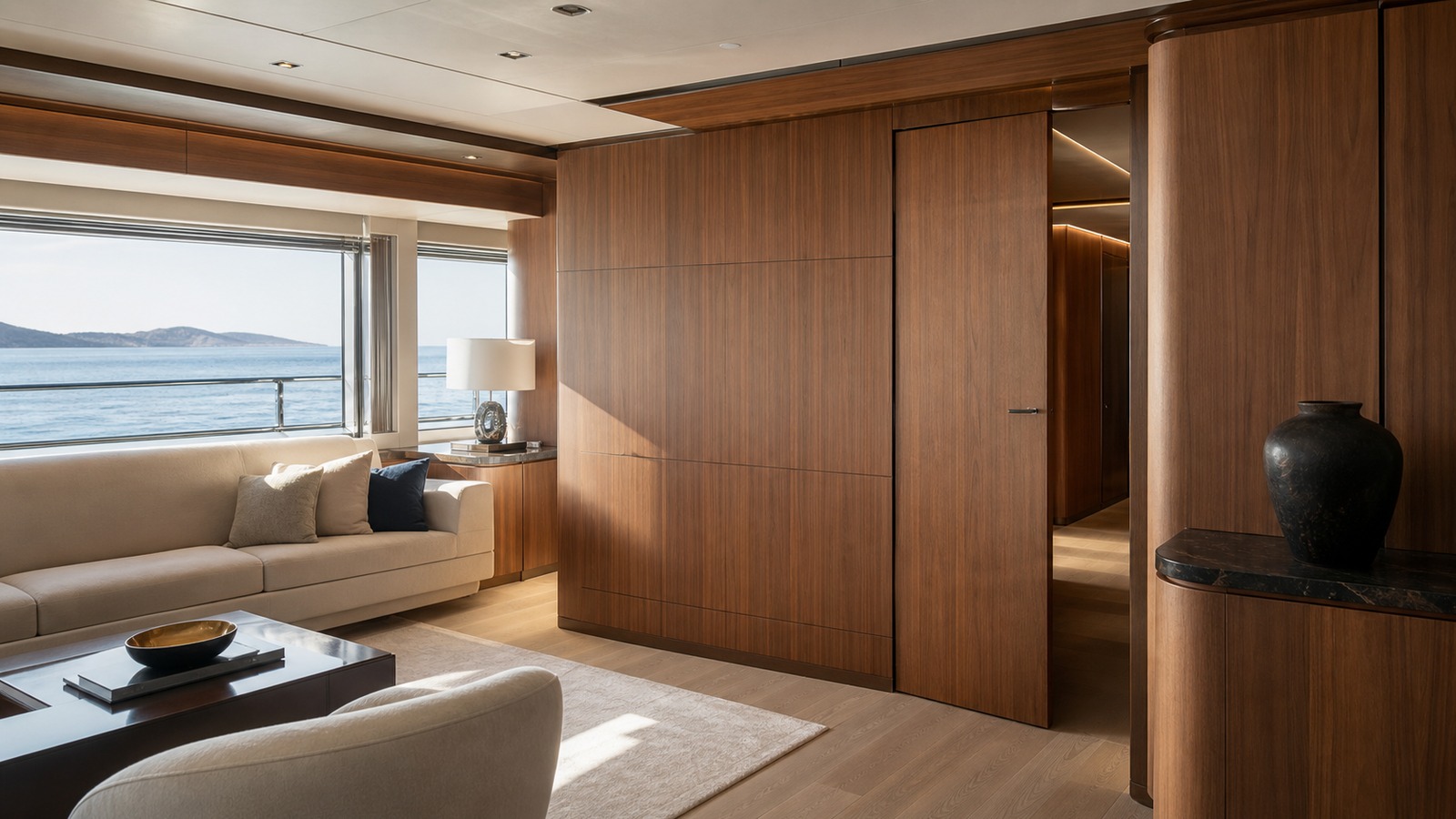
Luxury Makes Concealment Harder, Not Easier
Secret doors in luxury yachts and private jets sound effortless because the settings are associated with customization, privacy, and polished detail. In reality, these are some of the hardest places to hide a door well. Every inch matters, every material choice affects weight, every latch has to survive motion, and every concealed opening must respect safety rules. A hidden panel on a yacht or aircraft is not just an aesthetic flourish. It is a compact engineering decision wrapped in luxury finish, and it succeeds only when privacy, service flow, maintenance, and safety all work together.
A: Space, weight, motion, safety, service, and finish quality all create constraints.
A: They may hide storage, crew routes, safes, private cabins, controls, or service access.
A: Often yes. Privacy and visual calm are usually more valuable than surprise alone.
A: Heavy panels and hardware can affect performance, balance, and installation complexity.
A: Yes, which is why latching and vibration control are essential.
A: It may be integrated discreetly, but required access and information must stay clear.
A: Quiet motion, precise alignment, material continuity, and genuine usefulness.
A: Sometimes, but those routes must remain simple and reliable for service.
A: Future repairs should not require damaging expensive interiors.
A: Concealment has to respect the limits of the vessel or aircraft.
Small Spaces Make Every Door Important
Luxury yachts and private jets may be expensive, but they are still constrained environments. Cabins, lounges, galleys, crew areas, wardrobes, lavatories, storage compartments, and technical access points all compete for limited volume. A secret door can help keep the visible interior calm, but it cannot waste space.
This is why concealed access in these settings often hides practical functions: crew routes, service storage, mechanical panels, wardrobe compartments, safes, entertainment systems, or private sleeping areas. The door may look seamless, but the reason behind it is usually very specific.
A hidden door that works in a house may fail on a vessel or aircraft because the tolerances are different. Movement, vibration, humidity, pressure changes, and maintenance access all matter. Luxury finish does not remove those constraints. It has to work within them.
Privacy Is the Real Luxury
On a yacht or private jet, privacy is often more valuable than the surprise of the door itself. Owners and guests may want crew service to feel discreet, personal belongings to stay organized, or private spaces to remain visually quiet. A concealed door can make a compact interior feel more composed and less busy.
The best privacy doors do not turn the space into a puzzle. They simply reduce visual noise. A paneled wall may hide a sleeping cabin, a cabinet may conceal a safe, or a lounge wall may open to service storage. The effect is calm, not theatrical.
Weight Changes the Design Conversation
Weight matters in both yachts and aircraft, though in different ways. Heavy doors, thick stone panels, oversized hardware, and decorative mechanisms can affect performance, balance, installation, and maintenance. Designers have to create the impression of solidity without adding unnecessary burden.
Movement Tests Every Mechanism
Yachts move with waves, vibration, and changing humidity. Aircraft experience vibration, pressure cycles, and strict safety requirements. A concealed door in either environment must stay closed when it should, open easily when authorized, and avoid rattling. A beautiful panel that buzzes, sticks, or swings loose will not feel luxurious for long.
Latches and hinges therefore carry much of the experience. They must be quiet, secure, serviceable, and compatible with the surrounding materials. The mechanism should feel effortless to the user, but it should never be casual in design.
This is where luxury craft becomes most visible to the hand rather than the eye. The guest may not see the hinge, but they feel the way the door moves. A hidden door in a moving environment has to feel deliberate every time it opens.
Crew Flow Needs Discretion Without Confusion
Yachts and private aircraft rely on service. Crew need access to galleys, storage, technical compartments, laundry, supplies, and guest areas. Concealed doors can help crew move discreetly, but the routes must remain clear to the people using them under time pressure.
Overly clever hidden access can slow service or create awkward moments. The best solutions are simple for trained crew and invisible to guests who do not need them. That balance protects both hospitality and efficiency.
Materials Have to Earn Their Place
Luxury interiors often use wood veneer, leather, fabric panels, metal trim, stone, glass, and lacquered finishes. On yachts and private jets, those materials have to meet performance demands. A hidden door must match the surrounding finish while allowing access for inspection, repair, cleaning, and emergency needs.
Material continuity is crucial. If the concealed panel has a different sheen, grain direction, sound, or reveal width, the disguise weakens. In compact interiors, people sit close to the surfaces, so errors are easy to notice.
Good designers plan the secret door as part of the surface from the beginning. They do not cut it in after the luxury finish is already decided.
Safety Cannot Be Hidden Away
A concealed door should never obscure required safety equipment, emergency egress, ventilation access, or crew procedures. Luxury users may enjoy visual calm, but they still need clear information when it matters. The more compact the environment, the more important this becomes.
Storage Is Often the Smartest Secret
Some of the best secret doors in yachts and jets do not lead to rooms at all. They hide storage. A panel may open to luggage space, bar equipment, safety supplies, bedding, entertainment controls, or cleaning tools. This kind of concealment makes the interior feel larger because necessary objects are close but not visible.
Storage secrets age well because they solve daily problems. A hidden bar may be fun, but a perfectly placed storage panel that keeps a lounge uncluttered can be more valuable over time.
Maintenance Access Should Be Designed Beautifully
High-end interiors still need maintenance. Filters, wiring, plumbing, inspection panels, audiovisual systems, and structural access cannot disappear forever. Concealed doors and panels should make maintenance possible without damaging finishes.
This is one of the marks of serious design. A panel that can be opened cleanly by technicians and closed without visible damage protects the owner’s investment. Hidden access is not only for guests; it is for the long life of the vessel or aircraft.
Ignoring maintenance creates expensive problems. If a repair requires tearing apart a luxury wall, the concealment was poorly planned. The best hidden panels make future care part of the design from the start.
The Reveal Should Feel Quietly Expensive
In luxury settings, the best reveal is usually understated. A wall opens with a soft movement, a wardrobe conceals a private compartment, or a panel gives crew access without breaking the interior rhythm. The guest does not need to see a performance. They need to sense that the space has been considered deeply.
That quiet confidence is what separates refined hidden doors from novelty. The secret should make the yacht or jet feel calmer, more private, and more capable. It should not make the interior feel like a stage set.
Constraint Creates the Elegance
The fascination of secret doors in yachts and private jets comes from constraint. There is no extra room for sloppy ideas. The hidden door has to manage weight, movement, safety, service, finish, storage, and maintenance in one compact gesture. That is why these doors can feel so sophisticated when they are done well.
The lesson carries beyond luxury travel. A hidden door is strongest when it respects the limits of its setting. On land, at sea, or in the air, concealment works best when it solves a real problem with calm precision.
That precision is what keeps the result from feeling like a novelty. A guest may never know how many compromises sit behind a seamless panel, but they will notice if the door closes softly, the room stays uncluttered, and the crew can work without awkward interruptions. Luxury concealment succeeds when the constraint disappears into ease.
The Best Hidden Travel Door Feels Inevitable
A yacht or private jet interior is judged at very close range. Guests touch surfaces, sit near panels, hear small vibrations, and notice whether a room feels settled. That intimacy changes the standard for hidden doors. A clever reveal might delight once, but the door has to keep earning its place on every trip. If it rattles during a crossing, blocks a narrow passage, complicates cleaning, or makes crew service slower, the glamour fades quickly.
This is why good hidden access in travel spaces often looks understated. A panel may disappear into book-matched veneer, a wardrobe door may conceal a safe without breaking the cabin rhythm, or a service opening may align with a decorative joint that already belongs to the wall. The design does not ask guests to admire the trick. It lets them enjoy a room that feels more spacious, private, and composed than the floor plan alone should allow.
For designers, the discipline is to decide what must remain visible. Safety instructions, emergency equipment, handholds, lighting, and essential controls need clarity. The secret door should remove clutter, not remove knowledge that people may need under pressure. The most refined projects treat concealment as one part of a larger hospitality system, where beauty and responsibility are not competing goals.
That is the enduring appeal of secret doors in luxury yachts and private jets. They prove that extravagance can be quiet. The hidden panel is not there simply because the client can afford it. It is there because a compact, moving, carefully serviced environment needs every visible surface to work harder. When the door feels inevitable, the whole interior feels smarter.
Service Is the Measure of Success
The final test for a hidden door in a yacht or private jet is not the first reveal. It is the hundredth ordinary use during a trip. Crew members should be able to pass through without hesitation, technicians should reach what they need without harming finishes, and guests should feel that the room remains calm even when service is active around them. A door that supports all three groups has solved a design problem, not merely performed a trick.
This service-first view also protects the luxury atmosphere. When luggage, barware, linens, safety supplies, and technical systems have logical hidden places, the visible cabin can stay composed. The concealed door becomes part of the hospitality rhythm, allowing practical work to happen close at hand without making the interior feel crowded or improvised.
That is why the most successful travel-space secrets often feel simple after they are discovered. The owner does not wonder why the panel exists. The crew does not fight the mechanism. The technician does not dread opening it. Everyone understands the value of the concealed access because it belongs to the vessel or aircraft as naturally as the seating, lighting, and storage around it.
Quiet Craft Outlasts the Reveal
The reveal may be what people remember first, but quiet craft is what keeps the door valuable. On a yacht or jet, a hidden entrance has to age with the surrounding interior, survive real movement, and remain useful after the novelty has vanished. That is why the best examples are less about secret theater than disciplined coordination between designer, builder, crew, and owner. The door has to understand how people actually travel: where bags collect, when meals are served, how quickly crew must respond, and which surfaces guests touch most often. When those details guide the concealment, the result feels private without feeling precious. It is luxury expressed as foresight, with the practical life of the cabin considered before the dramatic moment of discovery. The most elegant door is the one that keeps working after everyone stops pointing at it. That is lasting refinement.


