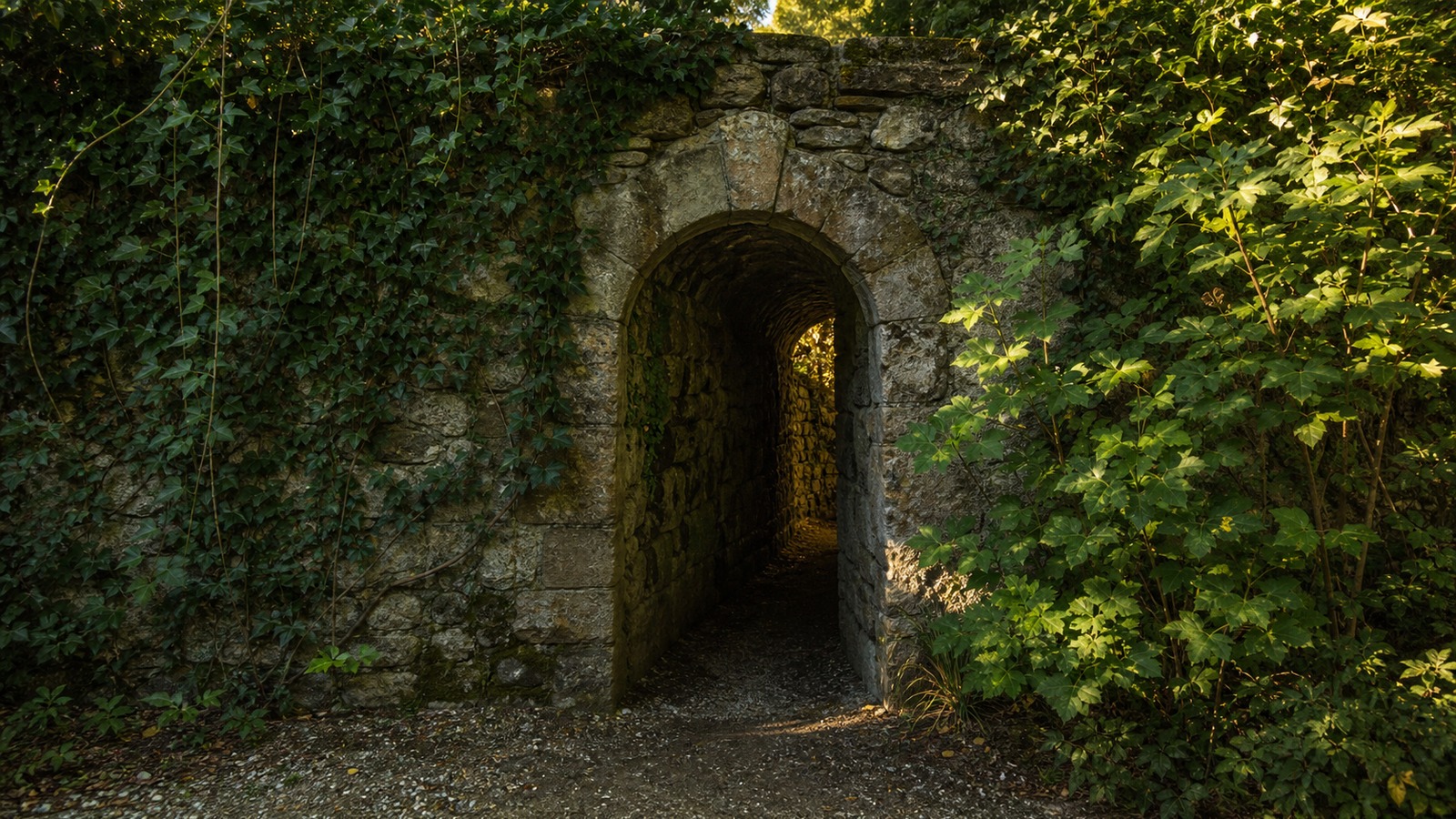
Every Culture Seems to Imagine a Hidden Route
Myths and legends of secret passages around the world endure because they make buildings feel alive with withheld knowledge. A castle is said to hide an escape tunnel. A monastery is rumored to connect to a cave. A palace supposedly contains a royal route under the garden. A city is believed to have smugglers’ passages beneath ordinary streets. Some stories preserve real architectural memory, while others grow from fear, pride, romance, or the irresistible idea that power always has a back door. The legend matters because it reveals what people want architecture to explain.
A: Some preserve real clues, but many become longer or more dramatic over time.
A: They combine danger, hierarchy, thick walls, and expectations of escape.
A: Yes. It may preserve memory, emotion, or a smaller architectural truth.
A: Plans, materials, wear marks, terrain, records, and practical route logic all help.
A: Caves, cellars, warehouses, and shorelines make hidden movement feel plausible.
A: Yes, often tied to refuge, relics, restricted access, or sacred mystery.
A: No. Unknown passages can be unsafe, private, protected, or legally restricted.
A: Long routes connect emotionally important places and make better stories.
A: It can change the story, but often makes the real history more interesting.
A: With curiosity, respect, evidence, and a willingness to accept grounded explanations.
Secret Passage Legends Often Start With a Real Clue
Many legends begin with something physical: a blocked arch, a sealed stair, a cellar door, an unusually thick wall, a tunnel-like drain, or a memory of construction work. The clue may not prove the full story, but it gives imagination a place to stand. A small opening becomes the seed of a long route.
Over time, the story can grow beyond the evidence. A service passage becomes an escape tunnel. A drainage channel becomes a smuggler route. A private stair becomes a royal secret. This does not make the legend worthless. It means the story has to be read on two levels: what the building shows and what the community needed the building to mean.
Castles Attract Escape Stories
Castles and fortified houses are natural homes for secret-passage legends because they combine danger, power, thick walls, and social hierarchy. People expect rulers, prisoners, soldiers, and servants to have hidden routes. Some castles really do contain private stairs, postern gates, wall passages, or concealed storage. Others collect stories that are more dramatic than the architecture supports.
Escape legends are especially durable because they turn stone into suspense. A blocked passage suggests someone needed to flee, hide, or move unseen. Even when the route was practical, the later story often becomes emotional.
The most responsible interpretation keeps both possibilities open until evidence decides. A castle can be fascinating without every tunnel leading to romance or rebellion.
Religious Sites Create Sacred Mystery
Monasteries, temples, churches, mosques, shrines, and pilgrimage sites often attract stories of hidden chambers, protected relics, escape routes, or underground connections. These legends may preserve memories of restricted access, storage, persecution, ritual movement, or later reuse. They may also express reverence through mystery.
Smugglers and Outlaws Need Geography
Coastal towns, border regions, mountain villages, and old market districts often produce smuggler-passage stories. The landscape helps the legend. Cliffs, caves, cellars, riverbanks, warehouses, and narrow streets make hidden movement feel plausible. Some stories are grounded in real illicit trade, while others grow because the setting feels perfect for it.
Smuggler legends often explain awkward urban features. A cellar opening, low tunnel, blocked waterfront door, or passage between buildings becomes part of a wider underground network in local memory. The actual route may have been shorter, more practical, or unrelated to smuggling, but the legend gives the town a dramatic hidden economy.
Palaces Inspire Stories About Power
Palace secret-passage legends usually focus on rulers, lovers, servants, guards, or political danger. A hidden stair can be said to connect royal apartments to gardens. A tunnel may be rumored to reach a river, chapel, prison, or nearby residence. These stories endure because palaces already represent unequal access.
The legend says that powerful people had routes ordinary people did not. Sometimes that is true in practical terms: private circulation, service corridors, guarded exits, and ceremonial back routes were common in elite buildings. The myth grows when those practical routes become wrapped in scandal or intrigue.
Palace stories also survive because they make power spatial. A ruler who can leave unseen, summon someone privately, or move between formal rooms without public notice becomes easier to imagine through architecture. Even when the supposed tunnel is exaggerated, the legend expresses a truth about elite buildings: access was managed carefully, and not everyone experienced the same plan.
Urban Legends Turn Infrastructure Into Secrets
Modern cities have their own secret-passage myths. Old subway tunnels, steam pipes, utility corridors, basements, prohibition-era rooms, storm drains, and abandoned stations can become the basis for stories about hidden networks. These legends feel plausible because cities really do have unseen infrastructure below and behind public streets.
Why Legends Grow Longer Than Tunnels
A real passage may be short, but a legend wants distance. It wants the tunnel to reach the castle, the river, the church, the border, the prison, or the sea. Long routes make better stories because they connect places with emotional meaning. The architecture becomes a line between danger and escape, secrecy and revelation, power and survival.
That storytelling instinct is not foolish. It reflects how people use space to imagine relationships. If two places are historically connected in memory, a secret tunnel gives that connection physical form, even when evidence is incomplete.
The challenge is to let the story be meaningful without forcing it to be literal. A legend can reveal local values, fears, and hopes even when the tunnel is shorter than claimed.
Evidence Does Not Have to Kill the Story
Archaeology, building surveys, maps, and archival records may prove, shrink, or disprove a secret-passage legend. That can disappoint people who prefer the dramatic version. Yet evidence often makes the story better by showing what actually happened.
A service corridor used daily may teach more about class and labor than a fictional royal escape. A drainage tunnel may reveal engineering skill. A sealed stair may show changing family life. A short passage between cellars may tell a more grounded story about trade than a mile-long myth.
Legends Can Preserve Fragile Memory
Even exaggerated legends can protect memory. A story may keep people from forgetting that a building once had a hidden room, that a community faced danger, that a route existed before redevelopment, or that certain spaces were restricted. Oral tradition can carry a clue until someone has the tools to study it.
Of course, memory can distort. That is why legends should be paired with careful investigation. The aim is not to mock the story or believe it blindly. The aim is to understand what it preserved and what it added.
This balanced approach lets local stories remain valuable. They become starting points for curiosity rather than final proof.
How To Listen to a Secret Passage Legend
A good listener asks several questions. What physical clue supports the story? Who tells it? When did it first appear? Does the route make practical sense? Are there maps, repairs, ownership changes, or excavations that help test it? What does the story say about the community’s sense of itself?
The Best Myths Make Us Look More Carefully
Secret passage myths endure because they change attention. They make people look at walls, cellars, hillsides, drains, stairs, and old plans with curiosity. That attention can lead to real discoveries, better preservation, and richer local history.
They also remind us that buildings are emotional objects. People do not only want to know how a wall was built. They want to know what the wall allowed, prevented, protected, or concealed. Secret-passage legends answer that desire in architectural form.
The Hidden Route Is a Human Story
A myth of a secret passage is rarely only about a passage. It is about escape, privilege, danger, forbidden love, sacred protection, illegal trade, resistance, or knowledge kept from outsiders. Whether the tunnel is real, exaggerated, or symbolic, the story points toward human pressure.
That is why these legends travel across cultures. Every society understands that visible paths are not the only paths. The secret route gives shape to the suspicion that important movement happens out of sight.
It also gives people a way to talk about risk indirectly. A community may remember persecution through a rumored refuge, political fear through a hidden exit, or economic hardship through smuggler routes below shops. The passage becomes a container for feelings that ordinary records may handle poorly. That emotional work helps explain why the same stories are retold long after the original building use is gone.
Wonder and Skepticism Can Share the Same Door
The best way to approach secret passage legends is with wonder and skepticism together. Wonder keeps the story alive long enough to care. Skepticism keeps the building from being buried under fantasy. When both are present, the hidden passage can become more than a rumor. It can become an invitation to read place, memory, and architecture with more attention.
The Legend Is Often the Entrance
In many places, the rumored secret passage is less a confirmed route than an entrance into local memory. It draws people toward an old house, a castle wall, a religious site, a waterfront cellar, or a street with unusual basements. The story asks them to notice what they might otherwise pass by. Even when research shortens the tunnel or changes its purpose, the legend has already performed a kind of preservation by making the place matter.
That does not mean every tale should be repeated carelessly. Rumors can damage fragile sites, encourage trespassing, or bury real history under a more exciting version. The responsible approach is to keep the story attached to evidence: maps, material changes, oral histories, surveys, repairs, and practical geography. A smaller truth is not a disappointment if it helps people understand the building more clearly.
The enduring power of these legends comes from the way they join architecture to possibility. A wall might be only a wall, but it might also remember fear, privilege, service, escape, worship, trade, or imagination. Secret-passage myths invite readers to stand at that threshold without pretending certainty where none exists. The best stories leave us more attentive, more careful, and still willing to feel the old thrill of a hidden way.
How Legends Keep Places Visible
A secret-passage legend can keep a place visible long after its original function has faded. People may preserve an old cellar because of a rumored tunnel, ask questions about a sealed stair because a family story survived, or protect a ruin because local memory insists that something hidden remains. The legend may not be a perfect record, but it can keep attention fixed on fragile architecture until better evidence arrives.
That is why the most useful response is neither mockery nor blind belief. The story should be welcomed as a clue, then tested with care. When wonder leads to documentation, and documentation leads to preservation, the hidden passage has already done important work, whether it reaches a distant castle or stops after a few practical feet.
The Rumor Leaves a Door Open
Perhaps that is why secret-passage legends are so difficult to exhaust. They leave a door open between evidence and imagination. A careful reader can ask for proof, respect safety, and still enjoy the possibility that an old wall may hold a story not yet fully understood. That balance is where the best legends live, and it is why they keep sending us back to buildings with sharper eyes, better questions, and a little more patience for the mysteries that survive inside ordinary stone.