Hidden Access Can Serve Reverence
Secret doors in religious architecture are rarely only about secrecy. In churches, chapels, monasteries, synagogues, mosques, temples, meetinghouses, and retreat centers, discreet doors can help protect sacred objects, organize clergy movement, support music, hide maintenance access, separate public and private zones, and preserve a calm worship environment. The hidden threshold is often humble, not spectacular. It exists so the visible space can remain focused on prayer, ritual, gathering, memory, and care.
A: They support preparation, storage, music, maintenance, privacy, safety, and calm public space.
A: No. Many are modern additions or later adaptations inside older buildings.
A: Yes, when it protects objects, timing, attention, and respectful movement.
A: No. Closed or staff-only doors should be respected unless a guide invites access.
A: It often connects public worship areas with preparation or storage rooms.
A: Yes. Hidden access must not block emergency routes or required equipment.
A: They let musicians move and prepare without disrupting the central space.
A: With evidence, community context, and respect for living practice.
A: It should be quiet, useful, safe, and consistent with the room's dignity.
A: Concealment should preserve attention, not compete with reverence.
Religious Buildings Need Both Public and Private Movement
A religious building may welcome a congregation, host visitors, support clergy or leaders, store ritual objects, manage music, care for vestments or textiles, and maintain mechanical systems. Those needs do not all belong in the main public view. Discreet doors let people and objects move where they need to go without constantly interrupting the space’s purpose.
Sacristies, Vestries, and Preparation Rooms
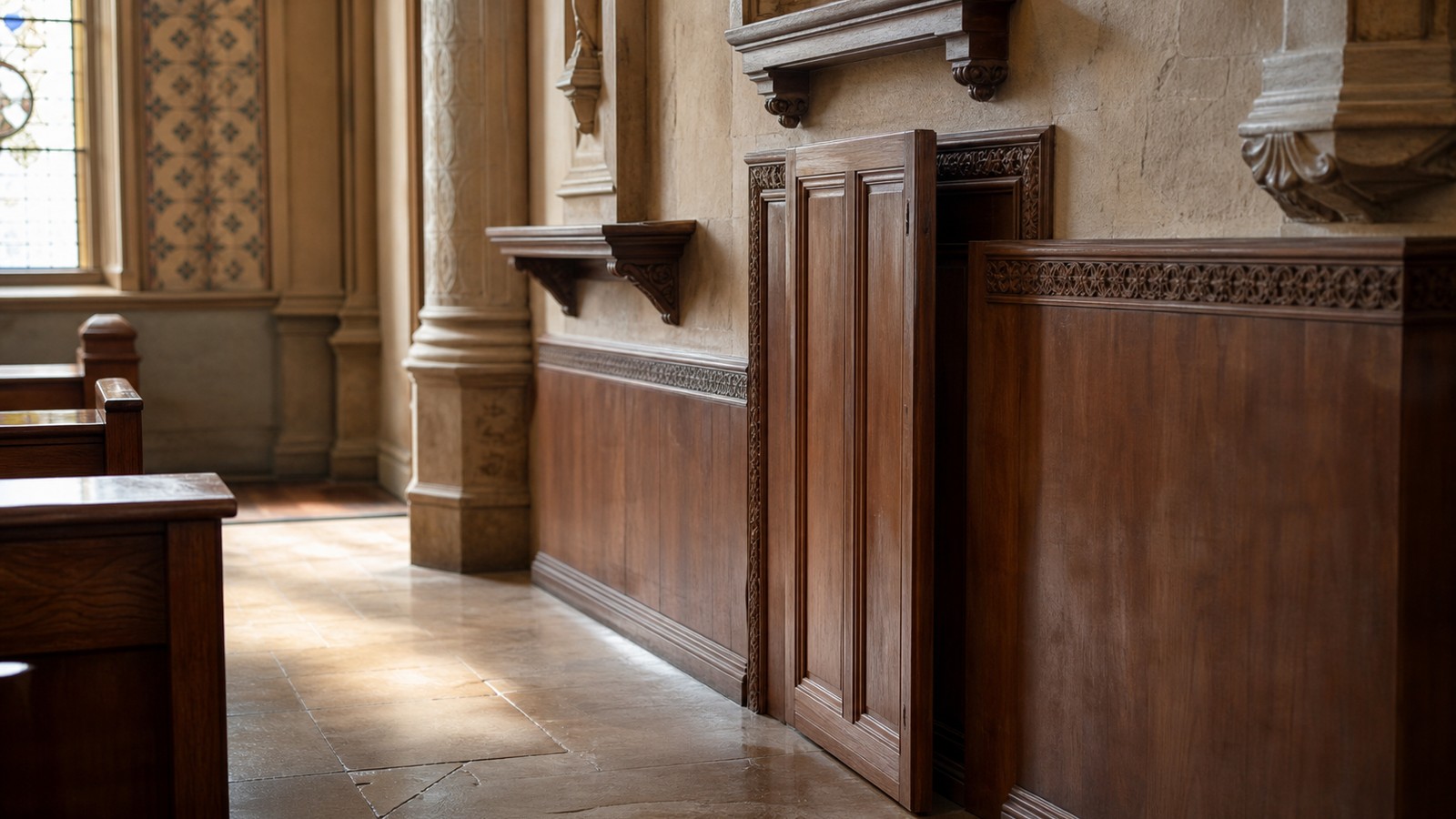
Many traditions have rooms where leaders prepare, objects are kept, garments are stored, or services are organized before a gathering begins. Doors to these spaces may be plain, paneled, or integrated into woodwork so they do not draw attention away from the sanctuary or prayer hall. Their quietness supports the transition between preparation and public ritual.
These rooms are not backstage in a dismissive sense. They are places of care. Candles, vessels, books, textiles, instruments, flowers, and other objects may be arranged with attention before they are brought into public use. A discreet door preserves that care without making the preparation itself the center of attention.
In older buildings, these preparation rooms can be altered many times. A former storage closet may become a vesting area, a side room may absorb modern equipment, or a narrow passage may be closed after a community’s needs change. The hidden door records those adjustments.
Choirs and Musicians Need Quiet Routes
Music shapes many religious spaces, and musicians often need access that does not disturb the room. Choir lofts, organ chambers, bell areas, instrument storage, and rehearsal rooms can require discreet doors and stairs. These routes may be narrow, practical, and easy to miss because they were designed for people who already know the building.
That hidden movement can affect the experience of sound. When musicians can arrive, prepare, and move without crossing the central space at the wrong moment, the service or ceremony can feel more continuous. The door supports the music by staying out of it.
Storage Is a Form of Respect
Religious buildings often hold objects that are meaningful, fragile, seasonal, donated, or used only at particular moments. Concealed or discreet storage can protect these objects from dust, casual handling, theft, or visual clutter. A hidden cabinet or panel may be less about secrecy than stewardship.
The best storage access is close to use but not visually intrusive. If objects are needed often, the route should be practical. If they are sacred or delicate, the door should support controlled handling. A beautiful worship space can still function only if its storage is thoughtful.
This is also where modern hidden-door hardware can be helpful in historic settings. A flush panel or matched cabinet door can give a community access to necessary supplies without introducing an obvious modern service door into a carefully preserved room.
The guiding question should be whether the concealed access protects dignity. If hiding a door makes care easier and the room calmer, it serves the building’s purpose.
Safety and Refuge Shape Some Hidden Doors
Some religious communities have used hidden spaces during periods of persecution, conflict, or social danger. In those cases, a secret door may carry a heavy emotional history. It may have protected people, texts, ritual objects, or leaders when public religious practice was threatened.
Maintenance Has to Disappear Gracefully
Modern religious buildings need heating, cooling, sound systems, lighting controls, cleaning supplies, accessibility upgrades, and fire protection. Historic religious buildings need those systems even more carefully because intrusive additions can damage the room’s character. Secret doors and discreet panels can hide service access while keeping maintenance possible.
Good concealment should never block safety equipment or confuse emergency movement. The goal is graceful integration, not obscurity at any cost. A hidden panel for mechanical access is useful; a hidden exit that nobody can find when needed is not.
Design teams often have to coordinate with preservation specialists, clergy, facility managers, and code officials. The final hidden door may look simple, but it can represent a careful compromise among beauty, function, safety, and tradition.
Older Buildings Contain Layered Beliefs
Religious sites can remain active for generations or be adapted into museums, community centers, schools, or cultural spaces. Each era leaves marks. A sealed side door, blocked stair, hidden cabinet, or odd passage may reveal changes in ritual practice, leadership, congregation size, gendered space, security, or maintenance needs.
These discoveries should be read with respect. A hidden door in a religious building may be tied to living memory or sacred practice, not only architectural curiosity. Interpretation should avoid treating every concealed space as a spectacle.
Designing New Hidden Access With Restraint
When new hidden doors are added to religious architecture, restraint is usually best. Match materials, align panel joints, keep hardware quiet, and make the door serve a clear need. The goal is not to make the space feel tricky. It is to let practical access support a room meant for attention, gathering, or contemplation.
The Quiet Door Can Be Deeply Purposeful
A secret door in religious architecture is most successful when it respects the larger purpose of the place. It may hide storage, preparation, music routes, maintenance, or protected memory, but it should not cheapen the room with novelty. The door’s quietness is part of its service.
That is what makes these thresholds so interesting. They show that hidden access can support reverence rather than compete with it. The building does not become less sincere because it contains concealed routes. It becomes more complete, because the unseen work of care has a place to go.
For visitors and designers alike, the lesson is to look for humility. A discreet panel beside a chapel, a small door near a choir stair, or a hidden cabinet in a sacristy may say more about a community’s care than a dramatic secret passage ever could. The architecture is serving a practice, and the practice gives the door its meaning.
Hidden Access Should Preserve Attention
The final measure is attention. If the concealed door helps people pray, gather, sing, remember, or care for sacred objects without distraction, it is doing meaningful work. In religious architecture, the best hidden door is not the one that surprises most loudly. It is the one that keeps the room’s focus intact.
Quiet Doors Carry Community Memory
Religious buildings often gather memories slowly. A door that looks plain to a visitor may be deeply familiar to volunteers, clergy, musicians, caretakers, or families who have used the building for years. It may lead to vestments, candles, choir music, kitchen supplies, cleaning tools, archives, or a room where people prepare before stepping into public gathering. Its meaning comes from repeated service.
That is why hidden access in religious architecture should be judged with humility. The most important door may not be the oldest or most beautiful. It may be the one that lets someone carry flowers without crossing the main aisle, reach a sound system before a service, protect a donated textile, or open a room for a grieving family. Concealment can support tenderness as well as ceremony.
When communities renovate, those quiet roles deserve attention. Removing a discreet door may make a wall cleaner, but it can also make daily care harder. Adding a hidden panel may solve a practical problem, but it should not erase meaningful fabric or confuse people who rely on the space. The best decisions come from listening to the building’s users, not only looking at its surfaces.
This is also where religious architecture differs from purely decorative hidden-door design. A home library door can delight through surprise alone, but a worship or community space carries shared expectations. The door should honor those expectations. Its operation should be calm, its purpose clear to those who need it, and its presence quiet enough not to pull attention away from gathering.
In that sense, the hidden door becomes a small act of stewardship. It gives practical care a place to happen, and it lets the room remain generous to the people who enter it for meaning, memory, and rest.
Hidden Doors Can Protect the Mood of Gathering
Many religious buildings are designed to help people shift attention. The world outside may be noisy, rushed, or fragmented, while the space inside asks for a different pace. A discreet door can support that shift by keeping preparation, storage, and maintenance out of the central view. The hidden access protects atmosphere.
This protection is practical, not precious. Communities need chairs, candles, microphones, cleaning supplies, music, seasonal objects, and repair access. If all of that activity spills into the main room, the space can begin to feel cluttered and tired. Hidden doors help the building remain ready without showing every task at once.
The result is a kind of quiet hospitality. Visitors may never know which panel hides storage or which small door leads to preparation, but they feel the order those doors support. The room seems calmer because the work of care has been given a thoughtful route.
The Hidden Threshold Should Serve the Shared Room
Religious architecture depends on shared attention, so every hidden threshold should be judged by how well it serves the shared room. If it helps volunteers prepare, protects sacred objects, supports music, or keeps maintenance from overwhelming the central space, it has a worthy role. If it exists only to impress, it can feel out of tune with the building’s purpose. The strongest secret doors in religious places are therefore humble, reliable, and relational. They connect the visible gathering to the hidden work that keeps the gathering possible. That connection should remain easy for the people who serve the space week after week. A concealed door that is beautiful but awkward will soon become a frustration; one that is quiet, durable, and clear to authorized users becomes part of the building’s care rhythm. It can help a small volunteer team work smoothly, help a musician arrive without fuss, or let treasured objects remain close without making the room feel crowded. These are modest tasks, but they matter because shared spaces depend on them.
The Small Threshold Can Protect the Larger Purpose
A discreet door may seem minor beside a sanctuary, prayer hall, or historic facade, but small thresholds often protect the larger purpose of the room. They let preparation stay nearby, keep necessary objects close, and give caretakers a way to serve without turning every task into a public interruption.
That is why religious hidden doors deserve more than architectural curiosity. They are part of the way a community cares for its space. When designed with restraint, they make the visible room feel calmer, more generous, and more ready for the people who gather there. Their quiet usefulness is the point.