Mythic Hidden Entrances Turn Places Into Tests
Concealed entrances in ancient mythology are not architectural details in the modern sense. They are symbolic thresholds where ordinary geography opens into danger, revelation, punishment, initiation, or divine knowledge. A cave mouth, underworld gate, labyrinth turn, veiled shrine, hidden spring, or forbidden doorway can mark the moment when a hero leaves the familiar world and enters a realm governed by different rules. These entrances matter because they connect secrecy with transformation. To find the hidden way is to face a test of courage, identity, memory, or restraint.
A: They turn transformation, danger, and forbidden knowledge into visible thresholds.
A: Caves naturally suggest descent, shelter, darkness, birth, burial, and mystery.
A: They mark the boundary between living society and the realm of death or loss.
A: It turns the threshold into an extended system of confusion and testing.
A: Yes, divine disguise can make a plain place sacred or dangerous.
A: Guides, tokens, and advice show that hidden access requires more than strength.
A: They often warn that knowledge and timing carry consequences.
A: Sometimes they resemble places, but their strongest role is symbolic.
A: They make inner change feel like a journey through a hidden place.
A: A concealed mythic entrance marks the moment a person crosses into transformation.
The Hidden Door Marks a Boundary
Ancient myths often begin with a boundary that should not be crossed. The entrance may be physically hidden, guarded by a creature, known only through prophecy, or disguised as an ordinary natural feature. What matters is that the route separates everyday life from a charged realm.
That boundary gives the story structure. Before the entrance, the hero belongs to a familiar world of family, city, field, sea, or court. After the entrance, the hero enters a space where normal rules weaken and deeper truths become dangerous.
The concealed threshold therefore makes change visible. It turns inner transformation into a place a listener can imagine.
Caves Became Natural Secret Doors
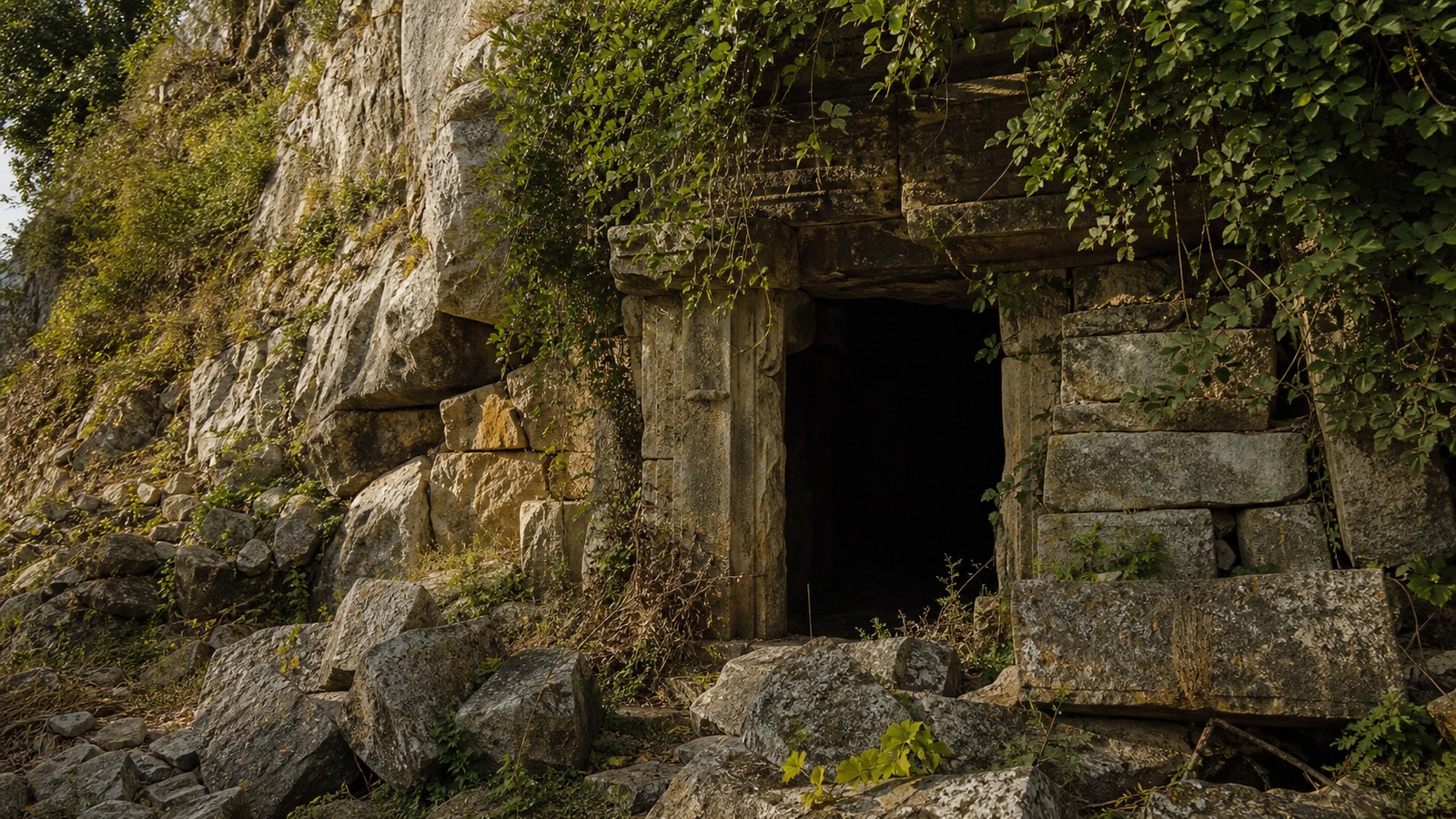
Caves appear in many ancient traditions because they already feel like openings into another order. They are dark, cool, echoing, and partly hidden by terrain. A cave entrance can suggest birth, burial, shelter, prophecy, or descent into the underworld without needing elaborate architecture.
In myth, the cave often holds more than darkness. It may contain a sleeping figure, a divine message, a monster, a treasure, a trial, or a path to the dead. The concealed entrance gives the natural world a supernatural depth.
Underworld Gates Were Moral Thresholds
Entrances to the underworld are among the most powerful hidden thresholds in ancient mythology. They may appear at river crossings, caves, chasms, remote groves, or guarded doors. Their concealment reflects the distance between living society and the realm of the dead.
These gates are rarely neutral. To pass through them requires permission, courage, ritual knowledge, divine favor, or a price. The entrance tests whether a living person can cross a boundary that should remain closed.
Underworld entrances also make grief spatial. A hero seeking a lost loved one, forbidden answer, or impossible return must travel to a place where absence becomes architecture.
That is why these thresholds remain emotionally powerful. They give shape to the human wish to enter what cannot be entered.
Labyrinths Hide the Way Through
A labyrinth is a concealed entrance stretched into a whole system. The problem is not only finding the door but surviving the route beyond it. Turns, walls, chambers, and confusion become part of the threshold.
Divine Disguise Makes Ordinary Places Strange
Ancient gods often hide in plain sight, and their entrances can do the same. A shrine, grove, spring, mountain path, or household door may seem ordinary until divine presence changes its meaning. The hidden entrance is not always mechanically concealed; it may be spiritually disguised.
This kind of concealment depends on recognition. The hero or seeker must notice what others miss, respect a taboo, answer a challenge, or approach with the right ritual attitude. The door opens because the person has changed enough to see it.
Mythic entrances often test perception as much as strength.
Forbidden Rooms Teach Restraint
Some myths center on a door or chamber that should remain closed. The concealed entrance tempts curiosity, but the story warns that knowledge may carry a cost. Hidden access becomes a test of obedience, trust, or timing.
These stories are not anti-curiosity in a simple way. They recognize that hidden knowledge can transform people before they are ready. The concealed entrance dramatizes the danger of entering a mystery without preparation.
Heroes Need Guides and Tokens
In many myths, the hero cannot find or survive the hidden entrance alone. A guide, thread, charm, key, ritual, song, password, or divine helper makes passage possible. The entrance is concealed not only by stone or darkness but by the need for relationship and instruction.
This pattern turns access into a moral lesson. The hero must accept help, remember advice, honor a promise, or carry a token correctly. The hidden entrance tests character through dependency.
Even when the hero is strong, the concealed way requires attention. Bravery without memory can lead to disaster.
The threshold rewards the person who can listen as well as act.
Hidden Springs Promise Revelation
Ancient stories often treat springs, wells, and pools as concealed entrances to wisdom, prophecy, healing, or danger. Water hides depth while reflecting the surface, which makes it an ideal mythic threshold. The seeker bends toward an ordinary element and finds a passage into knowledge.
Mountains Hide Divine Approaches
Mountains in ancient mythology frequently contain hidden routes to gods, monsters, caves, or sacred places. The entrance may be obscured by height, weather, remoteness, or ritual prohibition. To climb is already to leave ordinary life, and the concealed opening intensifies that departure.
These mountain thresholds are rarely convenient. They require endurance, attention, and sometimes divine permission. The difficulty makes the entrance feel earned rather than merely found.
Thresholds Can Punish the Unready
Mythic hidden entrances often punish people who enter for the wrong reason. Greed, impatience, pride, suspicion, or disobedience can turn discovery into disaster. The door is not evil; it reveals the character of the person who crosses it.
This pattern explains why so many myths attach conditions to hidden access. Do not look back. Carry the token. Speak the right words. Leave before dawn. Respect the guardian. The rule gives the threshold moral pressure.
Breaking the rule transforms the concealed entrance from opportunity into judgment.
Secret Places Preserve Sacred Distance
In myth, some places must remain hidden because sacred power is dangerous when approached casually. Concealment protects both the divine realm and the human visitor. The hidden entrance creates distance, and distance creates reverence.
Monsters Guard More Than Treasure
Guardians at hidden entrances often protect more than gold, weapons, or sleeping figures. They protect boundaries that should not be crossed without consequence. The monster makes the invisible rule visible through fear.
A guardian can also embody the threshold itself. It is the danger of descent, the cost of knowledge, the memory of death, or the force that separates ordinary people from sacred power. Defeating or appeasing it changes the traveler’s status.
Return Is Part of the Entrance
Finding a concealed mythic entrance is only half the story. The hero must also return, and return is often harder. The thread out of the labyrinth, the rule against looking back, or the command to carry nothing away all remind listeners that hidden places alter those who enter.
This return problem makes the entrance more than a doorway. It becomes a test of memory, self-control, and transformation. The traveler must bring back knowledge without being consumed by it.
Modern hidden-door stories still borrow this structure. The secret room is exciting because it raises the question of what the visitor will become after crossing the threshold.
Mythic Entrances Make Mystery Useful
Ancient myths do not hide entrances only to create suspense. They use concealment to teach caution, courage, respect, grief, maturity, and recognition. The hidden threshold gives mystery a job inside the story.
Hidden Entrances Explain Initiation
Many ancient stories use concealed thresholds to mark initiation. A person who enters a hidden cave, shrine, underworld path, or forbidden room is not merely changing location. The passage indicates that the traveler is moving into knowledge that ordinary life cannot provide.
Initiation stories often combine fear and instruction. The entrance may be dark, guarded, remote, or difficult to recognize, but it may also be guided by ritual, elders, prophecy, or divine aid. Access becomes a lesson in readiness.
Modern Readers Still Recognize the Threshold
Even when the ancient setting feels distant, the hidden entrance remains recognizable. People still understand the feeling of discovering a place that seems to ask for courage or restraint. A closed door, narrow passage, or concealed path can still make the world feel layered.
This recognition is why mythic entrances keep returning in novels, games, films, and architecture. The scene works because the old pattern still feels true: to cross into a hidden place is to accept that ordinary rules may no longer protect you.
Modern stories may change the symbols, but they keep the emotional structure. The hidden entrance remains a promise that the visible world is not complete.
That promise is both exciting and dangerous, which is exactly why mythology uses it so well.
Secrecy Gives the Sacred Weight
In ancient mythology, what is hidden often becomes more powerful because it is not casually available. The concealed entrance creates anticipation, reverence, and risk before the hero even crosses it. The threshold teaches the listener that sacred knowledge has a cost.
Myth Keeps Architecture Psychological
Ancient mythic entrances endure because they feel like emotional architecture. Everyone knows the sensation of standing before something hidden: a decision, a fear, a forbidden truth, a loss, a desire, or a new identity. Myth turns that inner threshold into a cave, gate, passage, or door.
That is why concealed entrances in mythology continue to shape modern stories. They give adventure a structure and give mystery a place to live.
The hidden entrance is never only a shortcut. It is the moment when the world admits it has deeper rooms, and the person who enters may not return unchanged.
That pattern gives mythic entrances their lasting reach. A listener does not need to believe in a literal underworld gate to understand the pull of a hidden way downward. The image speaks to grief, ambition, temptation, bravery, secrecy, and the hope that some closed place might still open. Ancient mythology uses the concealed entrance because it gives human longing a threshold, and thresholds are easier to remember than abstractions.
That is why the old images keep finding new homes. A cave in a myth, a secret gate in a fantasy novel, a sealed chamber in a game, and a hidden door in a film all draw from the same ancient grammar. The concealed entrance tells us that meaning begins where the known path ends.
Its power comes from making mystery active. The threshold asks for a choice, and the choice reveals the traveler. In ancient mythology, the concealed entrance is where curiosity stops being a mood and becomes a destiny. That is why these stories still feel close to us. We may no longer imagine every cave as divine, but we still understand the fear and attraction of a hidden opening that seems to know something about us before we enter. Myth gives that private feeling a public image, so the concealed doorway keeps its force across centuries and across changing kinds of storytelling.
The hidden entrance is therefore one of mythology’s most durable images. It can be natural or built, sacred or dangerous, guarded or apparently empty. In every form, it reminds the listener that revelation usually begins with a boundary and a choice.