Medieval castles were built to impress, defend, intimidate, and endure. From a distance, they looked like pure strength in stone form, with thick walls, towering keeps, narrow windows, and gates designed to stop armies in their tracks. Yet some of the most fascinating features in these fortresses were not the obvious ones. They were the hidden passages, concealed stairways, masked chambers, and secret doors built quietly into the architecture. These hidden elements added mystery to castles, but they were not simply romantic inventions for legends and stories. In many cases, they served practical, strategic, political, and deeply human purposes. Secret doors in medieval castles reveal a side of castle life that goes far beyond the grand hall and the battlements. They tell stories of rulers who feared betrayal, nobles who needed private access, defenders planning escapes, servants moving unseen through busy corridors, and builders who understood that power often depended on what others could not see. A castle was never just a home or a fortress. It was a machine of survival, hierarchy, secrecy, and control. Hidden doors fit perfectly into that world. Today, secret doors in castles still capture the imagination because they sit at the crossroads of history and legend. They suggest drama, danger, and discovery. A stone wall that swings inward, a chapel panel that opens into a narrow stair, a passage tucked behind a tapestry, or a chamber accessible only through a hidden hatch all make medieval architecture feel alive with intrigue. Whether used for protection, escape, communication, storage, or deception, these concealed features remind us that castles were designed for far more than what appeared on the surface.
A: Yes, many castles had concealed passages, hidden stairs, or discreet secondary entrances, though not always as dramatically as legends suggest.
A: Escape was one purpose, but they were also useful for privacy, defense, storage, and controlled access.
A: No. Some were well disguised, while others stayed effective simply because only a few people knew about them.
A: Common locations included private chambers, chapels, towers, keeps, stairwells, and thick defensive walls.
A: Some did, but many stories exaggerate their length, number, or purpose.
A: They could be concealed behind tapestries, wooden paneling, furniture, or within the rhythm of the masonry.
A: Hidden rooms were less common than small concealed passages, but they did exist in some fortified buildings.
A: Yes, they could help defenders move, hide supplies, send messengers, or retreat when necessary.
A: They combine real history with mystery, drama, and the enduring appeal of hidden architecture.
A: They are real, but their modern image is often amplified by folklore, fiction, and later retellings.
Why Medieval Castles Needed Secret Doors
Life in a medieval castle was not as steady or secure as the massive walls might suggest. Castles were constantly vulnerable to political unrest, family conflict, siege warfare, espionage, rebellion, and shifting alliances. A lord might host guests at a feast while quietly worrying that one of them could become an enemy within weeks. In that kind of world, privacy and controlled movement mattered immensely. Secret doors created options, and options could mean survival. Some hidden entrances were built for escape. If invaders breached the gatehouse or climbed the walls, a concealed route could allow a lord, lady, or small group of defenders to slip away to a safer part of the castle or even outside the fortification entirely. Other secret doors were designed for movement within the castle. They let important residents travel between private rooms, chapels, towers, and defensive positions without passing through crowded public areas. In a place full of servants, guards, visitors, clergy, and political allies, being able to move unseen could be extremely valuable. There were also psychological reasons for concealment. Secret doors added uncertainty for enemies and reinforced control for those in power. A hidden chamber could protect documents, valuables, weapons, or sacred objects. A concealed stairway could allow guards to appear suddenly where they were needed. In some castles, hidden features may even have helped create the impression that the lord was always watching, always prepared, and never fully exposed. Medieval power was theatrical as much as military, and architecture played a major role in that performance.
The Difference Between Legend and Reality
Secret doors in castles are often wrapped in myths, and that is part of their enduring charm. Stories speak of ghostly corridors, vanished prisoners, treasure rooms, tunnels stretching for miles, and hidden spaces built for forbidden meetings. While some castles absolutely did contain concealed doors and passages, not every dramatic story attached to them is historically reliable. Centuries of folklore, later renovations, Victorian romanticism, and modern tourism have all added layers of mystery that can blur the line between fact and imagination.
In reality, medieval builders were usually practical. A hidden door had to justify the labor and materials needed to create it. That means many genuine concealed features were probably smaller, tighter, and less glamorous than modern fiction suggests. A secret route might be a narrow stair hidden within a wall thickness, a simple timber door disguised by paneling, or a passage tucked behind a fireplace recess or hanging fabric. These were functional architectural tools, not always elaborate theatrical devices. Even so, the reality is no less interesting than the myth. A simple hidden access point in a medieval castle can reveal how carefully space was organized and how intelligently stone structures were planned. Thick walls allowed room for more than support. They could hide stairs, storage niches, guard routes, and service corridors. In a castle, architecture was layered. What looked like a solid defensive shell from the outside could contain a sophisticated internal network of movement and concealment.
Where Secret Doors Were Commonly Found
Secret doors in medieval castles were rarely random. They tended to appear in places where privacy, defense, or restricted access mattered most. One of the most common locations was near private chambers. A lord’s solar, bedchamber, or withdrawing room might connect to a hidden stair or secondary route, allowing discreet movement away from more public halls. This could be useful in times of danger, but it also helped preserve status and separation in daily life. Chapels and religious spaces were another likely setting. Because castles often had private chapels or devotional rooms, concealed access sometimes allowed important figures to enter or leave without crossing public areas. In an age when faith and political authority were closely tied, these spaces could serve both spiritual and strategic purposes. Hidden routes near chapels also later fed countless legends, especially when monasteries, castles, and noble households became linked in local storytelling.
Gatehouses, wall passages, towers, and keeps were also natural locations for concealed doors. Defensive architecture relied on surprise, compartmentalization, and controlled circulation. A hidden access point could allow defenders to move between levels, reach arrow loops, or reposition during an attack. In the keep, which often served as the final stronghold, a concealed chamber or escape route would have made particular sense. Some castles also included postern gates, smaller secondary entrances that were more discreet than the main gate and could function almost like secret exits under the right conditions.
How These Doors Were Built and Disguised
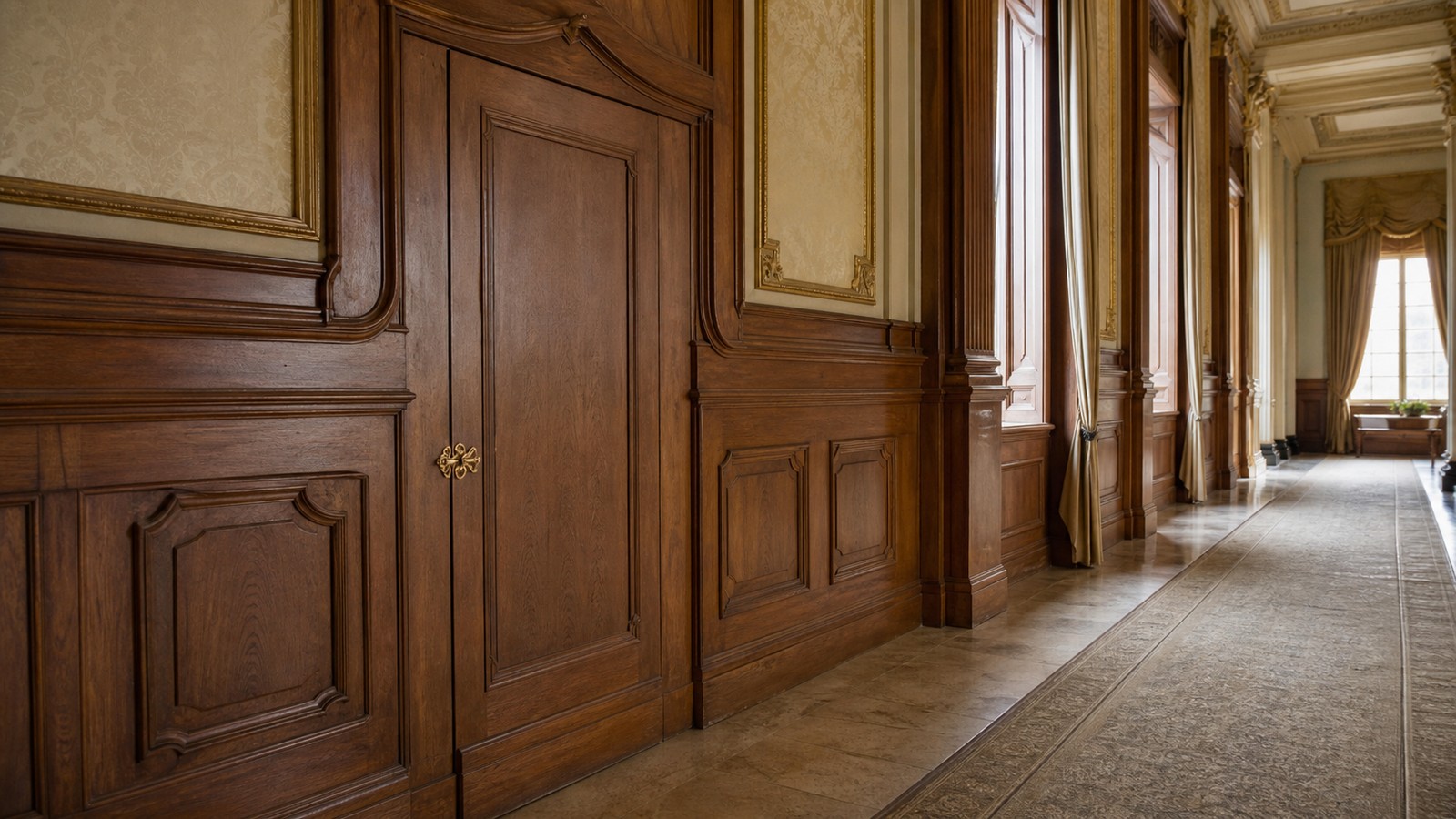
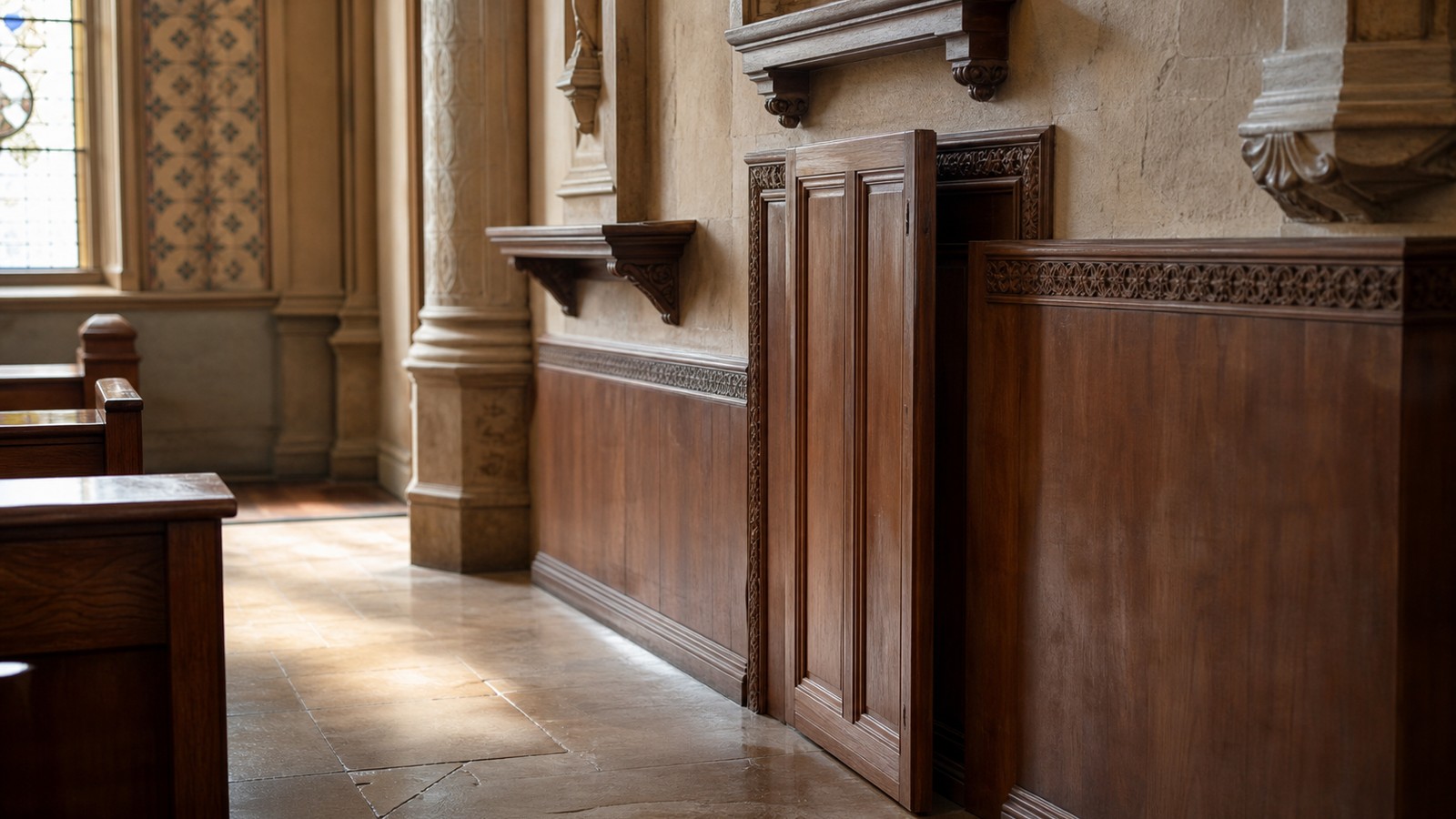
A medieval secret door had to blend with its surroundings, but the means of concealment depended heavily on the castle’s materials and style. In stone castles, complete invisibility was difficult, yet clever builders could still disguise openings remarkably well. A door might be fitted into paneling, hidden behind tapestries, masked by furniture, or built into the rhythm of a wall so that it did not immediately stand out. In timber interiors, the illusion could be even easier to maintain, especially when doors were integrated into wainscoting or structural framing.
Many concealed doors relied less on perfect disguise and more on restricted knowledge. A door did not need to be invisible to everyone. It simply needed to avoid attention from outsiders or casual observers. If only a few trusted residents knew that a certain panel opened, that could be enough. In dimly lit interiors, where torches and candles created shadows and uneven visibility, subtle disguises worked even better than they would in a brightly lit modern room. Mechanisms were generally simple by modern standards. Latches, pivots, bars, hooks, and concealed pulls were more likely than elaborate spring-loaded devices. A hidden door might open inward on sturdy hinges, slide aside with effort, or lift via a trap-like arrangement. Stone hatches, timber panels, and narrow access points all had different structural demands, but the guiding principle was the same: make the entrance seem like part of the building rather than a separate feature.
Escape Routes and Survival Strategies
One of the most dramatic uses for secret doors in medieval castles was escape. During a siege, every second mattered, and a concealed route could provide a last chance when the outer defenses were failing. Escape did not always mean fleeing the entire castle. Sometimes it meant moving from an exposed chamber to a safer tower, from the hall to the keep, or from one level of the fortress to another without crossing contested ground. In some cases, castles included postern doors or hidden exits leading beyond the main curtain wall. These smaller openings could allow messengers to slip out under cover of darkness, defenders to launch a surprise move, or key figures to retreat if defeat became certain. Not every castle had such a feature, and not every supposed escape tunnel really existed, but the logic behind them is easy to understand. A powerful household could not rely only on visible defenses. It also needed contingency plans. The existence of hidden routes speaks to the constant tension between confidence and fear in medieval life. Castles projected control, yet their inhabitants knew how quickly fortunes could change. A secret passage was a form of insurance built into the very bones of the structure. It reflected the grim truth that even the strongest walls could fail, and when they did, survival might depend on a door no enemy had noticed.
Privacy, Power, and Courtly Life
Not all secret doors were about warfare. Medieval castles were also homes, administrative centers, and stages for elite social life. Privacy in these settings was rare and precious. A concealed door could help separate public ceremony from private reality. Lords and ladies received visitors, oversaw estates, negotiated alliances, and managed households, but they also needed moments of retreat, confidential meetings, and access to personal quarters without constant observation. This mattered especially in castles where great halls served as the central public space. The hall was the heart of daily display, dining, and authority, yet it was also full of eyes and ears. Hidden or discreet routes allowed important residents to move beyond that public setting without drawing notice. They could reach chapels, private rooms, or upper chambers more quietly, preserving both dignity and security.
In that sense, secret doors were tools of social control. They reinforced hierarchy by giving some people privileged access and hidden mobility that others did not have. The architecture of a castle physically expressed the divisions of medieval society. There were spaces for rulers, spaces for retainers, spaces for servants, and spaces for defense. Secret doors blurred these boundaries only for those permitted to use them, which made them powerful symbols of rank as well as practical devices.
Secret Doors in Siege Warfare and Defense
Castle defense depended on more than thick walls and heavy gates. It also relied on internal organization. During an attack, defenders needed ways to move quickly, reinforce weak points, carry supplies, communicate, and react to breaches. Secret doors and concealed passages could support all of those tasks. A hidden stair inside a wall could let guards reach a parapet without crossing an exposed courtyard. A concealed chamber could store weapons or supplies away from prying eyes. A little-known access route could help coordinate resistance when chaos erupted.
These features also had value in deception. If attackers believed a section of the castle was isolated, defenders using a concealed route could surprise them. If a room seemed sealed, a hidden access point might allow movement in or out at a critical moment. Medieval warfare was brutal, but it was also psychological. Confusing the enemy, controlling information, and using the building itself as a weapon were all part of successful defense. At the same time, secrecy worked best when combined with discipline. A hidden door was useful only if trusted people knew when and how to use it. In a crisis, confusion could easily turn an advantage into a trap. That is why many secret features were likely known only to a small circle. In castle life, knowledge was often as valuable as steel, and a concealed door was only as secure as the people who kept its existence quiet.
The Role of Tunnels, Chambers, and Hidden Spaces
When people think about secret doors in medieval castles, they often imagine long underground tunnels. Some castles and fortified sites did include subterranean passages, storage vaults, and service corridors, but the idea of endless tunnel networks connecting every major structure is often exaggerated. Building and maintaining long secret tunnels was difficult, expensive, and not always practical. Still, shorter underground routes, escape passages, and concealed cellars certainly existed in some places. Hidden chambers were often more realistic than dramatic tunnels. These could be small storage rooms, priest holes in later centuries, concealed devotional spaces, treasury niches, or private retreats embedded within thick masonry. Some hidden areas may have been originally functional service voids that later took on legendary status. Others were likely planned from the beginning as protected spaces.
These rooms matter because they show how medieval architecture used depth as well as height. A castle was not just towers and battlements rising upward. It was also layers within layers, with voids, passages, stair cores, wall chambers, and underground areas shaping how people moved and hid. Secret doors were often the threshold to these layered spaces, turning solid-looking structures into places of hidden complexity.
Why Secret Doors Still Fascinate Us Today
Part of the modern appeal of medieval castle secret doors comes from their ability to make history feel personal. A battlement can impress us, but a hidden door invites us to imagine an individual hand pushing against stone or wood in a moment of urgency. It creates intimacy inside the scale of a fortress. Suddenly the castle is not just a monument. It becomes a stage for real choices, fears, ambitions, and secrets. These doors also appeal because they symbolize the gap between appearance and reality. Castles look permanent and straightforward from the outside, but secret architecture reminds us that the medieval world was full of hidden motives, private loyalties, and unseen risks. What seemed solid was often more complicated underneath. That idea still resonates strongly today.
In literature, film, games, and tourism, secret castle doors endure because they combine romance and realism. They offer suspense, beauty, danger, and discovery in a single image. Yet beyond the fantasy, they also teach us something important about medieval design. Builders were not simply stacking stone for defense. They were crafting environments shaped by politics, ritual, surveillance, fear, and imagination. Secret doors were one of the most compelling expressions of that layered world.
Conclusion
Secret doors in medieval castles were more than decorative curiosities or later inventions of legend. They emerged from the real needs of fortress life: defense, escape, privacy, restricted access, and control. Whether hidden behind stonework, timber paneling, stair cores, or fabric-covered walls, these concealed features reflected a world where power was never fully secure and visibility could be dangerous. They also reveal the sophistication of medieval architecture. Castles were not crude piles of stone but carefully designed systems where movement, secrecy, symbolism, and survival all intersected. A hidden door could protect a ruler, conceal a passage, store valuables, support defenders, or simply separate public authority from private life. Each one hinted at a story that unfolded beyond the reach of the obvious. That is why secret doors in medieval castles continue to capture attention centuries later. They are small openings into a much larger truth about the Middle Ages: beneath the grand walls and dramatic towers was a world shaped as much by what was concealed as by what was seen.