
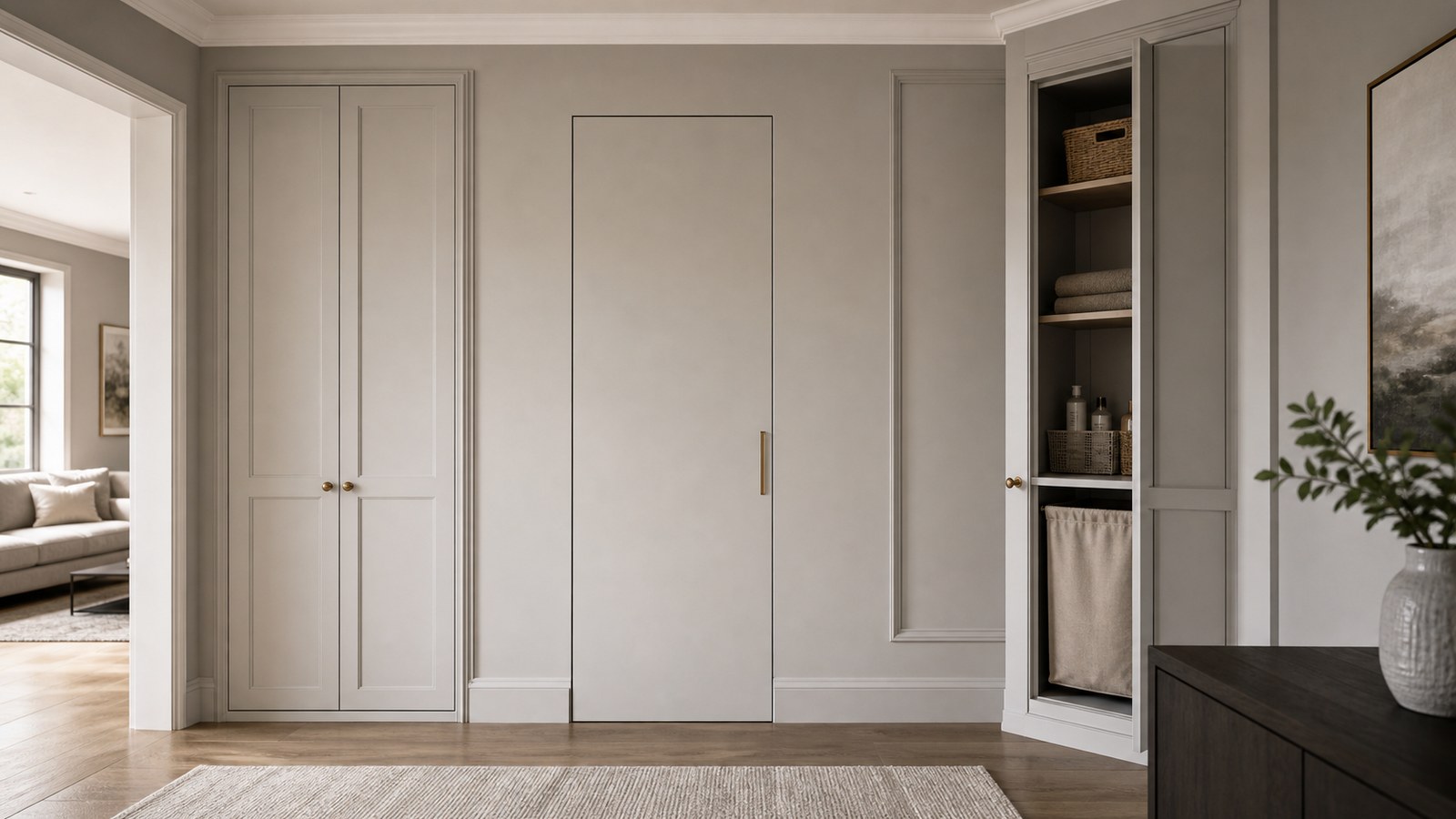
Hiding the Useful Parts Without Losing Access
Storage and utility rooms are essential, but their doors often interrupt the cleanest parts of a home. Linen closets, cleaning supply rooms, mechanical closets, laundry access, under-stair storage, and overflow pantry spaces all need to be reachable, yet they do not always deserve visual attention. Invisible doors solve that tension. They let the home keep its practical support spaces while making hallways, kitchens, living rooms, and bedrooms feel more composed. The best versions do not simply hide clutter. They keep the useful parts easy to find, safe to service, and durable enough for daily life.
A: Yes, as long as ventilation, safety, and service access are preserved.
A: A flush painted or paneled door usually calms the hallway.
A: They can be, but service access and code requirements must remain clear.
A: Use subtle cues and keep locations documented for the household.
A: Often yes, through slats, toe-kicks, or integrated panel details.
A: Use pulls or latches based on how often the closet is opened.
A: Yes, storage and utility doors are often high-contact surfaces.
A: Absolutely, hidden storage is more useful when shelves and lighting are planned.
A: They may use reversible paint, curtains, or furniture screens with permission.
A: The room stays easy to access while the surrounding space looks calmer.
Decide What Kind of Utility Is Behind the Door
A storage closet and a mechanical room have very different needs. A storage door may need shelves, bins, and easy daily access. A utility room may require ventilation, service clearance, fire separation, or special hardware. Before choosing an invisible look, define what the room must do. That definition should include who opens the door, how often it opens, what they carry, and whether anyone outside the household may need to find it quickly. A beautiful hidden panel is only successful if it respects those everyday and occasional users.
This decision affects everything else: door thickness, seals, vents, hardware, lock type, and finish durability. The door can disappear visually only after the practical requirements are respected.
It also helps prevent over-concealment. A rarely used seasonal closet can be very hidden. A water heater closet or electrical access panel needs to be findable by the people who maintain the home.
Household routines should be considered as carefully as equipment. A broom closet used every evening needs a different touch point than a holiday storage room opened twice a year. A laundry access panel near bedrooms may need quiet hardware, while a garage-adjacent tool closet may need impact-resistant edges. The more honestly the use is defined, the easier it is to choose a hidden door that helps instead of inconveniences.
Flush Panels Keep Hallways Calm
Flush invisible doors are ideal for hallways lined with closets or utility spaces. Instead of a row of standard doors and knobs, the wall becomes a smooth plane with subtle reveals. Paint, plaster, or wallcovering can continue across the openings.
This approach is especially useful in narrow corridors where visual clutter makes the space feel smaller. By reducing contrast, the hallway reads as longer and cleaner. The challenge is making each hidden door easy enough to open when needed. Corridors also receive strong grazing light from ceiling fixtures, so reveal lines and uneven slabs may be more visible than expected. Careful adjustment after painting or wallcovering is often necessary for the calm effect to hold.
Paneling Can Hide Multiple Closets
Wall paneling is one of the best ways to conceal storage because repeated lines can absorb several door edges. A linen closet, coat closet, and utility access can all sit inside one panel rhythm. The wall looks intentional rather than chopped into separate doors.
Paneling also protects high-traffic areas from scuffs. Painted wood, MDF, or laminate panels can be more durable than plain drywall near closets used by a busy household.
The panel layout should be planned around the openings. If trim lands awkwardly on a latch side or hinge side, the hidden door will still reveal itself.
Good paneling also creates a map for the eye. Vertical joints can align with door edges, rails can hide horizontal breaks, and repeated proportions can make one active panel feel like part of the larger wall. That planning should happen before framing if possible. Moving an opening a few inches on paper is easier than forcing a finished panel pattern to disguise a poorly placed door.
Hardware Should Match Frequency of Use
Storage and utility doors range from daily-use to emergency-only. A pantry overflow closet might need a comfortable pull. A seasonal storage room might use a push latch. A mechanical closet may need a keyed or tool-operated latch depending on safety needs.
Do not choose hardware only because it is invisible. If a door is opened often, the release should be intuitive. If the door protects equipment, the latch should be secure and appropriate. Function should decide the level of concealment.
Ventilation Cannot Disappear Completely
Some utility rooms need airflow. Mechanical equipment, laundry appliances, cleaning chemicals, or electronics may require ventilation or heat management. An invisible door should not seal those spaces dangerously.
Vents can be integrated into toe-kicks, slat patterns, high panels, or adjacent walls. The goal is to provide airflow without making the utility door the most noticeable feature in the room.
When in doubt, follow manufacturer requirements and local code. Invisible design should never override safety.
Airflow details can still be attractive. A slatted upper section may look like part of a millwork rhythm, and a toe-kick grille can disappear below cabinetry. The important point is that the vent is sized and located for the actual equipment or contents. A tiny decorative slot may satisfy the eye while failing the room behind the door.
Inside Organization Matters
A hidden storage door works better when the storage behind it is organized. Otherwise, the invisible door simply conceals a frustrating mess. Shelving, bins, hooks, labels, pullouts, and lighting can make the hidden room easier to use.
Think about the first motion after opening the door. Can someone reach the vacuum, towels, dog food, or tool kit without unloading everything else? The more useful the interior is, the more satisfying the hidden exterior becomes.
Depth and shelf height are easy to underestimate. Deep shelves can swallow small items, while shallow shelves may not hold bulky supplies. Adjustable systems are often worth the modest extra planning because storage needs change with seasons, family size, and hobbies. An invisible door feels more successful when the room behind it keeps adapting instead of turning into a hard-to-reach archive.
Lighting Helps Utility Spaces Work
Storage and utility rooms are often small, deep, or windowless. Lighting should turn on easily and illuminate shelves, equipment, and floor hazards. A beautiful invisible door loses value if the space behind it is dark and annoying.
Door-triggered lights, motion sensors, low-profile ceiling fixtures, and LED strips can all help. Keep wiring safe and serviceable, especially in mechanical or laundry spaces. Lighting should also reveal the floor immediately inside the opening, since hidden storage areas often hold bins, cords, baskets, or equipment that can become trip hazards. A small amount of practical light makes the concealed room feel intentional instead of forgotten.
Durability Is More Important Than Drama
Utility doors get bumped by vacuums, laundry baskets, tools, storage bins, and hands carrying awkward items. Finishes should handle that abuse. Washable paint, sealed wood, laminate, and protected edges are often better than delicate specialty finishes.
Invisible doors in practical areas should age quietly. If every scuff reveals the door outline, the design will not stay invisible for long.
Choose materials that can be touched up without repainting an entire wall. Maintenance is part of the concealment strategy.
Edges deserve special attention because they take the first impact. A painted slab can chip along the pull side, and a wallcovering can peel where fingers search for a grip. Small details such as edge banding, harder trim stock, or a discreet pull can protect the finish without making the door obvious. Durability is not a separate concern from invisibility; it is what keeps invisibility intact.
Keep Service Access Clear
Mechanical and utility rooms need clearance for service. A hidden door should not make equipment harder to repair or replace. Technicians may need to remove panels, open doors fully, or carry parts through the opening. This is where homeowners should be realistic about door width, swing direction, and removable trim. A flush wall may look cleaner on a normal day, but it should still allow a water heater, appliance part, or filter assembly to move through when maintenance is due.
Document what is hidden. Homeowners should know where shutoffs, panels, filters, and equipment live. Concealment should make the home prettier, not harder to operate.
Use Invisible Doors to Calm Busy Zones
Kitchens, mudrooms, laundry areas, and hallways often contain many small support spaces. Invisible doors can calm these zones by reducing the number of visible openings. The room still works hard, but it looks less fragmented.
This is valuable in open-plan homes where utility spaces sit near living areas. A hidden storage door can keep the main view polished while preserving convenience nearby.
The effect is strongest when all nearby support doors share a system. A pantry overflow panel, a cleaning closet, and a coat closet can use the same reveal language even if the interiors serve different needs. Consistency makes the wall feel intentional, while varied interiors keep the household functioning. That combination is why invisible utility doors often improve rooms that are not glamorous but are used constantly.
Make the Hidden Room Easy to Find When Needed
The people who live in the home should not have to hunt for essential storage or service access. Use subtle cues: a panel joint, a small matched pull, a consistent location, or a note in the home records. The door can be invisible to casual guests while still obvious to the household. For systems such as shutoffs, filters, electrical access, or cleaning supplies needed in a hurry, clarity is part of the design brief. A hidden door should reduce visual noise, not slow down the moment when someone needs to act.
That balance is the real success. Storage and utility rooms are hidden because they are not the visual priority, not because they are unimportant. Invisible doors let them support the home quietly.
Practical Spaces Deserve Good Design
Invisible utility doors remind us that good design is not only for showpiece rooms. A well-hidden broom closet, laundry access, or mechanical door can make everyday living smoother. It reduces clutter, keeps support spaces nearby, and lets the finished rooms feel calmer.
The best invisible storage door is easy to open, easy to maintain, and easy to forget when closed. That combination makes it one of the most practical hidden-door ideas in the house.
It also respects the work a home has to do. Cleaning supplies, spare linens, tools, filters, and appliances are not design failures; they are part of living well. Invisible doors give those necessities a quieter relationship with the finished rooms. The home can stay organized and attractive without pretending that daily maintenance happens somewhere else. That is why practical hidden doors should be judged by long-term ease as much as first impressions; the best ones disappear visually while making routine chores faster and less disruptive. When a hidden utility door helps people put things away, reach equipment, and keep a hallway calm, it has done far more than provide a neat visual effect. It has made the support side of the home easier to live with. That quiet usefulness is what makes the idea last beyond the first reveal. The door succeeds when nobody has to choose between order and access.


