
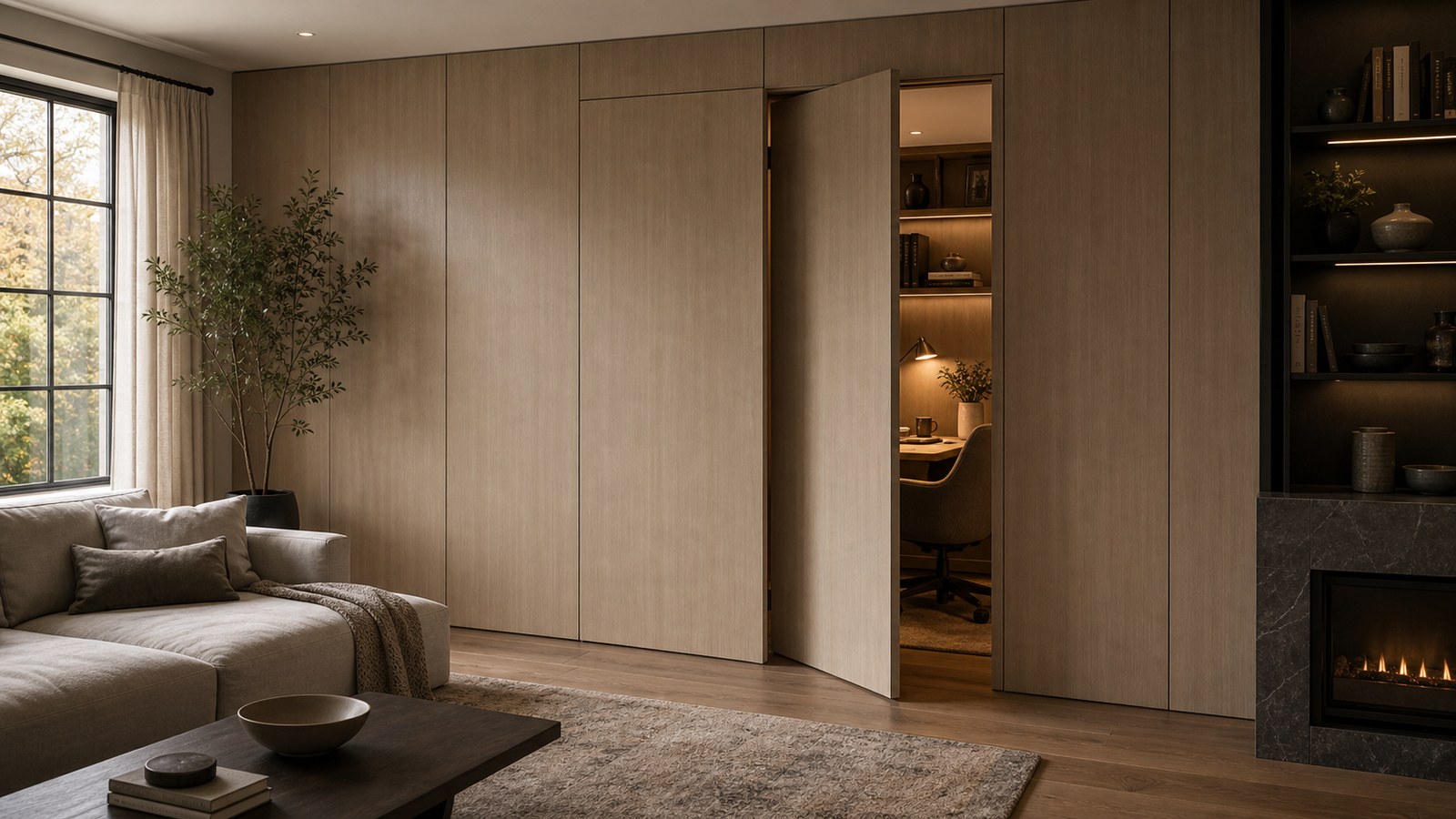
A Workspace That Appears When Needed
An invisible doorway to a home office can change how a house handles work. Instead of letting a desk, monitor, and paperwork dominate a living room or bedroom, the office gains a real threshold that can disappear into the architecture. During work hours, the room provides focus and privacy. After hours, the doorway closes and the home feels like itself again. The best invisible office entries are not only visual tricks. They are tools for boundary, concentration, storage, sound control, and daily reset.
A: The best option depends on use, but flush panels and bookcase entries are common.
A: Yes, with a solid door, seals, soft finishes, and quiet ventilation.
A: A discreet lock is useful for confidential work or valuable equipment.
A: Plan closed storage and a shutdown routine inside the office.
A: Yes, cabinet or wall-panel entries can make the workspace disappear when guests arrive.
A: Task lighting inside and controlled light leakage around the doorway.
A: They can be if the loaded shelf weight is engineered properly.
A: Yes, the door can be visually quiet without being confusing to the household.
A: A flexible doorway and adaptable storage make future uses easier.
A: Work gets privacy during the day and the home feels restored after the door closes.
Choose the Doorway Based on Work Habits
An invisible office used for occasional emails can be simpler than one used for full-time remote work. A daily office needs easy access, good sound control, ventilation, task lighting, and a door that can open quickly without a fussy release. A once-a-week workspace may prioritize visual concealment more heavily. The distinction matters because a hidden room that looks beautiful but interrupts the workday will quickly become annoying. The doorway should match the pace, privacy, and equipment demands of the person who actually uses the office.
Start by naming what needs to be hidden. Some offices need to hide clutter. Others need to hide confidential conversations, equipment, or the emotional presence of work. The doorway should solve the real problem rather than simply imitate a hidden-door photo.
That clarity also helps with budget. Spend on acoustics and comfort if the room is used for calls. Spend on millwork if the office sits in a public living area. Spend on storage if the work itself produces visual mess.
It also helps the office feel honest. A hidden door should not pretend that work requires no space, no supplies, and no recovery time. It should simply give those realities a better container. When the doorway is planned around actual habits, it can support deep work in the morning, a quick call in the afternoon, and a clean reset at night without asking the rest of the home to carry office clutter.
Flush Wall Entries for Quiet Rooms
A flush wall entry is ideal when the home office sits off a hallway, bedroom, or minimalist living area. The door face matches the wall, the frame is reduced, and the hardware is minimized. When closed, the office becomes a quiet part of the wall.
This approach works best with solid construction and careful paint matching. If the office is used for calls, a solid-core door and perimeter seals may be worth the investment. The invisible look should not come at the cost of privacy. Paint sheen deserves particular care because a slightly glossier door face can show up under hallway light even when the color is correct. Mocking up the finish, or at least reviewing samples in the actual room, can prevent a quiet wall from becoming a visible rectangle.
Bookcase Openings for Warmth
A bookcase doorway can make a home office feel like a study even when space is limited. Shelves provide a believable disguise and useful storage for books, objects, and closed bins. When the door closes, the office reads as furniture rather than another room.
Weight must be handled seriously. Books, decor, and office supplies add load. Hinges, pivots, casters, and framing should be chosen for the loaded door, not the empty shelf. A bookcase office door should move smoothly even after it has been styled.
Keep the shelf styling calm. If every object looks staged to hide a door, the disguise becomes obvious. A natural mix of useful and decorative items works better.
Depth matters too. Shelves that are too shallow may look decorative and suspicious, while very deep shelves can make the door heavy and awkward. Many successful bookcase entries use a controlled mix of fixed shelves, closed lower storage, and lighter display areas. That balance gives the doorway enough visual credibility without turning every opening into a demanding structural project.
Cabinet Walls for Compact Workstations
Not every invisible office is a full room. Some are workstations hidden behind cabinet doors, pocket panels, or folding fronts. This can be perfect in apartments, guest rooms, kitchens, and family rooms where a full office is not available.
The cabinet doorway should still support real work. Provide outlets, cable routes, ventilation, lighting, and space for a chair. A hidden workstation that takes ten minutes to set up will not be used as intended.
Acoustic Privacy Shapes the Experience
Sound control is often more important than visual concealment. If meetings, calls, recordings, or focused work happen in the office, the doorway needs enough mass and sealing to reduce household noise. Invisible does not mean thin.
Soft furnishings inside the office can help too. Rugs, curtains, shelves, and upholstered seating reduce echo and make calls sound better. The door protects the boundary, while the room treatment improves the experience inside.
Ventilation should not be forgotten. A sealed office can become uncomfortable during long calls. Quiet airflow keeps the room usable without forcing the door open.
Privacy also depends on how the door meets the floor and surrounding wall. A beautiful hidden panel with a wide undercut can still leak conversation into the hall. Seals, thresholds, and careful framing may feel technical, but they are what make the invisible doorway useful during real meetings. The goal is not recording-studio isolation for every home, but enough control that the office can support concentration without constant household negotiation.
Lighting Should Change Modes
The office needs productive light, while the outside room needs calm. A hidden doorway can support that transition with separate lighting zones. Inside, use task lighting, controllable overhead light, and flattering video-call illumination. Outside, keep the wall composition soft and uninterrupted.
Avoid bright light leaking through the door reveal at night. If the office is used early or late, seals and careful fixture placement can keep the hidden doorway from glowing around the edges. Dimmable task lights are useful because they let the room shift from focused work to quiet cleanup without broadcasting office activity into the rest of the house. The outside wall should remain visually calm even when someone is finishing a call after dinner.
Storage Keeps Work Behind the Door
An invisible doorway cannot hide work if the work keeps spilling out. Files, chargers, samples, notebooks, printers, and supplies need a place inside the office. Closed storage near the door helps the user reset quickly before leaving.
A simple end-of-day landing zone can make the whole system work. A drawer for papers, a hook for headphones, and a shelf for the laptop turn closing the invisible door into a real shutdown ritual.
Shared offices need even more intention. If two people use the room, duplicate charging spots, separate document zones, and clearly divided shelves can prevent clutter from drifting back into the house. The hidden doorway creates the visual boundary, but storage habits keep that boundary believable. Without enough interior order, the door becomes a curtain over unfinished decisions.
Hardware Must Be Intuitive
A home office doorway should not slow down work. Edge pulls, recessed grips, quiet magnetic latches, and concealed hinges can keep the wall clean while remaining easy to use. If the office is used many times a day, comfort matters as much as concealment.
Locks may be useful for confidential work or expensive equipment. Choose a lock that suits the hidden design but still allows safe exit from inside. Privacy should never make the room feel trapped.
Test the doorway in normal work scenarios: carrying a laptop, answering a call quickly, stepping out with coffee, or closing the room quietly during a meeting. Those small moments reveal whether the hidden design works.
Inside hardware deserves the same attention as the exterior. A clean outer wall is appealing, but the person working inside must be able to leave quickly and comfortably. The interior pull can be more visible if needed, especially in a private room. A hidden office should feel calm, not secretive in a way that makes daily use awkward.
The Outside Wall Should Feel Complete
The room outside the office should not look like it is missing something. Whether the doorway hides in paneling, paint, shelving, or cabinetry, the outer wall needs balance. Art, lighting, furniture, and trim should make sense even when the office is closed.
This is what makes the workspace disappear emotionally. The home does not feel like it is waiting for work to resume. It simply looks composed.
That composition can be subtle. A lamp might align with the panel rhythm, a console might cover the lower visual weight of the wall, or artwork might draw the eye away from the reveal. The design should not create obstacles in front of the opening, but it can use normal room elements to keep attention where it belongs. In open rooms, the closed office wall may be seen from several angles, so the disguise has to work from the sofa, the kitchen, and the main circulation path.
Invisible Does Not Mean Isolated
The office should be hidden from visual clutter, not cut off from household life in an unhealthy way. Family members may need to knock, find supplies, or understand when the room is occupied. A subtle cue can preserve function without announcing the office to guests. Some households use a small matched pull, a discreet indicator light, or a consistent knocking spot within the panel rhythm. Those cues let the office stay private without turning the doorway into a puzzle for people who live there.
That balance is the point of an invisible office doorway. It gives work a real place and then gives the home permission to stop looking at it. When the door closes, both sides of the wall get better.
Design for the Future of the Room
Work needs change. A home office might later become a homework room, guest room, craft room, or storage-supported study. The invisible doorway should be flexible enough to suit future uses. Durable hardware, adaptable storage, and a timeless wall treatment will outlast any one desk setup.
That future readiness makes the investment stronger. The hidden doorway is not only about today’s video calls; it is about giving the home a flexible private room that can appear and disappear as life changes.
Future planning is especially important when the office sits in a valuable living area. The wall finish should be broad enough to support a different furniture plan, and the door opening should be generous enough for another use. A room that can shift from office to guest suite or creative studio gives the invisible doorway a longer life than a solution built around one desk size. It is also smart to keep data, power, and lighting flexible so the hidden room can evolve without tearing apart the finished wall that makes it disappear. That flexibility keeps the doorway from feeling like a custom answer to a problem that may change in a few years. It turns the hidden office into a resilient room, not a single-purpose compartment. The door disappears, but the value of the room remains visible in daily life.


