
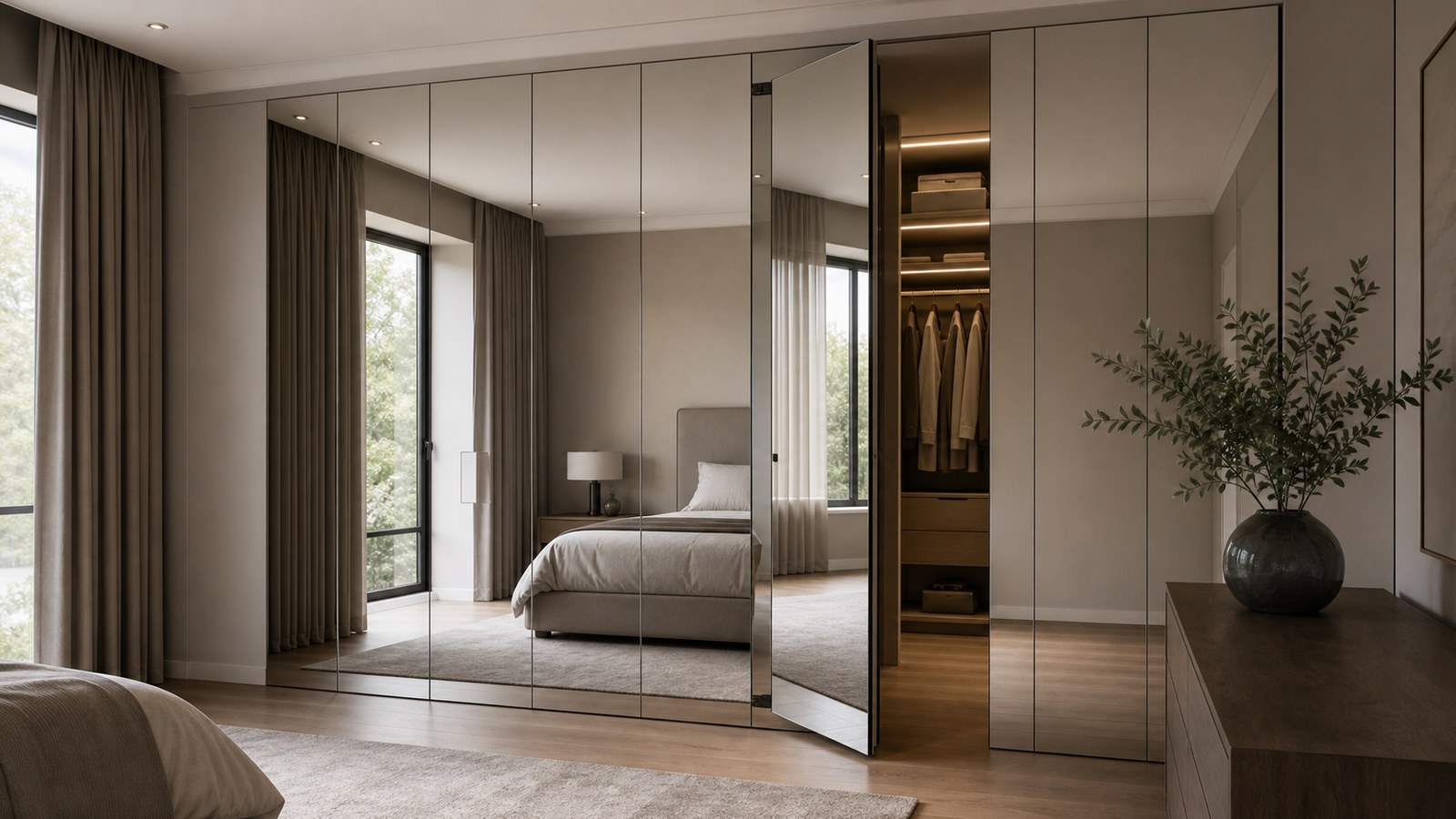
A Door That Works Like a Mirror First
Invisible mirror doors are effective because they give the room something useful to see. Instead of reading as a door, the surface reads as a mirror: it reflects light, expands the space, supports dressing routines, and adds polish. Behind that mirror might be a closet, bathroom, wardrobe, storage niche, or private passage. The result can be elegant and functional, but mirror doors require more care than a normal painted panel. Weight, safety backing, hinges, reflection angles, lighting, cleaning, and daily handling all shape whether the door feels refined or fragile.
A: They can be when the mirror, backing, slab, and hardware are properly specified.
A: Closets, dressing rooms, bedrooms, gyms, and entry areas are natural fits.
A: Yes, but moisture-resistant construction and privacy hardware matter.
A: Edge pulls or recessed grips usually keep the mirror face cleaner.
A: Often they need stronger or concealed hardware because mirrors add weight.
A: They can be, so design the pull to keep hands off the main mirror.
A: Yes, repeated panels can conceal multiple openings if alignment is precise.
A: Ideally light, space, or attractive views, not clutter or glare.
A: Sometimes, but existing door strength and swing clearance must be checked.
A: Safe construction, quiet hardware, clean proportions, and useful reflection.
Use Mirrors Where They Already Make Sense
Mirror doors work best in rooms where a mirror feels natural: bedrooms, dressing rooms, closets, bathrooms, entry halls, gyms, and wardrobe corridors. If the mirror belongs, the door becomes harder to suspect. If the mirror is placed randomly, it may look like a cover-up.
The size should match the room’s proportions. Full-height mirrors are especially convincing because people expect them near dressing and closet areas. Smaller mirrors can work, but they need to be composed with surrounding furniture or trim.
Think about what the mirror reflects. A beautiful reflection can make the room feel larger, while a reflection of clutter or bright fixtures can make the door more noticeable.
Placement should also support normal movement. A mirror door beside a bed, dresser, or wardrobe needs enough clearance for someone to stand, check an outfit, and open the concealed space without stepping around furniture. If the mirror is useful only from one awkward angle, the door will feel decorative rather than integrated. The best locations let the mirror earn its place before the hidden function is even discovered.
Safety Comes Before Concealment
Mirrors add weight and fragility. A mirror door should use proper backing, adhesive, mechanical support, and hardware rated for the finished assembly. Tempered or safety-backed mirror products may be appropriate depending on location and risk. The specification should also consider the people who will use the room: children, guests, older adults, and anyone moving quickly through a dressing area all change the risk profile. Safety is not a decorative downgrade; it is what allows the mirror door to feel relaxed in daily life.
Never treat a heavy mirror like a simple decoration stuck to a standard door. The hinges, frame, and slab must handle the load. If the door is used by children or in a busy area, soft-close control and impact protection become even more important. Installers should also think about what happens if the door is opened too far, bumped by furniture, or cleaned aggressively over time. Stops, edge protection, and careful clearances can prevent an elegant feature from becoming a fragile liability.
Hinge and Pivot Choices Matter
Invisible mirror doors often benefit from concealed hinges or pivot hardware because exposed hinges can interrupt the illusion. The hardware must carry the mirror’s weight while keeping the slab aligned. Sagging is especially obvious on mirrored surfaces because reflection exaggerates crooked lines.
Pivot systems can work well for full-height mirror panels, but they need floor and ceiling structure that can support the load. Standard hinges may be fine for smaller doors if they are strong and placed correctly.
Hardware should be selected after the mirror, backing, slab, and frame weight are known. Guessing early can lead to a door that looks elegant but moves poorly.
Movement quality is part of the visual illusion. A mirror panel that drifts, bounces, or scrapes immediately feels like a problem, even if the surface is beautiful. Hardware should hold alignment through repeated use and allow adjustment as the building settles. Because reflections reveal tiny shifts, a mirror door often needs more precise installation than a painted hidden panel of the same size.
Control Reflections and Light
Mirrors change the way light behaves. An invisible mirror door can brighten a hallway, make a bedroom feel larger, or reflect a window view. It can also reflect glare, clutter, or awkward angles. Place mirror doors where the reflection improves the room.
Lighting should flatter the surface without revealing the door outline. Strong side lighting may expose gaps, hinge edges, or uneven walls. Soft, even light usually works better for dressing and concealment.
Nighttime conditions should be checked too. A mirror that feels elegant in daylight may reflect a bright vanity fixture, hallway sconce, or television after dark. If the hidden room behind the door has its own light, the reveal can glow around the edges unless the frame is detailed well. Looking at the door under several lighting scenes prevents surprises after installation. It can also reveal whether the mirror makes the room feel larger or simply busier; reflection should calm and expand the space, not double every distraction.
Handles Should Stay Quiet
A large handle on a mirror immediately announces the door. Recessed edge pulls, finger channels, push latches, or very slim hardware can preserve the mirror’s primary identity. The pull should be easy to use without leaving fingerprints across the center of the glass.
For bathrooms or private dressing rooms, locking and privacy must be considered. A hidden mirror door should still be safe to exit, intuitive for users, and appropriate for the room behind it.
Test the handle with clean hands, wet hands, and in low light. If people cannot find the release comfortably, they will touch the mirror surface and make maintenance harder.
Fingerprints are not merely a cleaning nuisance. They can reveal the operating zone and make the mirror look handled in one spot. A narrow edge grip, a small side reveal, or a pull set into the frame can guide the hand without adding a visual interruption. The more naturally the hand finds the release, the longer the mirror keeps its polished effect.
Closets and Dressing Rooms Are Natural Matches
Invisible mirror doors shine in closet and dressing areas because they combine two functions. The mirror supports dressing, while the door hides clothing storage or a walk-in space. A wall of mirror panels can make a small dressing zone feel larger and more luxurious.
Inside, storage should be organized enough that opening the mirror feels satisfying rather than chaotic. Lighting, shelves, hanging space, and drawers all contribute to the success of the concealed door. The reveal should feel like access to a useful dressing system, not a surprise view into clutter. When the interior is planned with the same care as the mirror face, the door earns its place twice: it improves the room while closed and supports the routine when open.
Bathrooms Need Moisture Planning
Mirror doors near bathrooms or wet areas need moisture-resistant construction. Edges, backing, adhesives, and hardware should tolerate humidity. Poorly protected mirrors can desilver at the edges or loosen over time.
Ventilation matters too. A concealed mirror door should not trap moisture inside a closet or bathroom. Choose materials and detailing that suit the environment, not just the look.
Cleaning products should be compatible with the mirror and surrounding finishes. A hidden door that needs special care every day may not be practical.
Bathrooms also introduce privacy expectations. A mirror door hiding a powder room or en suite needs an obvious interior release, suitable locking, and a way for guests to understand the opening without embarrassment. Total concealment can be beautiful, but bathrooms are rooms people must identify confidently. A tiny cue, aligned with the design, often makes the experience more gracious.
Mirror Walls Can Hide Multiple Openings
In larger dressing halls or bedrooms, a series of mirror panels can hide several doors or closet fronts. The repeated reflection makes individual openings harder to distinguish. This can create a polished boutique effect while storing a lot of function behind the wall.
Alignment is critical. If one panel sits proud, reflects differently, or has a wider reveal, the invisible effect weakens. Mirror walls demand precise installation because the material shows every shift.
Keep the Door Easy to Maintain
Fingerprints, dust, and streaks are part of mirror life. Invisible mirror doors should be designed so people touch edges or pulls rather than the main surface. The more often the door is used, the more important this becomes.
Access to hardware adjustment matters as well. If a heavy mirror panel starts to sag, the fix should not require dismantling the entire wall. Serviceable design protects the elegance.
The surrounding finishes should be maintainable as well. Mirror cleaner can affect painted trim, wallpaper, or natural wood if overspray is constant. Choosing durable adjacent materials and setting a simple cleaning routine helps the entire composition age evenly. An invisible mirror door should not create a high-maintenance zone that the household begins to avoid. It should be possible to wipe the surface, check the pull, and inspect the reveals without special disassembly or worry over damaging nearby finishes.
Balance Elegance With Everyday Use
A mirror door can feel glamorous, but it should still behave like a reliable door. It should open smoothly, close quietly, and feel safe under normal use. The hidden room behind it should have appropriate lighting and ventilation. If the mirror conceals a closet, the user should be able to open it while holding clothing. If it conceals a bathroom or private dressing room, the user should understand the latch instantly from inside. Function is what keeps elegance from becoming a fragile display. The door should be tested by the same ordinary actions that will happen every week: opening it with one hand, closing it quietly at night, cleaning the glass, and adjusting the room behind it without fear of damage.
When those practical details are right, the mirror becomes more than a disguise. It improves the room, supports daily routines, and hides useful space with grace.
Refinement Comes From Restraint
The most elegant invisible mirror doors are usually simple. Clean proportions, safe construction, subtle hardware, and thoughtful reflection do more than ornate frames or dramatic effects. The mirror should feel like it belongs before anyone realizes it moves.
That is the charm of the idea. A familiar surface becomes a passage, a closet, or a private room without asking for attention. It is functional magic, polished enough for everyday life.
Restraint also keeps the door compatible with changing tastes. A plain full-height mirror can survive new bedding, different wall colors, or updated lighting better than a heavily styled feature. When the room evolves, the mirror still feels useful. That long-term flexibility is one reason invisible mirror doors can feel both decorative and practical rather than trendy for a single season. The room gets more light, the user gets a functional mirror, and the hidden opening remains quietly available without demanding constant attention. That balance is the reason the idea works in both compact homes and larger suites: it adds usefulness before it asks anyone to admire the concealment. The hidden function is a bonus, but the mirror has to deserve its place every day. When it does, the door feels less like a secret and more like good space planning. The elegance comes from that ease, not from making the opening difficult to understand.


