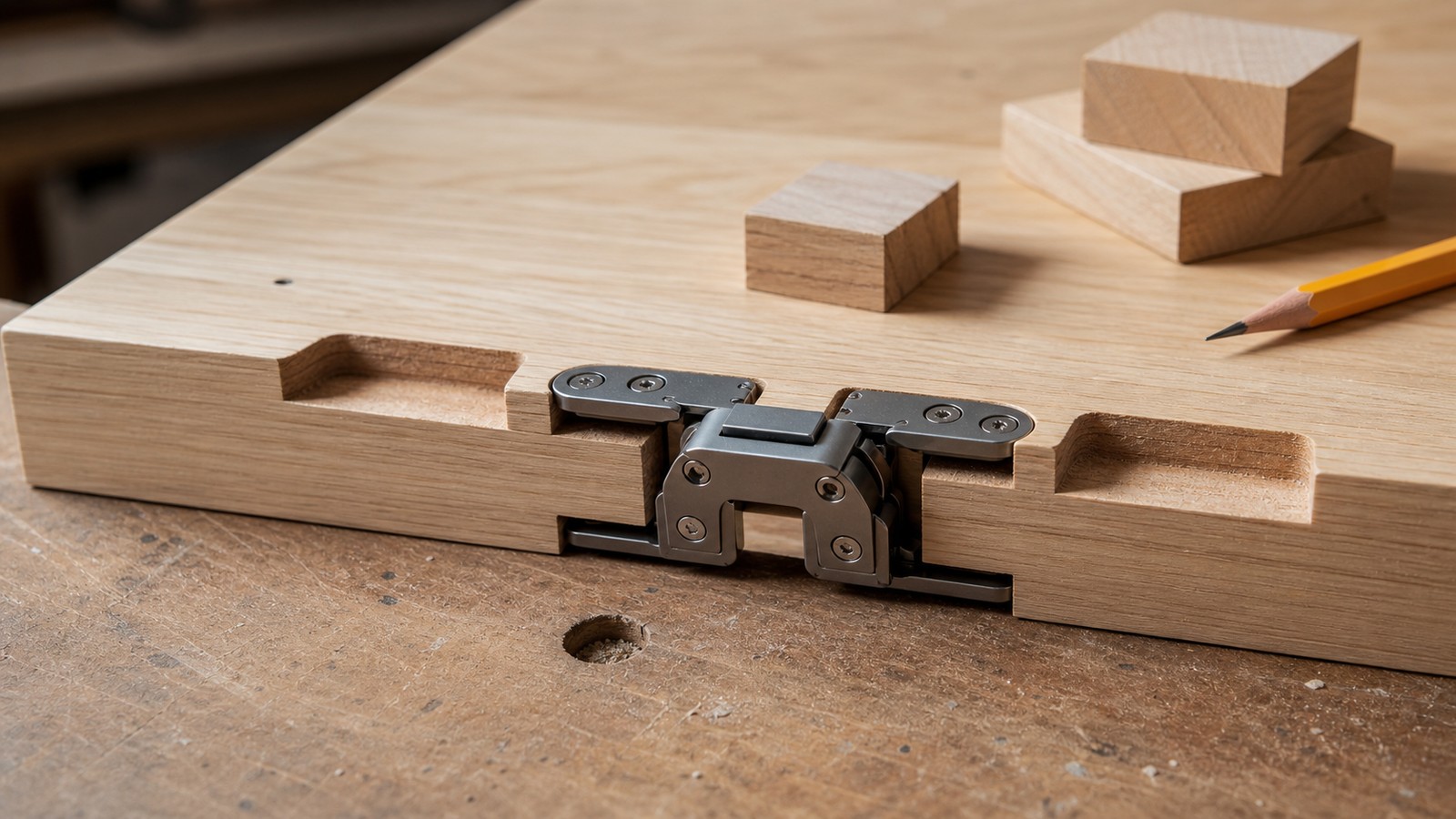
Invisible hinges are the quiet magicians of door hardware—the kind of hardware that disappears when the trick is done right. They allow a door or panel to swing with confidence yet leave no visible hinge knuckles, pins, or plates interrupting the sightline. Architects love them for minimalist interiors. Cabinetmakers use them to keep lines crisp on high-end furniture. Builders reach for them when a door needs to look like part of the wall—no shadows, no projections, nothing to betray the seam. This review dives into how invisible hinges work, what they’re made of, where they shine, where they struggle, how to choose the right model, and what it actually takes to install and live with them for years.
A: Most 80–84" interior doors use 3; tall/heavy doors may need 4. Follow the manufacturer’s height/weight chart.
A: Common models require at least 1-3/8" (35 mm); heavy-duty often need 1-3/4" (44 mm) or thicker.
A: Yes, but you’ll need new mortises, precise layout, and often edge patching or a new door/jamb for best results.
A: Properly anchored hinges with periodic screw/torque checks resist sag; 3D-adjust models let you re-tune reveals.
A: Some concealed hinges integrate dampers; otherwise pair with a concealed closer for controlled closing.
A: Choose stainless or rated outdoor models, seal mortises, and use gaskets/drips to keep moisture out.
A: Not necessarily—magnetic or touch latches allow push-to-open; ensure accessibility if required.
A: Very—small errors telegraph as uneven gaps. Use templates/jigs and test-fit each hinge.
A: 95° is common; specialty models reach 120°–180°. Check trim/baseboard conflicts.
A: Quality concealed hinges run more than standard butts—budget from $25–$80+ per hinge, more for heavy-duty or rated models.
What Is an Invisible Hinge?
“Invisible hinge” is a catch-all term for hardware concealed within the door and frame. When the door is closed, the hinge is not visible from either side; when open, only a sleek, engineered mechanism shows in the mortises. You’ll see several design families under the umbrella. The first is the classic interlocking “knife” or parallelogram style often associated with brands that made the concept famous; the second is the 3-way adjustable architectural hinge constructed from precision-machined links and journals; the third is miniature furniture-grade concealed hinges for small doors and panels; and the fourth is specialty models for fire-rated doors, outsized pivoting leaves, or even damp locations. What unifies them is the kinematics. As the door swings, multiple pivot points carry the load in a scissoring motion that keeps the mechanism neatly tucked inside both the door edge and jamb. Because the leaves live in routed pockets, there’s no external barrel to break the visual plane. Achieving that effect demands precise geometry: reveal gaps are tight, clearances are minimal, and load distribution must be predictable across the entire swing.
Why Choose Invisible Hinges?
The appeal begins with aesthetics. If you’re aiming for a flush, gallery-smooth wall line or cabinetry that reads as monolithic surfaces, visible hardware interrupts the design language. Invisible hinges let you honor the architecture and lighting without adding shiny distractions. They also open up detailing options: you can bring paint, veneer, or plaster tight to the door without needing hinge backplates or wide shadow lines. Performance is another strong case. Quality invisible hinges offer consistent, low-friction movement and stable alignment across thousands of cycles. Many architectural models are fully three-dimensional in adjustment—height, lateral, and depth—so you can fine-tune reveals after installation or as building movement occurs. Certain series add soft-close dampers or hold-open features that reduce slam fatigue and protect frames. For high-security doors, concealed hardware can be advantageous because hinge pins aren’t exposed to tampering when the door is closed. Finally, invisible hinges are friendly to specialty doors. Oversize, heavy, or laminated acoustic leaves often demand multiple hinges that can share the load while remaining hidden. With proper spec, you can combine a minimalist look with the duty cycle of a commercial opening.
Construction and Materials
The best invisible hinges earn their price tag with materials and machining. Bodies and links are commonly made from zinc-aluminum alloy, brass, or stainless steel. In architectural environments or humid climates, stainless components resist corrosion and creep, maintaining crisp action over time. Precision pins ride in machined knuckles or sintered bushings engineered to handle torsional loads without play. Tolerances matter; slop manifests as sagging doors or rubbing at the head or strike. Fastening methods vary. Most wood-door installations use full-thread wood screws seated into the stile and jamb. On metal frames and doors, machine screws thread into reinforced inserts or welded plates. High-end models include countersunk, deep-seat holes to prevent screw heads from rising into the hinge articulation. When you see a hinge with cleanly finished castings, tight pivot tolerances, and a balanced leaf geometry, you’re looking at a unit built for decades rather than seasons.
Load Ratings and Door Geometry
Invisible hinges are sold with load charts rather than vague adjectives. Manufacturers specify maximum door weight per pair, then tell you how many hinges you’ll need for a given leaf size and thickness. A rule of thumb is that taller or heavier doors require more hinges, but thickness and core composition also matter. A 1-3/4″ solid core door at 95 pounds is easier on the hardware than a 2-1/4″ laminated slab with stacked veneers and a dense core, even at the same weight, because of leverage and screw bite. Pay attention to backset and projection. Unlike butt hinges, which swing the door around a single pin, invisible hinges trace a compound path that can subtly shift the door toward or away from the stop as it opens. Most are designed for standard 90- to 180-degree openings, but the deeper the throw, the more important edge clearances become. If your casing, reveal, or wall treatment is particularly proud, verify that the hinge’s opening arc clears the finish materials.
Fire Ratings, Security, and Codes
If the door is part of a fire-rated assembly, choose hinges listed to the same standard as the door and frame. Fire doors must self-close reliably through heat and pressure, so hinges are tested for endurance and deformation resistance. On rated openings, pair the hinge with compatible closers, latches, and intumescent seals per the listing. For healthcare or education projects, ligature-resistant or tamper-concealed features may be required; in those programs, consult the hinge’s bulletins carefully and coordinate with the authority having jurisdiction. Accessibility and egress also affect hinge choice. An invisible hinge does not automatically guarantee the clear opening width required by codes; the hinge geometry and door thickness influence how much of the doorway is usable. Where gurney or equipment transport is common, ensure the hinge allows the door leaf to open fully without projecting into the clear width at latch height.
Where Invisible Hinges Shine
Minimalist architecture is the obvious home for invisible hinges, but they excel in many niches. Hidden doors and bookcase entries benefit from the fully concealed look and consistent action; when integrated with a magnetic latch and an automatic closer, the seam vanishes. Premium cabinetry—think paneled refrigerator fronts or utility closets embedded within millwork—keeps its furniture-grade integrity when hinges disappear. In galleries and offices, flush pivot doors with 3D-adjustable concealed hinges pull focus to the art rather than the hardware. In damp or coastal projects, stainless concealed hinges maintain both function and finish better than standard ferrous butt hinges.
Where They Can Struggle
Invisible hinges demand accuracy. A sloppy mortise or an out-of-square frame will telegraph immediately as binding, uneven reveals, or self-closing/springing behavior. They also require depth; thin doors may not have sufficient meat for a deep pocket without compromising structure. Retrofit scenarios can be challenging if the original jamb is riddled with holes from butt hinges or if the framing lacks rigidity. Finally, while life-cycle costs can be favorable, the upfront price per hinge is higher than commodity butt hinges, and installation time is often longer, especially on the first few doors you tackle.
Choosing the Right Model
Start with weight and height. Use the door’s actual mass—not just a catalog guess—and consult the hinge chart to determine the count and model. If your door is heavy, wide, or expected to live hard in a high-traffic corridor, err on the side of a higher-capacity series. Next, confirm door and frame materials. For wood-to-wood, most architectural models include wood screws; for metal doors or frames, look for compatible machine screws and reinforcing plates.
Consider adjustability. In new construction where framing may settle, 3-way adjustability is priceless. The ability to nudge the door up, in, or sideways after finishes are on saves callbacks and painter headaches. Decide on swing angle: do you need 120 degrees for corridor flow, or will 90 suffice? Look at special features such as built-in soft-close, which can be a boon in residential bedrooms and libraries, or hold-open for utility rooms. Finally, match the finish to your environment. Even though you won’t see the hinge when the door is shut, corrosion resistance and visual tone while open still matter; stainless or PVD-coated options survive harsh air and repeated cleaning.
Installation: Precision Is the Product
Installing invisible hinges is less about brute force and more about layout fidelity. You begin with a measured hinge set, marking the centerlines carefully on both the door and the jamb. Templates are invaluable. Plunge routers with template guides produce clean, flat-bottomed mortises with crisp walls; drill-press or handheld boring for the screw pilot holes keeps the fasteners tracking straight. Many pros dry-fit the hinge into the door first, then transfer holes to the jamb with a registration block, ensuring alignment across the pivot centers.
Depth matters: too shallow and the hinge will stand proud and bind on closure; too deep and the leaf may bottom out against the pocket, forcing the knuckles to carry unintended loads. As you seat the hinge, aim for a tight, wiggle-free fit. Install screws in a sequence that draws the hinge down evenly. After both door and jamb hinges are anchored, hang the leaf and check reveals. This is where 3D adjustment earns its keep; a few turns to heighten the leaf by a millimeter, a slight push toward the hinge side, or a pull toward the stop can eliminate rub and center the gap. Cycle the door dozens of times while listening. A healthy hinge is quiet, with no creak or scrape, and the latch engages cleanly without upward lift.
Maintenance and Longevity
A good invisible hinge is largely self-effacing in maintenance. Keep the mortise pockets free of dust and paint drips. If the model is serviceable, a drop of manufacturer-approved lubricant on the journals once a year is plenty. Periodically check screw tightness, especially after the first season as wood humidity cycles. If you hear a tick or feel a hitch, inspect for rack or twist in the frame; hinges often reveal building movement before casing cracks do. On soft-close models, dampers can eventually dull; many are replaceable without removing the entire hinge.
Acoustic, Thermal, and Security Considerations
Because invisible hinges enable very tight reveals, they partner well with acoustic seals and automatic door bottoms. The more continuous the compression around the perimeter, the better your Sound Transmission Class (STC) performance. Thermal comfort benefits for the same reason: fewer drafts, less thermal bridging at the leaf edge. Security improves subtly as well; without exposed knuckles or pins, there’s no easy point for hinge-side attack when the door is closed. Pairing concealed hinges with a robust latch set, strike reinforcement, and solid blocking yields doors that feel planted and safe.
Comparing to Butt Hinges, Pivots, and Continuous Hinges
Traditional butt hinges are rugged, inexpensive, and forgiving, but they present hardware to the eye and can telegraph alignment errors through uneven barrel spacing. They’re great for utilitarian doors and classic millwork where a visible knuckle reads as intentional. Floor and top pivots handle massive doors with grace and can create floating-panel effects, but they require precise floor prep, a compatible threshold strategy, and sometimes specialty closers that complicate retrofits. Continuous hinges spread load across the entire height of the door and excel in heavy-use institutional settings, though visually they announce themselves.
Invisible hinges sit between these options. They deliver a clean look and excellent adjustability while handling substantial loads. If you crave silence and minimalism but don’t want to carve in a pivot box or run a full-height piano hinge, they’re a compelling middle path.
Costs and Value
The sticker shock is real if you compare purely by unit price. A high-quality invisible hinge costs several times more than a builder-grade butt hinge. But evaluate the whole assembly: fewer call-backs thanks to adjustability, elevated design value that supports premium project pricing, and longevity that resists sag and squeak. For furniture makers, the hinge’s invisibility is part of the product’s perceived craftsmanship; for architects and builders, it’s the difference between walls that look “decorated” and walls that look “designed.”
Real-World Use Cases
Consider a flush corridor door in a modern home with level-5 drywall and a micro-bevel reveal. A visible hinge would interrupt the shadow line, while an invisible hinge lets the plane read continuously. In a library with concealed storage, a full-height millwork panel hinges open with nothing but a shadow gap to telegraph the seam; a concealed hinge allows push-to-open latching and soft closing so the literature stays undisturbed. In a hospitality suite, an outswing bathroom door with a slim jamb needs a hinge that won’t intrude into the mirror or tile plane; a compact concealed hinge maintains clearance without visual clutter. And yes, for the fabled hidden door—bookcase, shiplap wall, or plastered secret panel—the invisible hinge is the enabling technology that makes the illusion convincing.
Common Pitfalls (and How to Avoid Them)
Most issues trace to planning. Skimping on blocking is a classic mistake; a concealed hinge concentrates forces into a localized area, so give screws real wood or reinforced steel to bite. Another pitfall is ignoring finish buildup. If you intend to skim-coat, veneer, or apply acoustic seals after hanging the door, allow for those layers in your reveal calculations. A third is under-hinging a heavy door. If the chart recommends four hinges, use four; the initial savings of removing one hinge will be repaid by a sagging head and a rubbing strike in a few months. Finally, don’t paint the inside of the mortise or flood finish into the moving parts. A concealed hinge thrives in a clean, accurate pocket.
Installation Tips from the Field
Treat the template as gospel. If you don’t own the manufacturer’s jig, make one from hardwood with a clean edge and register fences that repeatable locate on the door and jamb. Use a sharp upcut spiral bit to keep mortise walls crisp and prevent burning. Mark the door’s hinge backset and jamb head reveal carefully, and dry-fit with shims mimicking final seals. When you set screws, snug them in a cross-pattern so the hinge draws down flat, and avoid over-driving which can swell fibers and distort the pocket. After hanging, micro-adjust with the door fully closed and latched; you’ll see and hear small improvements as you dial in lateral and depth positions. Finish by cycling the door at various speeds, ensuring the latch lands sweetly without bouncing.
Living with Invisible Hinges
End users mostly experience absence—no hardware in sight, no squeaks, and an uncanny sense that the door is simply part of the wall until it moves. The audible signature is subdued; even without soft-close, a well-hung door with concealed hinges closes with a solid, upholstered thud rather than a clatter. Cleaning is simpler too. With nothing projecting into the room, drapes slide, vacuums pass, and trim stays pristine. In furniture applications, invisible hinges preserve the story of the wood; a flush walnut closet reads like architecture, not a door.
The Verdict
Invisible hinges deliver a unique blend of design purity and mechanical sophistication. They reward careful specification and exacting installation with a look you can’t achieve any other way: surfaces that stay seamless until motion reveals the opening. Choose a hinge with credible load ratings, robust materials, and 3D adjustability. Respect the templates and tolerances, and give the screws something solid to bite. Pair the hardware with appropriate seals, latches, and closers for the use case. Do those things and you’ll enjoy a door that behaves as beautifully as it looks, year after year.