Movie Concealment Starts With the Camera
Set designers create concealed doors for film by thinking about what the audience will see, when they will see it, and how quickly the illusion has to read. A hidden panel on a set is not judged the same way as a permanent door in a house. It may only need to look perfect from one camera position, open cleanly for a few takes, and support the emotion of a scene. That makes the work wonderfully specific. The designer is solving a story problem with architecture, but the real client is the shot.
A: They are built around the camera, schedule, and scene rather than decades of daily use.
A: Only the seams visible to the planned camera angles usually need to disappear.
A: Light scenic materials move faster, reset easier, and reduce risk around performers.
A: The door must support their marks, timing, reach, and confidence.
A: Yes. Many heavy or magical door sounds are created in postproduction.
A: A clear story purpose and subtle visual setup make the moment satisfying.
A: They offer few natural lines to hide gaps, hinges, or shadow changes.
A: Usually no. They should borrow visual ideas while using durable real hardware.
A: It hides or reveals edges and sets the emotional tone of the hidden space.
A: The concealed door should serve the shot, the actor, and the story beat together.
The Script Defines the Door’s Job
Before anyone builds a concealed door for a movie, the scene has to explain why it exists. The door might reveal a villain’s lab, hide an escape route, turn a library into a command room, or give a comic character a sudden way out. Each purpose changes the design. A door meant for dread should not move like a punchline, and a door meant for comedy should not slow the timing until the joke goes flat.
Good production design begins with that dramatic function. The hidden door is scenery, but it is also a beat in the scene. If the audience needs to understand danger, the shape, light, and sound of the opening should support danger. If the reveal is tender or magical, the mechanism may be quieter and the space beyond more inviting.
Only Some Angles Have to Survive
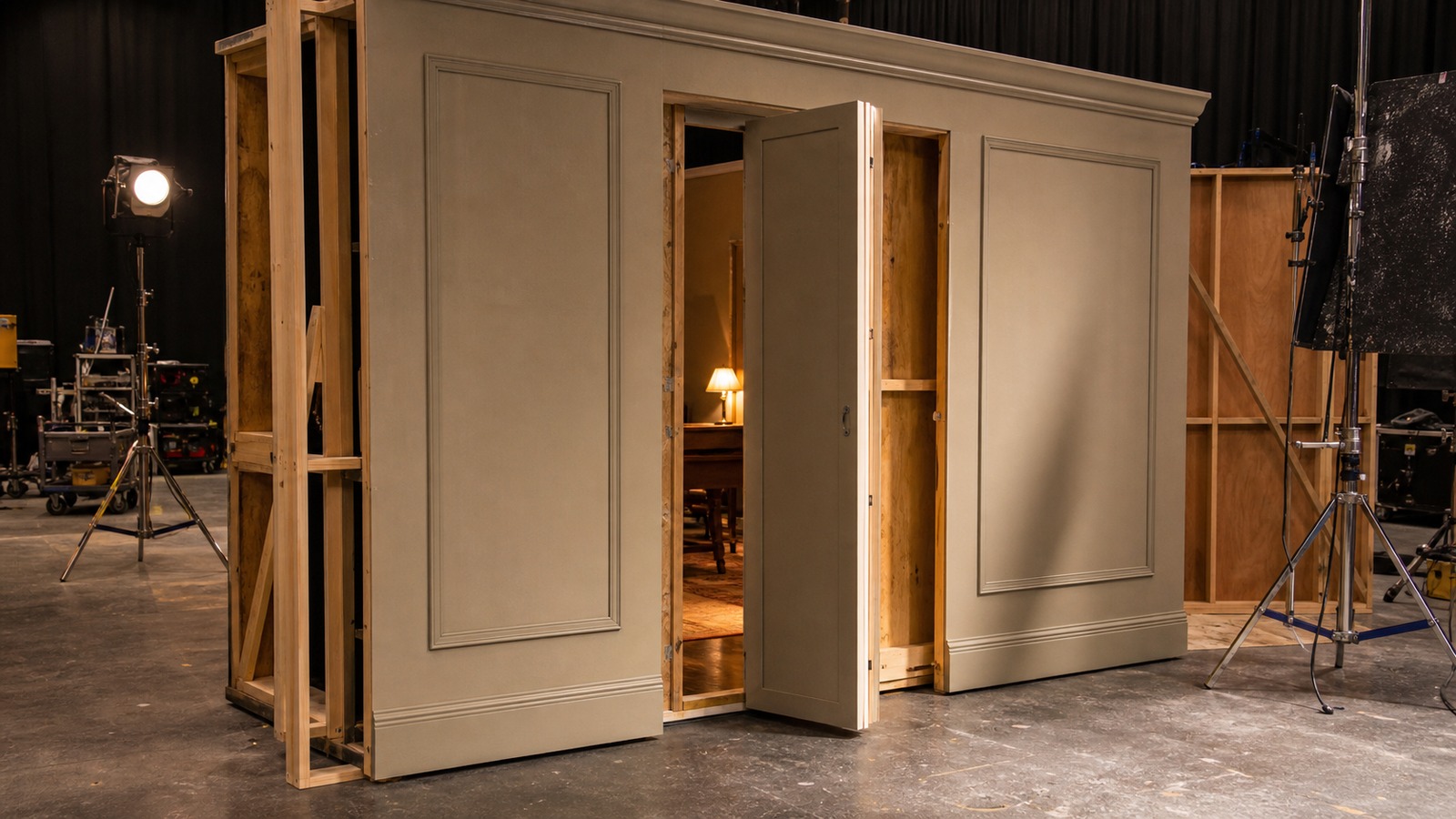
A film set can be more selective than a real building. The door may be beautifully concealed from the hero camera angle while bracing, hinges, crew handles, and unfinished backing sit just outside the frame. That is not cheating; it is film craft. The set exists to serve the lens, so the best solution is often the one that looks most convincing from the planned view.
Materials Are Chosen for Illusion and Speed
Set materials need to look right under lights and behave reliably during a shooting day. A carved wood panel might actually be lightweight scenic skin. A stone wall might be foam, paint, and texture. A heavy bookcase might be a shallow facade mounted to a practical frame.
Film sets are full of repeated takes, so performance matters as much as surface. The door may open dozens of times while actors reset, cameras change, and lighting is adjusted. A material that looks luxurious but sags, binds, or chips after three takes can become a problem quickly.
The best scenic choices balance appearance with handling. Designers want the audience to believe in a room, but they also need grips, carpenters, and actors to work safely around the reveal. A perfect-looking door that cannot perform on schedule is not a good movie door.
The Seam Is Hidden by Visual Noise
Set designers often hide door seams inside patterns that already belong to the room. Panel joints, bookcase verticals, tile grout, wallpaper repeats, cabinet lines, and shadow gaps can absorb the outline. The audience sees a normal surface because the eye has been given a plausible explanation for every line.
That is why blank walls are harder than they look. A smooth surface has nowhere to hide errors. Any crack, shadow, or misalignment becomes suspicious. Detailed scenery gives the designer more camouflage and gives the camera more texture to enjoy.
Actors Need a Door They Can Trust
A concealed door is only successful if the performer can use it confidently. The actor may need to hit a mark, press a disguised trigger, pull a hidden edge, or step through while delivering a line. If the movement feels uncertain, the scene can lose its rhythm. Safety and confidence are part of the design, even when viewers never think about them.
The Reveal Is Choreographed With Crew Timing
Many film concealed doors involve coordination beyond the actor. A crew member may operate the mechanism off camera. Another may control a light cue. The camera may dolly toward the opening while the door moves. The reveal can look effortless only because several people are matching timing precisely.
This choreography is why rehearsal matters. The door has to move at the right speed, stop at the right position, and avoid blocking the actor or camera. Even a simple sliding panel can become complex when it has to land exactly on a line of dialogue.
Lighting Helps Sell the Hidden Space
When a concealed set door opens, the audience often understands the space beyond through light before they understand it through detail. A warm glow suggests invitation. A cold slit of brightness feels controlled or dangerous. Low light makes the doorway feel uncertain. The lighting cue becomes part of the reveal.
Designers and cinematographers usually discuss this together. The door may need a light leak at the edge, a strong contrast inside the hidden room, or a shadow that conceals the seam until movement begins.
Real hidden doors can borrow this lesson. A pantry, office, or media room feels more deliberate when the lighting beyond the door is resolved. The reveal should not open into a forgotten-looking space.
Sound Is Designed Separately From the Build
The set door may make very little usable sound during filming. Later, sound designers can add clicks, rumbles, locks, slides, or mechanical weight to match the mood. That means the physical door and the perceived door are not always the same thing. Viewers may hear a massive stone panel while the actual set piece was lightweight and quiet.
Realism Depends on the Film’s World
A grounded historical drama needs different concealed-door logic than a superhero film or fantasy comedy. In one story, the audience may need to believe in hinges, servants’ passages, and old masonry. In another, a wall can open with polished impossibility because the whole movie is operating in heightened style.
Set designers judge realism by the rules of the world. The concealed door should feel believable inside the film, not necessarily inside a building inspector’s report. When those rules are clear, viewers usually accept the device.
Maintenance Happens Between Takes
A real home door must perform quietly for years. A movie door may be adjusted constantly between shots. Scenic crews tighten hardware, repaint scuffs, reset books, repair trim, and clean contact points so the illusion is ready for the next take. The audience sees one perfect moment, not the maintenance behind it.
That hidden labor is part of production design. A concealed door that looks simple on screen may have required carpenters, painters, riggers, props, safety checks, and standby repairs to keep it alive during the day.
This difference explains why copying a movie door directly can disappoint in real life. Film can concentrate effort around a short reveal. Homes need solutions that remain practical when nobody is standing by with a toolkit.
The Door Must Match the Room’s Character
A set door feels stronger when it grows naturally from the visible room. A professor’s study can hide a passage in shelving. A hotel suite may use paneling or service doors. A laboratory can conceal access in clean modular walls. The disguise should feel like it was chosen by the person or institution that owns the space.
Good Movie Doors Leave Small Clues
Some films let the audience notice the hidden door only after it opens. Others plant hints earlier: a repeated shelf line, a slightly unusual wall depth, a character’s glance, or an object placed where a hand will later reach. These clues make the reveal feel earned.
Set designers can build those clues subtly. The aim is not to announce the trick. The aim is to let the second viewing feel fair, as if the room had been telling the truth quietly from the start.
Film Craft Can Inspire Home Design
Homeowners should not copy the fragile side of movie scenery, but set design offers useful principles. Hide seams in existing patterns, coordinate lighting, make the opening motion feel intentional, and think about the reveal from the user’s point of view. A concealed door is experienced in time, not just viewed in elevation.
The practical side is just as important. Real concealed doors need durable hardware, code-aware planning, safe clearances, and finishes that can handle daily touch. The cinematic lesson works best when it is paired with real construction judgment.
The most useful borrowing is perspective. A set designer asks where the viewer stands, what they notice first, and what changes after the opening. A homeowner can ask the same questions in a calmer way. The answer may lead to a better pantry wall, a more graceful office entrance, or a media room that feels intentionally revealed instead of awkwardly hidden.
The Best Set Door Serves the Moment
Set designers create concealed doors for film by balancing illusion with performance. The door must look hidden, open when needed, support the actor, photograph well, and make the story turn feel satisfying. That is a lot of work for a few seconds of screen time.
Yet those few seconds can define a scene. When the wall opens at exactly the right moment, the audience feels the room become larger than it seemed. That feeling is the reward. The door is not only a trick of scenery; it is a controlled release of information, built by people who understand that architecture can become drama when the camera is watching.
Designers Also Build for the Edit
A concealed door on film has to give the editor useful choices. The scene may need a wide shot that establishes the wall, a close shot of the actor’s hand, a reaction from another character, and a cut into the newly revealed space. If the door moves too slowly, too quickly, or without a readable midpoint, the edit can feel clumsy even when the construction works.
That is why set designers often think in pieces rather than one uninterrupted reveal. The seam must be convincing before movement, the first motion must be readable, the opening must create a clean frame, and the hidden room must be ready for the next shot. Each stage gives the director another way to shape suspense, comedy, awe, or discovery.
This editing logic explains some of the apparent neatness of movie concealment. The audience sees the door at the most flattering instant, from the angle that gives the reveal its best rhythm. Real projects do not have a cutaway to hide awkward operation, so the design has to be satisfying through the whole movement. Film makes the moment sharper; daily architecture has to make the whole action dependable.
The Illusion Is a Collaboration
No single craft department owns the final effect. The writer gives the reason, the designer shapes the room, carpenters build the moving piece, painters hide the edge, lighting gives the threshold emotion, actors motivate the movement, and editors decide how the audience receives it. That collaboration is why a simple concealed door can feel so satisfying on screen. It is a small architectural event built from many precise decisions.
That is also why the finished reveal can feel bigger than the door itself. The audience experiences one smooth threshold, but the effect carries the thinking of an entire crew. Concealment on film is rarely a solo trick; it is a coordinated way of making a room disclose exactly the right secret at exactly the right second.