Haunted Attractions Make Walls Feel Untrustworthy
Concealed doors in haunted attractions are built around timing, control, and uncertainty. A visitor walks through a hallway, cabin, laboratory, crypt, carnival room, or old house set believing the path is fixed. Then a wall opens, an actor appears, a panel slams, a figure vanishes, or the route changes. The hidden door turns architecture into a scare device. It is not only there to hide access. It is there to make guests feel that the room itself cannot be fully trusted.
A: They create surprise, actor access, resets, and the feeling that walls may move.
A: It fires at a clear beat while staying hidden until motion begins.
A: Distressed scenery, shadows, fabric, props, and texture disguise openings.
A: The same scare may need to work repeatedly for closely spaced groups.
A: They can be if swing paths, exits, or actor spaces are poorly planned.
A: It can misdirect attention, mask mechanics, or make the door itself scary.
A: No. Some support vanish effects, route changes, or staff access.
A: Fragile mechanisms, blocked exits, and hidden spaces without supervision.
A: A door feels stronger when its movement matches the room's story world.
A: The best concealed door is theatrical for guests and predictable for operators.
The Scare Door Needs a Clear Beat
A haunted attraction concealed door works best when it is tied to a specific beat. The guest looks left, the sound hits, the actor appears from the right, or a panel opens just after a distraction. The door is part of a sequence, not an isolated trick.
Designers think about what visitors are seeing, where their bodies are pointed, how fast the group is moving, and how long the actor has to reset. The hidden door must support all of that. A scare that fires at the wrong moment can miss the group or feel random.
The best scare doors feel sudden to guests and predictable to the team operating them. That contrast is the craft.
Scenic Texture Hides the Mechanism
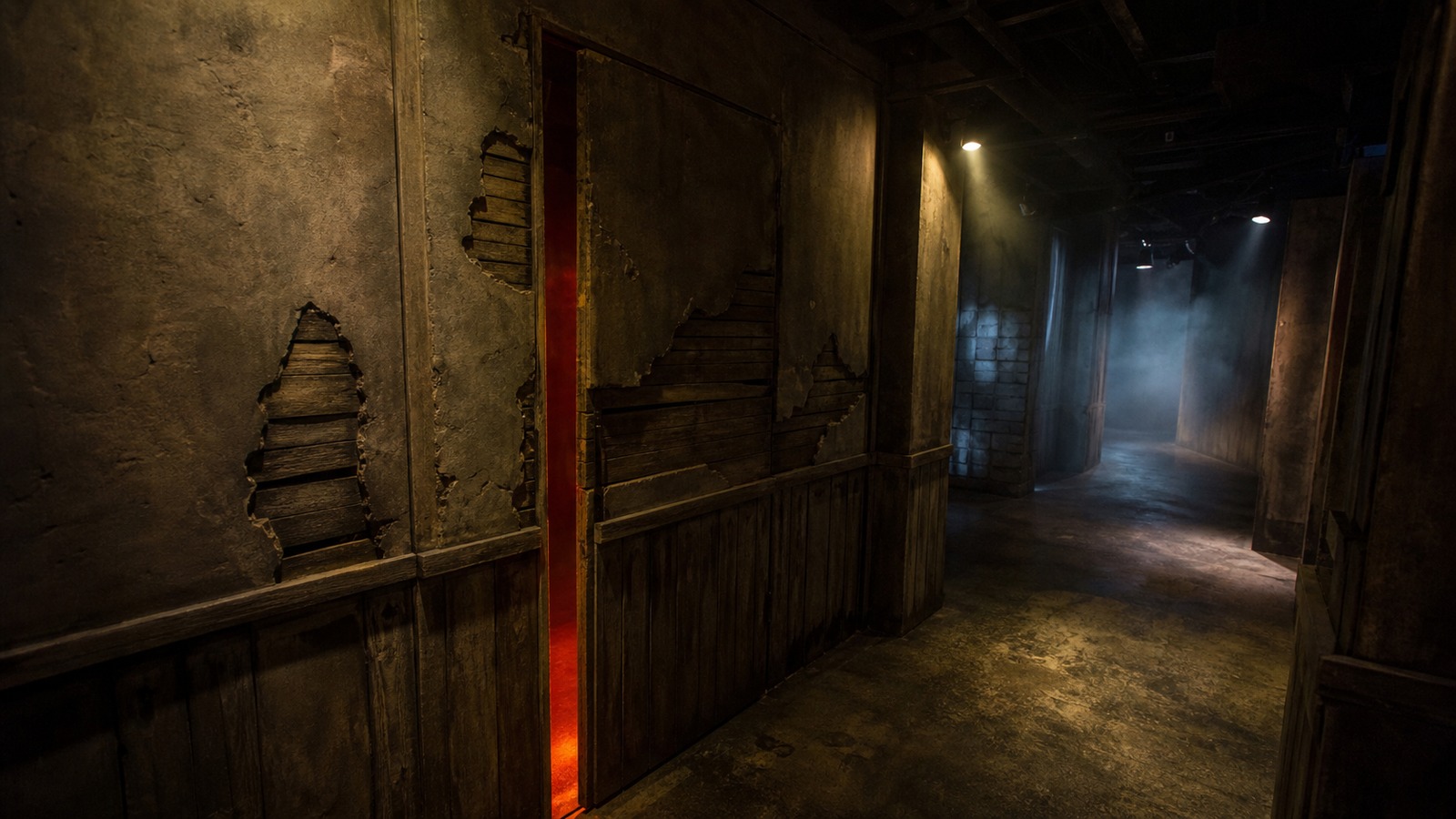
Haunted attractions have a visual advantage: distressed scenery naturally hides seams. Cracked plaster, warped boards, hanging fabric, rusted metal, fake stone, damaged wallpaper, and deep shadow can disguise panels that would be obvious in a clean modern room.
The disguise still needs discipline. Too many random cracks can make the set messy without improving concealment. The best scenic work makes the door look like part of the environment’s decay.
Actors Need Fast and Safe Access
Behind a concealed scare door is usually a performer with a practical job. They may have only seconds to reset, hydrate, check sightlines, and prepare for the next group. The door must open reliably, close safely, and allow movement without pinching fingers, scraping costumes, or colliding with guests.
Sightlines Control Surprise
Guests often travel in groups, and each person sees the room from a slightly different angle. A concealed door that is hidden from the first guest may be obvious to the third if the sightline is not controlled. Designers use bends, curtains, scenery, lighting, and distraction to guide attention.
This is why haunted layouts rarely rely only on a hidden panel. They choreograph vision. The guest should be looking where the attraction wants them to look before the concealed door moves.
Good sightline control also protects reset moments. If an actor can be seen returning to position, the next scare weakens before it starts.
Sound Can Lead or Misdirect
Haunted attractions use sound to steer fear. A noise in one corner can pull guests’ attention while a concealed door opens somewhere else. A sudden slam can make the door itself the scare. A low scrape can create dread before anything appears.
Sound also helps conceal mechanics. Fans, music, ambient creaks, and scene audio can cover small operational noises. The goal is not silence; it is controlled attention.
Guest Flow Determines Door Placement
A hidden door cannot swing into a visitor’s path without careful planning. Attractions need to consider spacing, accessibility, emergency routes, actor reach, and group density. A great-looking scare door in the wrong location can become a safety problem.
Reset Speed Is Part of the Design
Haunted attractions repeat the same moments hundreds or thousands of times. A concealed door must reset quickly and consistently. If the actor has to fight the latch, reposition a loose panel, or wait for a slow mechanism, the scene loses capacity.
Designers often favor simple, rugged solutions over delicate tricks. A door that works every thirty seconds on a busy night is more valuable than a beautiful mechanism that fails under pressure.
The reset area matters too. Actors need enough room behind the door to stand safely, avoid trip hazards, and hear or see the next group approaching.
Concealment Can Create Anxiety Before the Scare
Once guests realize a haunted attraction uses hidden doors, every wall becomes suspicious. That suspicion is useful. The attraction can let visitors anticipate a scare, then delay it, redirect it, or let the expected door stay closed while something else happens.
Emergency Logic Must Stay Visible to Staff
Haunts are theatrical, but they are still public spaces. Emergency exits, staff routes, fire requirements, and evacuation procedures must remain clear to the team. Scenic concealment cannot create confusion when staff need to move quickly.
The strongest designs separate guest illusion from operational clarity. Guests may see a rotting wall. Staff may know exactly which panel opens, which path is clear, and how to exit in an emergency.
Different Themes Use Different Door Behavior
A haunted mansion may use creaking panels and bookcases. A sci-fi horror attraction may use airlock-style doors. A backwoods cabin may use rough planks. A hospital scene may hide access in curtains, cabinets, or maintenance panels. The door’s behavior should fit the world.
When the movement matches the theme, the scare feels integrated. A random sliding panel in a rustic crypt may work once, but it can feel artificial if the setting does not support it.
The door should seem like the room’s own way of turning against the visitor.
Durability Matters More Than Delicacy
Haunted attraction doors endure hard use. Actors hit marks quickly, guests may bump scenery, humidity changes materials, and nightly operation stresses hinges, closures, and frames. Concealment has to be rugged enough to survive the season.
Home Haunted Rooms Borrow Carefully
People who build home haunts or themed rooms can borrow the idea of concealed access, but they should keep safety and simplicity first. A hidden panel can create a fun reveal, but it should not trap people, block exits, or depend on a fragile mechanism.
For residential use, the best haunted-door ideas are usually low-risk: a concealed storage door, a themed closet, a sliding panel for props, or a reveal that happens with clear supervision.
The Scare Is Stronger When the Door Has Purpose
A concealed haunted door should not exist only because hidden doors are fun. It should serve a scare, route, reset, or story moment. Guests sense when a reveal is arbitrary. They also sense when the room has been arranged to manipulate attention with care.
Purpose helps the attraction avoid repetition. One door may deliver a startle, another may allow an actor to vanish, another may redirect the path, and another may support maintenance. Different purposes keep concealed doors from becoming predictable.
The strongest haunts vary rhythm. If every hidden panel opens at shoulder height after the same delay, guests learn the pattern and the fear fades.
Concealed Doors Make the Path Feel Alive
Concealed doors remain central to haunted attractions because they make the built environment feel active. The hallway is not passive. The wall can open, the cabinet can breathe, the painting can move, and the room can produce a person who was not there a second ago.
The Best Haunted Door Disappears Until It Moves
The ideal haunted attraction door is invisible at rest and unforgettable in motion. Guests should not spend the whole scene staring at the mechanism. They should feel the reveal land in their bodies before they analyze how it worked.
That takes practical design, not just spooky decoration. The door needs a readable scare beat, safe actor access, durable construction, concealed seams, controlled sound, and a reset plan that can survive a long night. When all of those pieces align, the concealed door becomes one of the haunt’s most effective tools. It teaches visitors that the next wall may not stay still, and that uncertainty is the attraction’s favorite kind of architecture.
Good Haunts Vary the Contract
Visitors quickly learn the rules of an attraction, even when they are frightened. If every concealed door opens from the same side, at the same height, after the same sound cue, the group begins to predict the scare. Good haunt design varies the contract. Sometimes the door opens; sometimes it only rattles; sometimes the distraction is the real scare; sometimes the expected panel stays closed while another route activates.
This variation does not require complicated machinery. It requires rhythm. The designer has to decide when to teach a pattern and when to break it. Concealed doors are useful because they can support both moves. They can establish that walls are dangerous, then make guests doubt which wall deserves attention.
That uncertainty is more durable than a single jump scare. A visitor may forget the exact panel, but they remember the feeling that the building had intentions. The hidden door turns an ordinary hallway into a negotiation with the unknown.
Behind-the-Door Comfort Affects Performance
The guest never sees the actor’s waiting area, but the actor feels it all night. A cramped, hot, poorly lit pocket behind a concealed door can make performance harder and safety worse. Good attractions give performers enough room, ventilation, footing, visibility, and communication to repeat the scare without strain.
Maintenance Crews Are Part of the Scare
Haunted doors rely on maintenance as much as imagination. A hinge that sags, a latch that sticks, a panel that scrapes, or a scenic edge that peels can ruin timing and expose the method. Crews who inspect doors before opening, during breaks, and after closing protect both the show and the performers.
That maintenance has to be practical. Access panels should not require destroying scenic paint every time hardware needs adjustment. Durable hidden doors are designed so the scary surface can be repaired without turning the attraction into a nightly rebuild.
The Room Teaches Guests How to Fear It
A concealed haunted door works inside a larger lesson. The attraction teaches visitors that portraits might move, cabinets might open, walls might breathe, or hallways might change. Once guests learn that lesson, even a closed panel can create tension. The door does not need to fire every time to do its work; sometimes the possibility is enough.
That possibility gives haunted architecture its special charge. A normal building tells people where movement is allowed. A haunt suggests that the rules can shift without warning. Concealed doors are perfect for that suggestion because they are both physical and psychological: they move in the room, but they also move inside the guest’s expectations.
The best designers use that expectation carefully. They let visitors suspect one opening, then reward or betray the suspicion with timing. The concealed door becomes a way to pace fear, hold attention, and keep the route emotionally unstable until the final exit.
When guests leave, they may not remember every hinge or panel, but they remember the sensation that the environment was awake. Concealed doors create that sensation with remarkable efficiency, turning ordinary surfaces into potential threats and making the walk-through feel less like a corridor and more like a place with its own nervous system, ready to twitch whenever attention slips for even a second in the dark around them at the wrong moment suddenly.