University Hidden Entrances Mix History With Campus Legend
Concealed entrances in famous universities are often hard to separate from student stories, old building plans, maintenance routes, restricted collections, tunnels, faculty rooms, and preservation choices. Campuses grow over centuries, and each generation adds new uses to old spaces. A door hidden behind paneling, a locked stair, a service tunnel, or an unmarked library entrance can become part of campus mythology. The most useful way to understand these entrances is to treat them as architecture first and legend second.
A: Many have discreet, restricted, or historic access routes, though legends can exaggerate them.
A: No, many are utility or maintenance routes.
A: Special collections and staff work often need controlled, quiet access.
A: No, many locked rooms serve administrative, research, or facilities needs.
A: Locked doors, old buildings, and restricted spaces invite stories.
A: Yes, plans and records can clarify former entrances and renovations.
A: Safety, preservation, privacy, security, and collection care can all matter.
A: Only with permission and respect for safety and preservation.
A: Prestige can make ordinary service routes feel legendary.
A: They reveal the working campus behind public academic life.
Old Campuses Accumulate Hidden Routes
Famous universities often contain buildings from many eras. Halls, libraries, laboratories, chapels, dormitories, museums, and service buildings are altered repeatedly. As uses change, entrances may be blocked, hidden, repurposed, or absorbed into new construction.
This layered growth creates real hidden access. It also creates opportunities for rumors when students notice a locked door or unusual stair.
Libraries and Archives Need Restricted Access
University libraries may hold rare books, manuscripts, archives, maps, scientific records, or special collections. Doors to these areas are often discreet, secure, or staff-only. They may not be secret, but they are intentionally controlled.
A concealed or unmarked entrance protects both material and workflow. Researchers, librarians, and conservators need routes that support collection care without turning reading rooms into traffic corridors.
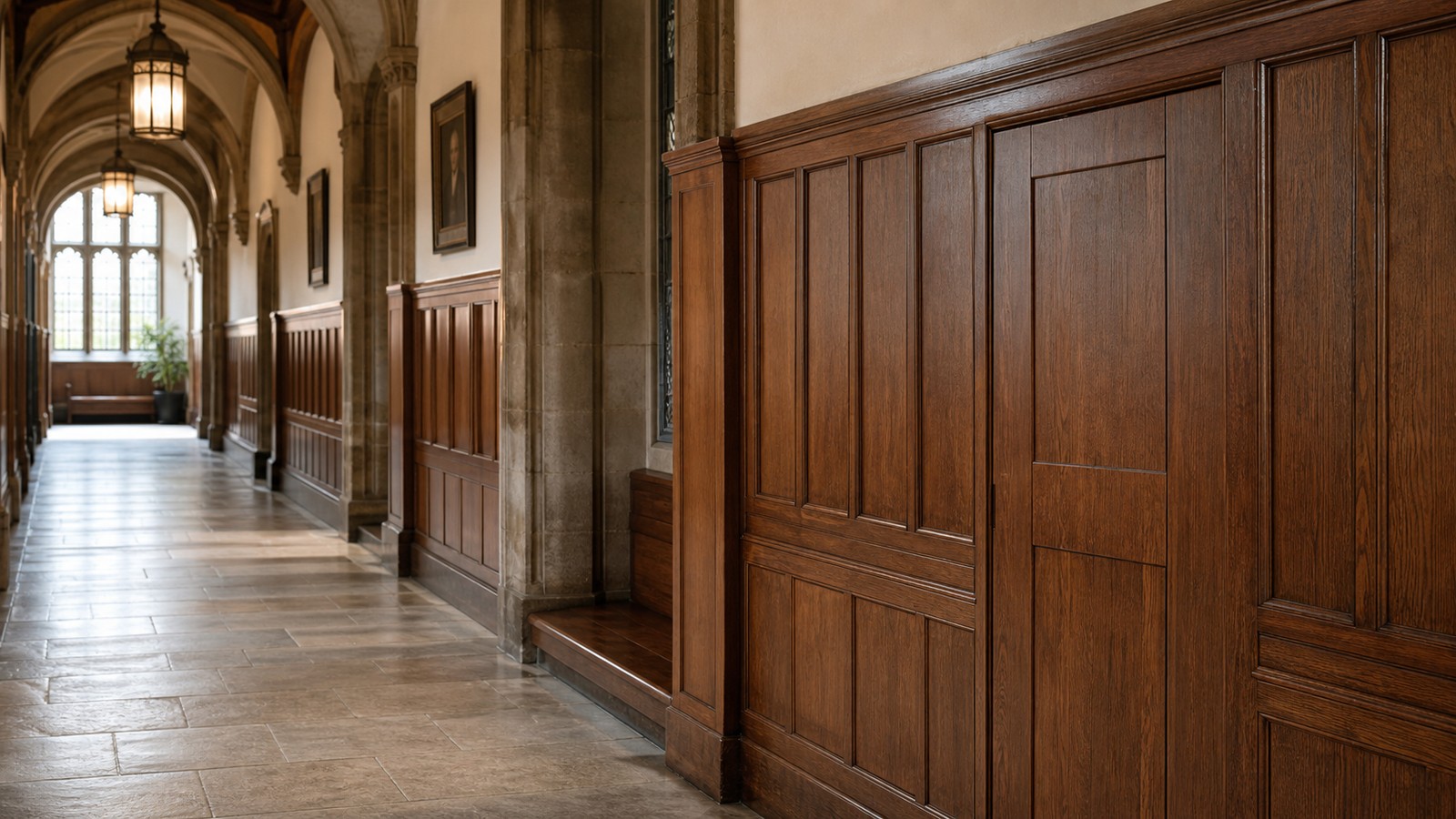
In old libraries, a hidden door can preserve the look of a book-lined room while allowing professional access behind it.
Service Tunnels Become Campus Myths
Many campuses have utility tunnels, steam routes, delivery passages, or maintenance corridors. Students may imagine them as secret societies’ networks or forbidden adventures. In reality, they often serve heating, wiring, plumbing, deliveries, or staff movement.
Faculty and Administrative Spaces Use Discretion
Universities need private offices, meeting rooms, records rooms, exam storage, and administrative spaces. Discreet entrances can separate those areas from student circulation. The hidden quality may be about confidentiality and workflow rather than secrecy.
An unmarked door in a historic corridor may simply lead to a registrar’s storage room or faculty stair. Ordinary institutional needs can look mysterious when access is limited.
Student Legends Attach to Locked Doors
Campus culture thrives on stories. A locked hatch becomes a tunnel to another building; a paneled door becomes a society room; a sealed stair becomes an escape route. Some legends preserve fragments of real history, while others grow because campuses are old, complex, and full of restricted spaces.
The legends are part of university life, but they should not replace evidence. Building records, staff knowledge, and physical context often explain the door more clearly.
That said, the stories reveal how students emotionally inhabit the campus. Mystery makes the place feel larger.
Research Buildings Need Controlled Movement
Laboratories, museums, and collections may require controlled access for safety, security, or preservation. Discreet entrances can manage movement of specimens, equipment, staff, or sensitive materials. These doors are practical, not theatrical.
Chapel and Ceremonial Buildings Have Backstage Areas
University chapels, assembly halls, theaters, and ceremonial rooms need preparation spaces, side stairs, storage, and staff routes. Entrances to these areas may be visually quiet so the public experience remains focused on ceremony.
As in palaces and theaters, the visible event depends on unseen movement. A concealed entrance can help the campus perform tradition smoothly.
Preservation Can Hide or Reveal Old Doors
Historic university buildings are often restored, modernized, or adapted for accessibility and safety. A former entrance may be covered to preserve a wall, reopened for interpretation, or retained behind paneling because it belongs to the building’s history.
Modern codes, security systems, and accessibility needs may change how entrances function. A door that once served everyday access may become a preserved feature or emergency route.
Campus buildings keep changing even when they look timeless.
Famous Names Can Inflate Ordinary Features
When a university is famous, every locked door seems more important. A routine service entrance may become part of a grand story simply because the campus has prestige. Fame adds narrative pressure.
Concealed Entrances Support Academic Privacy
Scholarship sometimes requires quiet, controlled rooms: archives, reading rooms, seminar spaces, faculty studies, and conservation labs. Discreet entrances help protect that focus. They keep the public campus from overwhelming specialized work.
This kind of concealment is not about exclusion for its own sake. It is about preserving conditions for study, teaching, care, and administration.
Campus Maps Rarely Tell the Whole Story
Public maps show buildings, paths, and entrances for ordinary navigation. They usually omit service routes, restricted stairs, old tunnels, locked rooms, and maintenance access. The campus known by facilities staff is different from the campus known by visitors.
That difference creates hidden geography. A concealed entrance may be invisible on a brochure and essential to daily operations.
Universities are cities in miniature, and every city has back routes.
Exploration Has Limits
Hidden campus entrances can be tempting, but restricted areas may contain hazards, sensitive records, equipment, or preservation risks. Unauthorized exploration can be dangerous and can damage historic buildings. Curiosity belongs with permission.
Architecture Shapes Campus Identity
Concealed entrances contribute to the feeling that a famous university is deeper than its public paths. They suggest layers of scholarship, tradition, labor, and memory behind the visible campus. Even when the true function is ordinary, the hidden door adds texture.
This is why campus legends endure. They express the sense that learning itself has hidden rooms.
Facilities Staff Know Another Campus
Students and visitors usually experience the university through quads, lecture halls, libraries, dining rooms, dormitories, and ceremonial spaces. Facilities staff know a second campus made of service doors, roof access, basements, mechanical rooms, delivery routes, and utility corridors. Concealed entrances often belong to that working geography.
That difference explains why campus mysteries can feel so convincing. A door that looks strange to a student may be completely ordinary to the people who maintain the building. The hidden route is real, but its meaning is often practical.
Understanding both views makes the campus richer. The visible university depends on an invisible layer of labor.
Restricted Access Protects More Than Prestige
Famous universities guard archives, art, specimens, equipment, student records, exams, laboratories, and ceremonial objects. Discreet entrances help control those responsibilities without advertising every protected space. The goal is often stewardship rather than drama.
Older Buildings Keep Former Uses Alive
A university building may begin as a residence, become a library, shift into classrooms, host offices, and later become a museum or administrative hall. Each change can leave behind doorways that no longer match the public story of the building. Paneling, bookcases, blocked stairs, and odd corridors can preserve traces of former use.
Those traces are easy to mythologize because they feel intentional. Sometimes they are. Other times they are leftovers from adaptation, convenience, or code changes. The campus becomes a layered document, and concealed entrances are among its most tempting footnotes.
Tradition Makes Practical Doors Feel Symbolic
On a famous campus, architecture carries ceremony. A service stair near a chapel, an unmarked library door, or a private passage beside a great hall can take on symbolic weight because generations have passed near it. The door becomes part of a story larger than its original function.
That symbolic layer is not false just because the function is ordinary. People build identity from repeated encounters with places. A concealed entrance may be maintenance access, and it may also be the doorway that gives a building its whispered reputation.
The strongest campus stories usually sit in that middle ground between use and imagination.
Permission Keeps Curiosity Generous
Hidden university entrances are best explored through tours, archives, published histories, and authorized access. That approach protects old buildings and the people who work in them while still allowing the mystery to be enjoyed. Curiosity becomes more satisfying when it learns how the campus actually functions.
Campus Time Moves Unevenly
A famous university can feel timeless from the outside, but its buildings are constantly being repaired, rewired, secured, expanded, and repurposed. Concealed entrances often appear where that uneven time becomes visible. An old stair survives beside a new elevator; a former service route sits behind restored paneling; a utility door hides beneath ceremonial architecture.
These layers give campus hidden entrances their special charm. They are not only secret routes but evidence of institutions adapting while trying to preserve continuity.
Student Stories Preserve Emotional Truth
Even when a campus legend exaggerates the facts, it may preserve how the place feels to students. Old universities can be intimidating, beautiful, competitive, and mysterious. A hidden entrance story gives that atmosphere a concrete object.
The story may be wrong about the door’s original purpose and still right about the campus mood. Architecture invites emotional interpretation, especially in places where young people are constantly discovering new rooms, rules, and traditions. The concealed entrance becomes a symbol of knowledge just out of reach.
That is why the best campus histories listen to folklore without surrendering to it.
Hidden Routes Reveal Institutional Labor
Behind every polished quad and grand reading room is a network of caretakers, archivists, technicians, cleaners, guards, curators, and maintenance crews. Concealed entrances make that labor easier to overlook, but they also point directly toward it when read carefully.
A staff-only door behind paneling or a tunnel beneath a path is a reminder that the university is not maintained by tradition alone. It is maintained by people moving through spaces visitors rarely see. The concealed entrance becomes a quiet monument to work as much as to mystery.
The Best Stories Keep Evidence Nearby
Concealed university entrances are most interesting when legend and evidence are allowed to coexist. The legend gives emotional life; the evidence gives shape. A locked stair may be a maintenance route and still become a beloved student story.
Famous universities are built from both architecture and imagination. Their hidden entrances remind us that institutions are not only classrooms and quads, but layered places where work, history, secrecy, and curiosity meet.
The doorway may lead to an archive, a pipe chase, a faculty stair, a former service route, or a preserved room whose purpose changed long ago. Whatever the destination, the threshold asks a useful question about the campus: what parts of learning, memory, labor, and authority happen just outside the visitor’s map? That question is why these entrances keep their hold on campus imagination.
The answer is rarely a single dramatic secret. More often, it is a layered picture of study and upkeep, status and routine, legend and documentation. Concealed university entrances endure because they make that layered institution feel tangible in one small, half-hidden place.
They also soften the distance between institution and individual. A student who hears about a hidden stair is really hearing that the campus has more to reveal. The concealed entrance turns academic history into a threshold someone can imagine standing before. It gives the university a sense of depth that is physical, social, and emotional all at once, which is why even practical doors can become treasured campus lore. The best versions leave students more attentive to the buildings they pass every day, with more care for the spaces behind familiar walls and lasting curiosity for years.