
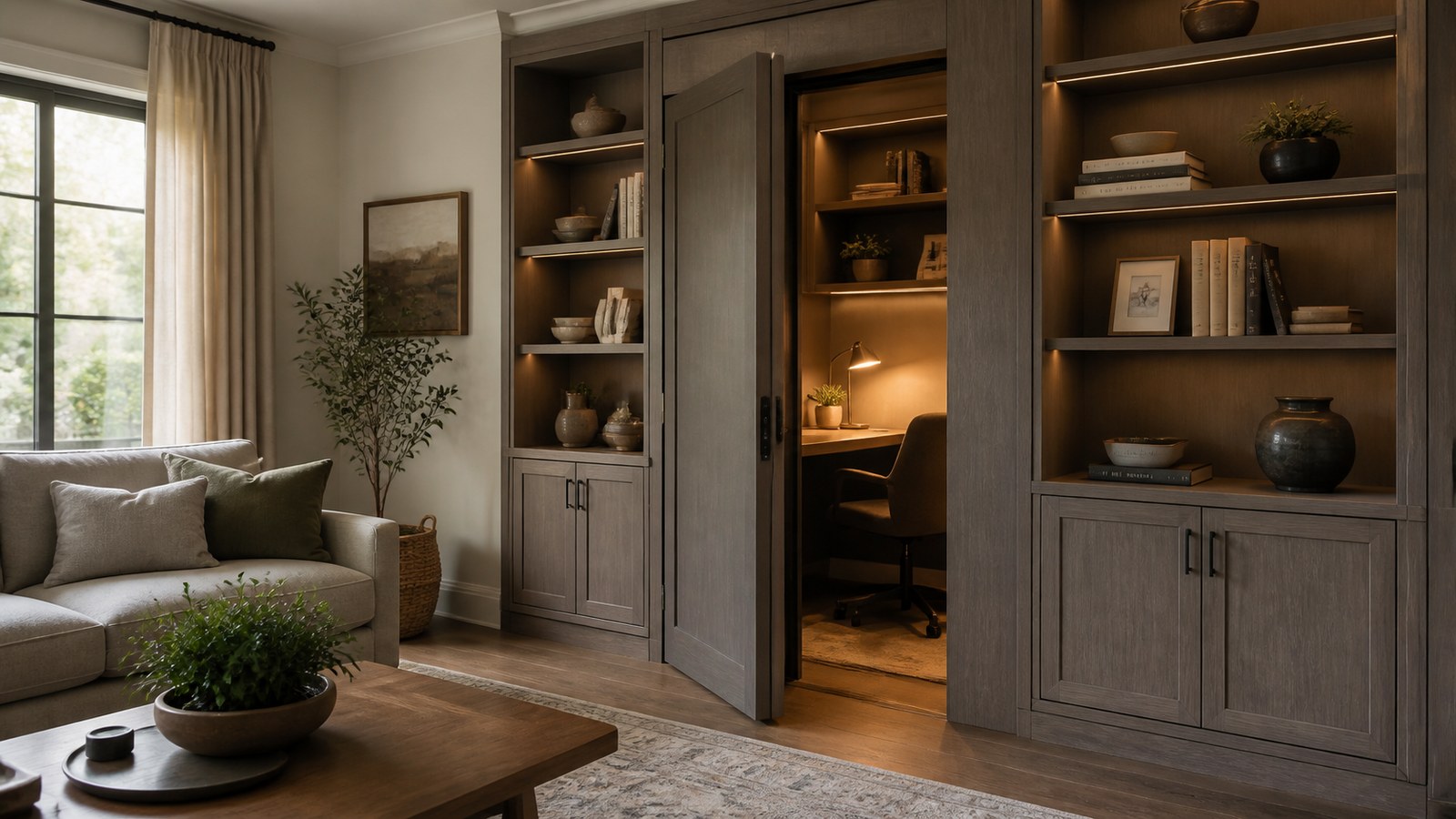
When the Workday Needs a Door That Vanishes
A home office can be essential during the day and visually exhausting at night. Monitors, task chairs, files, chargers, samples, and project materials all have a way of reminding the rest of the house that work is still waiting. A concealed office door solves that problem by letting the workspace exist fully when needed and disappear when the day ends. The best designs do not simply hide a desk. They manage focus, sound, storage, lighting, access, and the emotional shift between professional time and home life.
A: The best choice depends on use: bookcases feel warm, while flush panels feel quieter and more modern.
A: It can be improved with solid doors, seals, soft finishes, and careful ventilation.
A: A discreet lock is useful for confidential work, shared homes, or expensive equipment.
A: Yes, if the hardware and frame are rated for the loaded weight.
A: Plan cable trays, grommets, outlets, and charging zones before closing the office into cabinetry.
A: Yes, mirror doors, wall panels, or cabinet fronts can make the workspace disappear after hours.
A: Not if the living side looks complete and the opening cue is subtle.
A: Task lighting inside and controlled light leakage around the concealed entrance.
A: It can be, but daily offices often need a release that works quickly and predictably.
A: The office supports real work, then closes cleanly enough for the home to feel restored.
Start With the Kind of Work Being Hidden
A concealed office for occasional emails has different needs from a daily video-call room, design studio, therapy office, or financial workspace. The more often the room is used, the more important comfort and access become. A hidden door that is charming but slow to open will become irritating if you pass through it ten times a day.
Work style also affects the emotional goal. Some people need the office to feel like a separate professional suite, while others simply need the laptop and paperwork out of sight after dinner. The door should support that boundary without making the room feel cut off from the household.
Think about what must disappear when the door closes. Is it visual clutter, sound, confidential paperwork, client-facing equipment, or simply the feeling of being at work? That answer guides the door style, storage plan, and hardware.
Bookcase Doors for Studies and Living Rooms
The bookcase office door remains popular because it feels natural in rooms where shelves already belong. A wall of books, objects, and closed storage can conceal the entry while adding function to the living space. When open, it reveals a private office; when closed, it reads as built-in furniture.
Weight is the main concern. A bookcase door must be engineered for the loaded shelves, not the empty frame. Keep the heaviest items low, use hardware rated for the real load, and avoid delicate objects that shift when the door moves. The shelving should look styled, but it also needs to behave like part of a moving door.
Flush Panel Doors for Minimal Homes
In a contemporary home, a flush panel may hide an office more effectively than a bookcase. The door can match the wall, continue millwork, or disappear into a run of tall panels. This style is especially useful when the office sits off a hallway, bedroom, or open living area where shelves would feel too busy.
Flush panels are also helpful when the office is close to a visually important area. A dining room, primary bedroom, or living room may not need another furniture-like feature. A quiet wall panel lets the workspace exist without changing the mood of the adjacent room.
Flush office doors need good sound control because work often involves calls. A solid core, perimeter seals, and a quiet latch can make the office feel private without making the entrance look technical. Even small acoustic upgrades help separate household noise from focused work.
Cabinet Walls That Hide Work Zones
Some concealed offices are less like separate rooms and more like work alcoves hidden inside cabinetry. Pocketing doors, folding panels, or tall cabinet fronts can cover a desk, printer, and supplies. This approach is useful in apartments, guest rooms, kitchens, and multipurpose spaces where a full room is not available.
The hidden office must be planned for cable management and heat. Printers, chargers, monitors, and task lights all need ventilation and access. A beautiful cabinet office becomes frustrating if every work session begins by untangling cords or moving equipment.
Sound Control for Calls and Concentration
Privacy is one of the strongest reasons to hide an office behind a real door. If calls, recordings, or confidential conversations happen regularly, a hollow slab or loose bookcase will not be enough. Use mass, seals, soft furnishings, and thoughtful ventilation to reduce sound transfer.
The need goes both directions. The worker may need protection from household noise, and the household may need relief from meetings, typing, or equipment. A concealed office that sounds calmer is easier for everyone to respect.
Inside the office, acoustic comfort matters too. Rugs, curtains, upholstered chairs, shelves, and fabric panels reduce echo during calls. The goal is not a recording studio for most homes. It is a room where the person working can think clearly and the rest of the household does not hear every sentence.
Lighting That Supports Both Sides
The living side of the concealed door should look complete when the office is closed. The office side needs task lighting, flattering video-call light, and enough ambient light to avoid eye strain. These are different jobs, so they should be planned separately.
If the concealed door is a bookcase, shelf lighting can make the living room side feel intentional. Inside the office, a warmer desk lamp and controllable overhead light may be better. Avoid bright light leaking through cracks around the hidden entrance, especially if the office will be used early or late.
Storage Makes the Disguise Easier
A concealed office works best when the room behind the door has enough storage to reset quickly. Closed cabinets, file drawers, printer shelves, cable trays, and wall hooks keep work from spilling into the main room. The hidden door should not be responsible for hiding every mess by itself.
Storage should also match the shutdown routine. If the person working needs to clear the desk for creative focus, drawers should be close at hand. If the office holds active projects, open shelves inside the room may be better than carrying supplies into shared spaces.
Plan a landing zone near the entrance for bags, notebooks, and charging devices. If the user has to carry everything back and forth each day, the office will start spreading into the house again. Good storage makes the boundary easier to maintain.
Hardware Should Feel Professional
The door to a workspace should open smoothly and close confidently. Sticky latches, dragging panels, and noisy hinges undermine the sense of professionalism. A concealed office is often used during time-sensitive moments, so the mechanism should not require patience or a special trick.
Privacy hardware may also be needed. A discreet lock, soft-close latch, or inside release can protect focused work without advertising the office to the rest of the room. Choose hardware that respects both the hidden look and the seriousness of the work happening inside.
Separate Work Mode From Home Mode
The psychological benefit of a concealed office is real. Closing the door can create a ritual that ends the workday. The living room, bedroom, or kitchen no longer has to carry visible reminders of tasks and deadlines. That separation is one reason concealed offices feel so appealing in homes where square footage is doing double duty.
The transition can be subtle but powerful. A different light temperature inside the office, a door that closes softly, and a clean living-side wall all tell the brain that work has a place and that place can rest. This is design doing emotional labor as much as spatial labor.
Design can strengthen the transition. Use a calmer palette inside the office, comfortable lighting, and storage that makes shutdown simple. On the outside, let the door blend with the room so home mode feels restored when it closes.
Make the Hidden Workspace Easy to Live With
A concealed office should not be so secret that it becomes impractical. The person using it should be able to enter with a laptop, answer a call quickly, and close the door without noise. The household should know how to find it when needed, while guests simply see a composed wall, shelf, or cabinet.
When the balance is right, the hidden office supports both productivity and peace. It gives work a dedicated place, then lets that place disappear. In a home where every room has to earn its keep, that kind of flexible boundary can be more valuable than another decorative feature.
Keep the Office Discoverable to the Household
A concealed office does not need to be secret from the people who live there. Children, partners, guests, or helpers may need to find it, knock, or avoid interrupting. A subtle cue on the private side, a consistent panel line, or a familiar pull can keep the workspace hidden from casual view without making everyday life awkward.
That balance protects the design from becoming a gimmick. The office can disappear visually while remaining part of the home’s working rhythm, which is exactly what makes concealed workspace doors so useful.
It also helps the room feel respected. When the household understands the door and the boundary, the workspace can stay private without feeling isolated or off-limits in a strange way.
Design the Inside to Reset Quickly
The concealed door can only do so much if the office interior is hard to reset. A shutdown routine should be built into the room: a place for the laptop, a drawer for papers, a hook for headphones, and cable management that does not require effort. The faster the office can be tidied, the more satisfying it feels to close the door at the end of the day.
Keep Comfort Equal to Concealment
Hidden offices sometimes fail because too much energy goes into the outside wall and not enough into the working room. Ventilation, chair clearance, task lighting, outlet placement, and acoustic comfort determine whether the space is pleasant for long stretches. A concealed entrance should support a real office, not hide a cramped afterthought.
When comfort and concealment are balanced, the room becomes genuinely flexible. It is focused when open, calm when closed, and useful enough that the hidden door feels like a daily advantage rather than a novelty.
This comfort is what keeps the office from feeling like a compromise. The door may be hidden, but the person working behind it should not feel tucked into leftover space.
Plan for Hybrid Work Changes
Work habits shift over time, so a concealed office should have some flexibility. The room might start as a video-call space and later become a homework room, studio, guest office, or storage-supported command center. Durable wiring paths, adaptable shelving, and a door style that suits the larger home will make those changes easier.
The hidden entrance should not lock the room into one narrow use. It should create a clean boundary that remains valuable even as the work inside changes.
Close the Day Cleanly
The most satisfying concealed office moment often happens after work. The chair is pushed in, the equipment is quiet, and the door returns the room outside to its intended mood. That small daily reset is why hiding a workspace can feel so restorative.
Protect the Boundary Over Time
A concealed office works best when the boundary is respected after the novelty fades. Keep work storage inside the room, maintain the latch, and avoid letting the living-side shelves become a dumping ground. The hidden door can only restore calm if the habits around it support that purpose.
When the boundary is protected, the workspace remains useful without taking over the home.


