
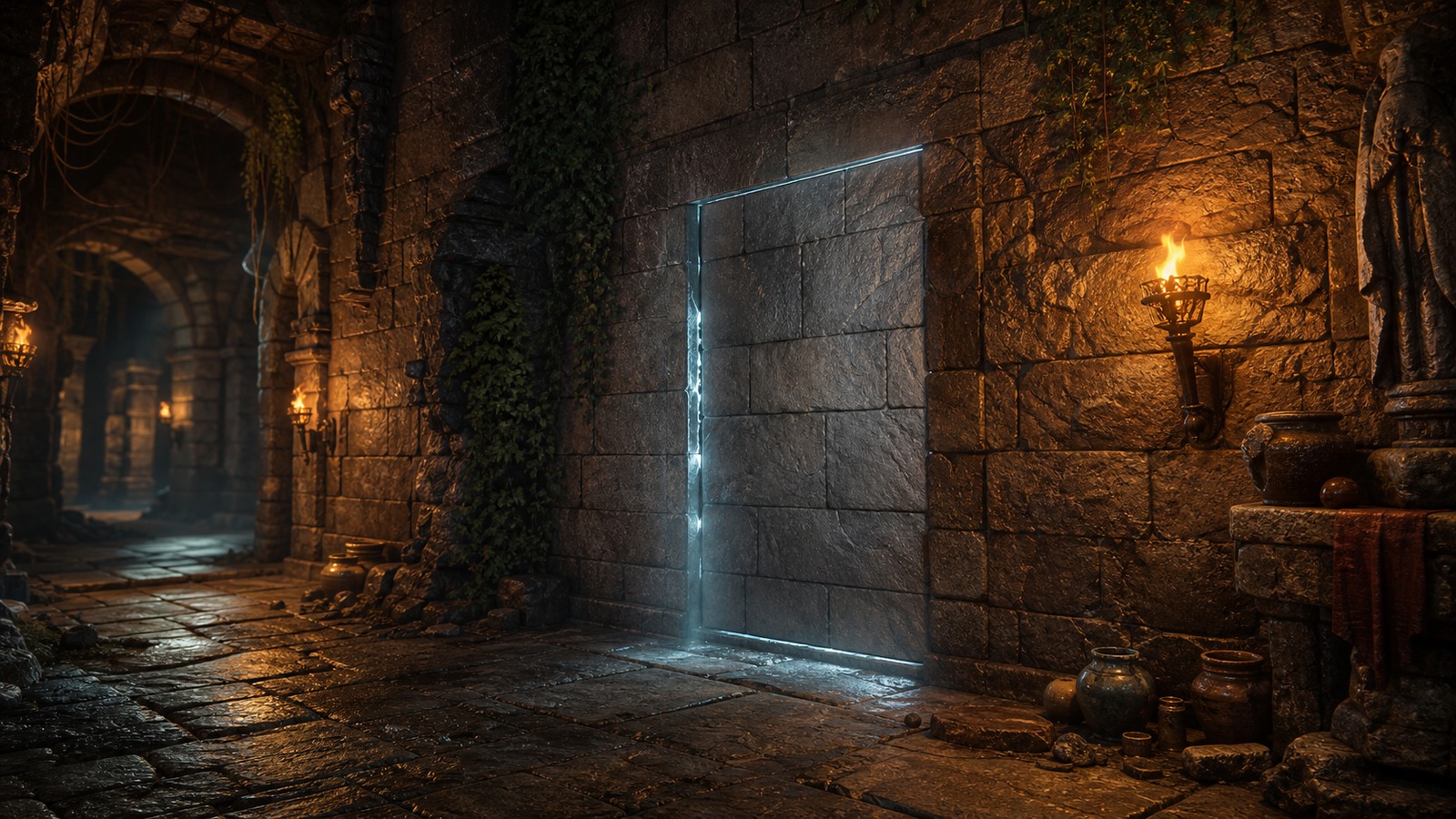
Game Doors Reward the Player Who Looks Twice
Concealed doors in video games turn curiosity into action. A suspicious wall, odd texture, unreachable ledge, cracked panel, musical cue, or strange map outline can tell a player that the visible level is not the whole level. When the door opens, the reward may be a hidden room, alternate route, collectible, boss arena, shortcut, joke, lore fragment, or entire secret stage. The pleasure is different from film because the player participates in the reveal. The hidden door does not simply surprise them; it confirms that their attention mattered.
A: They reward curiosity and make exploration feel interactive.
A: The discovery should feel earned, surprising, and worth the effort.
A: They can use maps, textures, lighting, sounds, geometry, and item placement.
A: They can be fair when optional, patterned, or supported by clues.
A: They turn discovery into better movement through the world.
A: They make safe spaces feel unstable and decisions feel risky.
A: Yes. Hidden rooms can carry lore without slowing the main path.
A: Invisible critical routes, weak feedback, and excessive wall-checking.
A: Yes. Interaction, feedback, and payoff matter in both settings.
A: The player feels rewarded for seeing possibility where others saw only a wall.
Hidden Doors Teach Spatial Reading
Games train players to read environments. A wall is not always just a wall; it may be a clue. Level designers use texture changes, lighting, enemy placement, map gaps, item trails, and unusual geometry to suggest that something is worth testing. Over time, players learn a visual language of suspicion.
This language can be generous or punishing. A generous game gives patterns that reward observation. A punishing game hides progress behind nearly invisible triggers. The difference affects whether the player feels clever or cheated.
The Reward Defines the Risk
A concealed door feels satisfying when the reward matches the effort. If the player spends time testing a suspicious passage, the hidden space should offer something meaningful: a useful item, a safer route, a story clue, a memorable encounter, or a playful surprise. The reward does not have to be huge, but it should acknowledge the search.
Designers also think about risk. A secret door behind danger can justify a stronger reward. A hidden panel beside the main path may offer something smaller. The level is making a bargain with the player.
That bargain is central to exploration design. Players will keep looking when discoveries feel fair, varied, and worth the detour.
Some Doors Hide Shortcuts
Not every concealed game door leads to treasure. Some create shortcuts that change how the level works. A locked gate opened from behind, a disguised wall that returns to a hub, or a hidden elevator can turn a difficult area into a connected place. The reward is movement.
Genre Changes the Clue System
Platformers, role-playing games, horror games, immersive sims, adventure games, and puzzle games all use concealed doors differently. A platformer may hide a wall behind a jump arc. A role-playing game may tuck a passage behind a bookshelf. A horror game may use a door to alter safety and fear. A puzzle game may make the concealed entrance part of the solution itself.
Players bring different expectations to each genre. If a game has been teaching environmental puzzles, they will inspect patterns. If it has been teaching speed and reflexes, a hidden door may be signaled through movement possibilities. Good design speaks in the language the game has already taught.
Map Design Can Hint Without Spoiling
Maps are powerful clues. An empty rectangle beside a corridor, a room outline with no visible entrance, or a suspicious dead end can suggest a hidden door without marking it directly. The player feels invited to investigate rather than instructed.
Sound Makes Discovery Feel Physical
The sound of a concealed game door can become part of the reward. A deep rumble, magic chime, stone scrape, electronic unlock, or soft mechanical click tells the player that the world responded. That response is important because games are interactive. The player did something, and the environment answered.
Sound also helps confirm hidden actions. If a switch opens a door across the room, the audio cue can tell players that a change occurred even before they see it. Without feedback, discovery can become frustrating.
The best cues feel connected to the world. A temple door should not sound like a spaceship hatch unless the game intentionally blends those ideas.
False Walls Need Fairness
Some classic games hide doors behind walls that look almost identical to their surroundings. This can be thrilling for players who enjoy secrets, but it can also create obsessive wall-checking. If every surface might hide progress, exploration slows into labor.
Modern level design often softens this by limiting critical secrets, offering subtle cues, or making hidden doors optional. The player can miss a reward without losing the main experience.
Hidden Levels Create Mythology
Few game discoveries feel bigger than unlocking a hidden level. A secret stage suggests that the game world is deeper than advertised. It gives players a story to tell: where they searched, what they noticed, how they opened the route, and what waited beyond it.
This is why hidden levels often become part of a game’s community memory. Players share hints, rumors, maps, and challenge runs. The concealed door becomes a social object after it becomes a design object.
A great hidden level can make a game feel generous. It tells players that curiosity might reveal whole experiences, not only small bonuses.
Secrets Can Support Story
Concealed doors can deliver lore more elegantly than exposition. A hidden archive, abandoned lab, shrine, smuggler tunnel, or developer room can expand the world without forcing every player through the same information. The secret feels personal because the player found it.
Puzzles Turn Doors Into Understanding
In puzzle-heavy games, the concealed door is often less about spotting a seam and more about grasping a rule. The player may need to align symbols, redirect light, decode sound, move objects, or understand level geometry. The door opens when understanding becomes action.
That makes the reveal especially satisfying. The game is not saying the player clicked the right wall. It is saying they learned how this space thinks.
Horror Games Use Concealment for Dread
In horror games, a concealed door changes the meaning of safety. A room that seemed secure may contain another route. A wall may hide a stalker path. A secret exit may offer relief but also uncertainty. The player does not simply discover more space; they discover that the space was less stable than it seemed.
Horror design often uses sound, darkness, and limited resources to make hidden doors emotionally charged. The player wants access and fears access at the same time.
This tension is uniquely interactive. The player must choose whether to open the thing they just found.
Game Secrets Should Respect Time
Hidden doors can become irritating when they demand too much aimless searching. Fair design respects the player’s time by providing patterns, clues, optionality, or meaningful feedback. The joy should come from discovery, not from exhausting every pixel.
Real Hidden Doors Share the Same Principle
Residential concealed doors are not games, but the design lesson overlaps. A hidden pantry, office, cellar, or media room can feel satisfying when the user notices a careful seam, presses a sensible latch, and receives a graceful reveal. The interaction should reward attention without becoming awkward.
Games remind designers that hidden access is experiential. It has anticipation, action, feedback, and payoff. A real door can be more enjoyable when those moments are considered.
The Best Game Door Makes Curiosity Feel Intelligent
Concealed doors in video games endure because they turn curiosity into proof. The player wonders, tests, listens, and explores. When the wall opens, the game confirms that the world has been paying attention to the player’s attention.
That is the heart of the hidden-level fantasy. Somewhere behind the visible route is more game, more story, more reward, or more strangeness. A concealed door gives that possibility a handle. It invites the player to believe that the world is not exhausted by the main path, and that looking twice may still matter.
The strongest examples also respect different kinds of players. Some people want every secret, while others want the main path to remain clear. A well-designed concealed door can delight explorers without punishing everyone else. It makes optional depth feel abundant rather than compulsory.
Ability Gates Make Old Doors New
Many games use concealed doors that cannot be opened immediately. The player sees a cracked wall, high platform, sealed rune, locked terminal, or strange barrier, then returns later with a new ability. The door is hidden in one sense, but it is also a promise. The game is telling the player that memory will be rewarded.
Secrets Can Change How a Level Is Remembered
A level with a good concealed door often becomes more memorable than a level that simply moves the player forward. The secret creates a second story inside the same space: the official route and the discovered route. Players remember not only what the level looked like, but how they found their way behind it.
This is especially true when the secret changes context. A hidden room might reveal why enemies were placed strangely, explain a piece of lore, or connect two areas that seemed unrelated. The door does not merely add content; it changes the player’s mental map.
Discovery Loops Need Variety
If every concealed door uses the same clue, players eventually stop feeling surprised. They learn to hit every cracked wall, check every suspicious shelf, or test every waterfall. Repetition can be useful for teaching, but too much of it turns discovery into routine.
Variety keeps the search alive. One secret might be visual, another audible, another tied to movement, another hidden behind a puzzle, and another revealed by returning with new knowledge. The player still learns the game’s language, but the language has enough vocabulary to stay interesting.
Variety also protects pacing. A fast-action area may need a quick secret that does not interrupt momentum. A quiet exploration zone can support a slower puzzle door. Matching the hidden entrance to the surrounding play keeps discovery from feeling pasted on.
Hidden Doors Turn Players Into Coauthors
One reason game secrets feel personal is that players build their own path through them. Two people can finish the same level and remember different moments because one found the concealed door and the other missed it. The designer provided the possibility, but the player created the experience through attention, risk, and persistence. That shared authorship is powerful.
It also explains why hidden levels are discussed long after release. Players do not only report content; they report discovery. The route, clue, accident, rumor, or sudden realization becomes part of the story they tell about the game.
The Door Is a Conversation With Trust
Every concealed game door asks whether the player trusts the designer. If previous secrets were fair, the player will read odd spaces with excitement. If earlier secrets felt arbitrary, the same wall may produce irritation. Trust is built through consistent feedback, satisfying rewards, and clues that respect attention. The hidden door is small, but it represents the game’s relationship with exploration.
That relationship can change across a playthrough. Early secrets may teach the player how to look, while later secrets can complicate the language with bolder hiding places. The player feels growth because their reading of space becomes more fluent.
When that trust holds, a concealed door turns from an obstacle into an invitation. The game seems to say that the route ahead is important, but the route beside it may be personal, optional, and worth remembering for players.


