
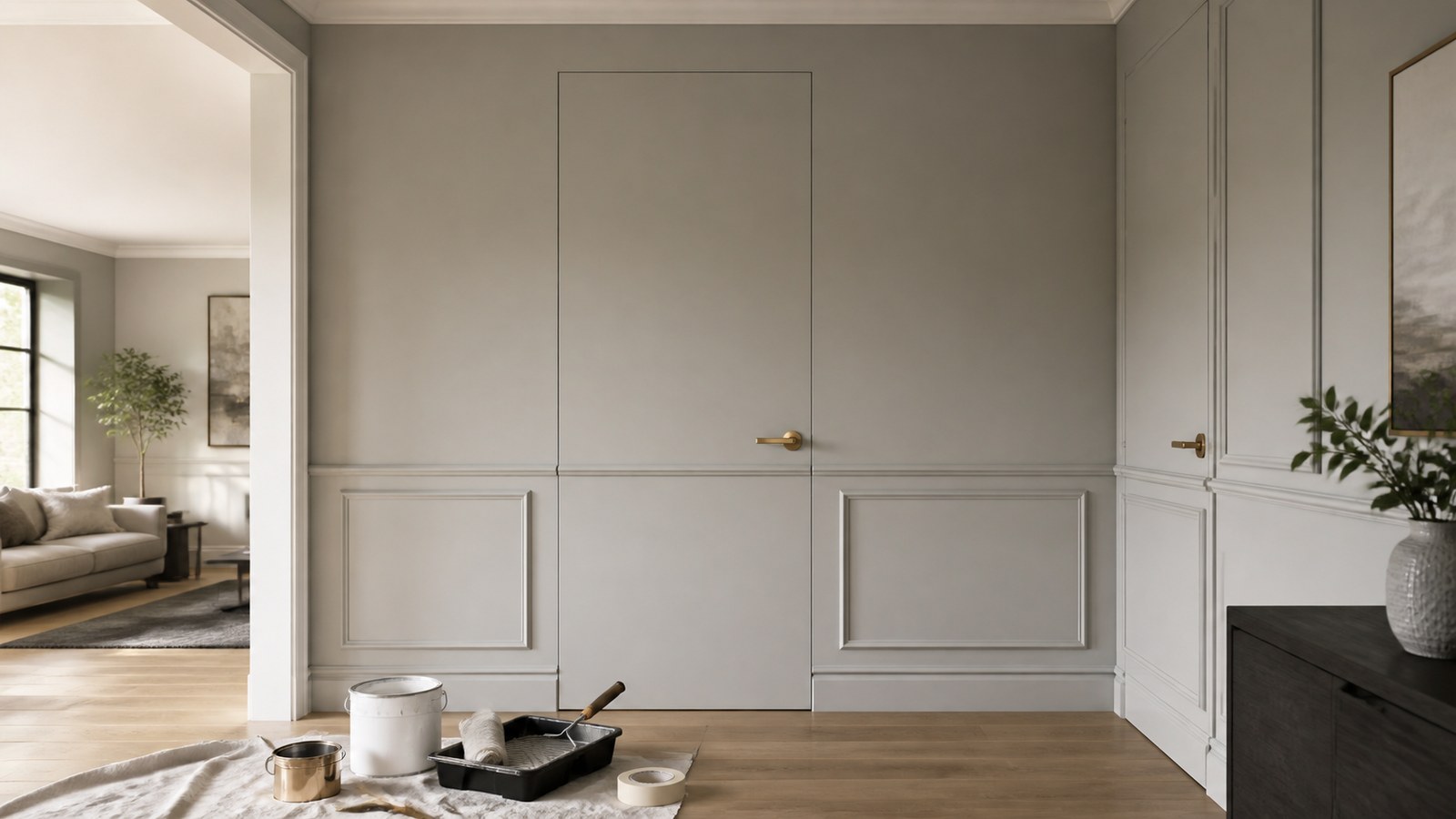
When Paint Becomes Camouflage
A door disappears into a wall when the eye stops receiving the usual clues: a different sheen, a bright casing line, a visible knob, a shadow around the jamb, or a slab that reflects light differently from the surrounding surface. Paint is one of the most affordable ways to reduce those clues, but it only works when the whole doorway is treated as part of the wall composition. The trick is not simply painting a door the same color as the room. It is managing texture, trim, hardware, reveal lines, light, and touch-up work so the door feels intentional instead of forgotten. A well-painted hidden door should look calm in the background, not like a door that someone tried to erase at the last minute.
A: Yes in low-traffic areas, but washable matte or eggshell often handles touch better.
A: For a disappearing effect, matching trim usually works better than contrast.
A: Dark paint can hide gaps, but it may show fingerprints and dust more readily.
A: Removing hinges gives a cleaner result; painted hinge barrels often look thick and sticky.
A: Prime and fill grain if the surrounding wall is smooth and the grain calls attention.
A: Yes, as long as the added thickness does not block swing or rub the frame.
A: Use a color-matched low-profile knob, edge pull, magnetic catch, or push latch.
A: Sheen, texture, hardware, and shadow gaps may be exposing it more than color.
A: Yes, visible edges should be finished so the illusion holds when the door moves.
A: Touch up broad logical areas and keep the original paint details on file.
Start With the Wall, Not the Door
The most convincing hidden door begins with a decision about the entire wall plane. If the wall is flat drywall, the door should be as flush as the existing frame allows. If the wall has picture molding, board-and-batten, shiplap, or panel trim, those elements should continue across the door in the same rhythm. A lone painted slab in the middle of a detailed wall still reads as a door, even when the color matches.
Look at the room from the angles people actually use. A door at the end of a hall is judged head-on, so symmetry and panel alignment matter. A door on a side wall is judged by raking light, so sheen and shadow control matter more. Walk the room at different times of day and notice where the doorway reveals itself. Those visual clues become the paint plan.
Match Sheen With Discipline
Color matching gets most of the attention, but sheen is often the giveaway. A satin door against a matte wall can flash every time light crosses it. A flat-painted door may hide better, but it can scuff more easily in a high-touch area. The best choice depends on traffic, cleaning needs, and the amount of natural light in the room. Hallways with windows, skylights, or glossy floors are especially unforgiving because reflected light exaggerates even subtle differences between products.
If the wall uses a durable matte or washable flat finish, carrying that same product onto the door can produce a very quiet look. In mudrooms, kitchens, or children’s areas, a low-sheen eggshell may be more practical. What matters is consistency. Do not use one brand and sheen on the wall and another on the door unless you test them side by side after they dry.
Dark colors can hide seams beautifully, but they can also highlight dust, fingerprints, and uneven patches. Pale colors reduce drama but may expose shadow lines around the frame. Always sample on both the wall and door, not only on a paper card.
Make Trim Either Vanish or Participate
Casing is one of the strongest door signals. If the goal is a fully disappearing door, bulky contrasting trim works against the illusion. Painting the casing, jamb, door, and wall the same color reduces contrast immediately. For a stronger transformation, some homeowners replace traditional casing with a minimal reveal bead or flush trim detail, but even standard trim can become quieter when it is treated as wall architecture rather than a frame around an opening.
In paneled rooms, trim can do the opposite job. Instead of erasing it, continue the pattern across the door. A vertical stile that lines up from wall to slab can disguise the hinge side. A horizontal rail crossing the door and wall can break up the outline. The painted pattern should look balanced across the whole wall, not like camouflage added only around the opening.
Reduce Hardware Clues
A shiny lever on a painted wall is a beacon. If the door must latch like a normal room door, choose hardware that matches the wall color, the trim color, or the dominant metal already used nearby. Low-profile knobs, edge pulls, magnetic catches, and touch latches all reduce visual noise. For closets, pantries, powder rooms, and utility spaces, the simplest approach may be a push-latch with no visible handle at all.
Hinges deserve the same attention. Exposed hinges painted in place often look clumsy if paint builds up around the knuckles. Removing hardware before painting gives a cleaner finish. If the project allows it, concealed hinges make the illusion stronger, but they require precise installation and door compatibility.
The hardware should still be comfortable to use. A door that looks invisible but requires awkward pressure, fingernail prying, or a secret shove will feel unfinished. Test the release with wet hands, full hands, and in low light, because the best disguise is one that disappears visually without becoming frustrating in daily life.
Use Texture to Blend the Surface
Drywall texture, plaster movement, brush marks, roller nap, and panel grain all affect whether the door belongs. A smooth slab in a room with orange peel texture may look too polished. A heavily brushed door on a smooth wall may catch light differently. The goal is not always to create identical texture, but to make the difference subtle enough that the door does not ask for attention.
For flat doors, sanding and priming are essential. Glossy factory finishes need deglossing so paint bonds evenly. Wood doors may need grain filling if the surrounding wall is smooth and modern. MDF or hardboard doors often hide well because they accept paint consistently, but edges must be sealed so they do not absorb finish differently.
On a paneled hidden door, caulk lines should be crisp and restrained. Over-caulked joints create soft ridges that catch light. Under-caulked joints leave dark cracks. A sharp paintable seal is one of the quiet details that makes the wall feel continuous.
Texture also needs to make sense at the edges. If the wall has a skim-coated plaster look, the door face may need extra surface preparation so it does not read as a factory slab. If the wall has brush-applied limewash or subtle movement, apply it across the door as part of the same pass rather than trying to imitate it later in a smaller rectangle.
Control the Reveal With Color Placement
The narrow gap around the door will always exist, but paint can decide whether it shouts or whispers. Painting the jamb and stop the same color as the door and wall keeps the shadow from turning into a contrast line. In darker rooms, a slightly darker jamb can recede; in lighter rooms, exact color matching usually works better.
Do not let old white primer or raw wood remain visible on the edge of the slab. Open the door and paint the hinge edge, latch edge, top, and any visible return. People may not consciously study those edges, but a pale flash when the door moves can break the illusion.
Plan Around Light and Sightlines
Raking light reveals seams, patches, roller marks, and hinge barrels. If a window throws light across the hidden door, the surface preparation has to be better. Sand repairs wide, feather primer, and use a consistent roller direction on the final coat. A doorway that looks invisible at noon can reveal every flaw at sunset.
Furniture, art, and lighting can support the effect without becoming gimmicks. A console table may draw attention away from a lower reveal. A sconce repeated on both sides of a wall may make the door look like part of the composition. Avoid hanging one obvious decorative object directly on the door unless the piece is meant to move with it and is installed safely.
Long hallways need special care because the eye reads every line in perspective. A slightly crooked trim strip, a proud slab corner, or a mismatched sheen can stand out from twenty feet away. Step back farther than you think is necessary before deciding the wall is finished.
Test, Touch Up, and Let the Paint Cure
Paint changes as it dries and cures. A freshly painted door may look slightly different from the wall for several days, especially with deeper colors. Let the finish settle before judging the match, then touch up entire logical areas rather than dabbing tiny spots. Spot touch-ups can create visible islands of different sheen.
The most successful disappearing doors are maintained like part of the room. Keep a record of the paint brand, color, base, sheen, and date. If the wall gets repainted later, repaint the door at the same time. The illusion is not a one-time trick. It is a finish strategy that stays convincing because every small detail keeps agreeing with the larger wall.
Decide How Invisible the Door Needs to Be
There is a difference between a door that politely recedes and a door that truly disappears. A bedroom closet may only need a calmer paint scheme and quieter hardware. A secret pantry in a minimalist kitchen may require flush details, edge pulls, and exact sheen control. Naming the goal helps you spend effort in the right places and avoid turning a simple paint project into unnecessary reconstruction. It also keeps expectations realistic: paint can perform a near-magic trick when the wall, trim, and hardware cooperate, but it cannot fully hide a warped slab, a proud frame, or a bright handle that belongs to a different design language.
Use the Room’s Existing Language
A disappearing door works best when it borrows cues that already belong in the room. In a traditional hallway, that may mean painted panel molding, baseboards, and a repeated rail height. In a modern room, it may mean a flat surface, crisp shadow gap, and hardware that is reduced to the edge. In a playful space, it may mean color blocking or wallpaper that crosses the door without apology. The right paint trick is the one that looks like the room would have used it even if no hidden door existed.
This is why copying a dramatic hidden-door photo rarely works without adjustment. The wall height, light direction, trim style, and traffic pattern in your home are different. Let the existing architecture decide whether the door should vanish through sameness, rhythm, or distraction. When the strategy fits the room, guests notice the overall polish before they notice the opening. Even a modest paint job can feel custom when the color continues cleanly over the casing, the sheen behaves consistently, and the hardware no longer interrupts the wall.
Keep the Finish Easy to Refresh
A painted hidden door will be touched, cleaned, bumped, and repainted over time, so the finish strategy should be repeatable. Save the paint information, use products that can be refreshed without flashing badly, and avoid one-off decorative effects that are impossible to repair. The door disappears more convincingly when maintenance does not create a new patchwork of mismatched touch-ups. A simple, repeatable finish is often more invisible over the years than a complicated effect that only looked perfect on installation day. That practicality is part of the illusion, because the best camouflage survives cleaning days, furniture moves, and the occasional scuff.


