Fantasy Entrances Make Wonder Conditional
Concealed entrances in fantasy literature often ask characters to prove that they can see, believe, remember, or deserve what ordinary people miss. A door may open only at moonrise, respond to a riddle, appear to a child, reveal itself to the rightful heir, or hide a city from hostile eyes. The hidden entrance is not just a route. It is a test of perception and belonging. Fantasy uses concealed thresholds to make wonder feel selective, protected, and slightly dangerous.
A: They turn the boundary between ordinary and magical worlds into an event.
A: Clear rules, meaningful clues, and consequences for entry.
A: They make access depend on understanding rather than force.
A: Yes. They can protect privilege, hoard knowledge, or exclude outsiders.
A: Concealment protects the community and creates a ritual of belonging.
A: A portal moves quickly across worlds, while a passage makes crossing a journey.
A: They can use sensory shifts, repeated landmarks, and almost-visible clues.
A: Yes, because rules make wonder feel structured instead of convenient.
A: Yes, by shaping mood, scale, light, and destination.
A: The visible world feels richer when attention can uncover another layer.
The Entrance Separates Worlds
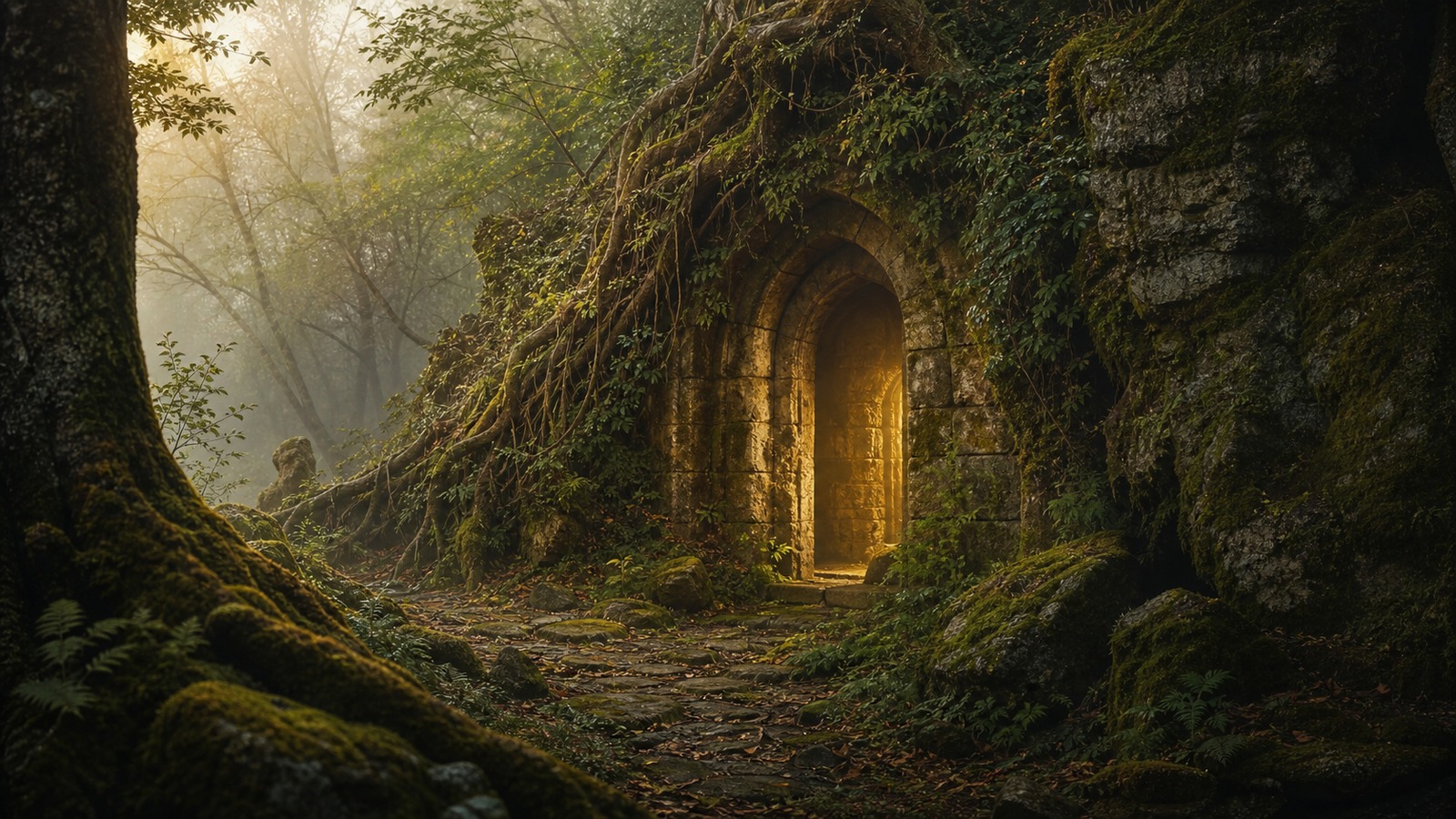
Fantasy stories depend on boundaries between the ordinary and the enchanted. A concealed entrance gives that boundary a physical form. A wardrobe, cave, ruined arch, inn cellar, forest hollow, mirror, gate, or hidden stair can move a character from known life into a world with different rules.
The threshold matters because crossing it changes expectations. After the hidden entrance, animals may speak, time may bend, maps may lie, or power may answer to names. The door tells readers that the story has entered a new contract.
Access Often Requires Recognition
Many fantasy doors do not open for everyone. They respond to bloodlines, passwords, songs, tokens, courage, humility, or moral readiness. The entrance becomes a judge. It separates those who merely stand before it from those who understand how to approach it.
This recognition gives fantasy thresholds emotional weight. A character who opens the door may feel chosen, burdened, welcomed, or exposed.
It also raises stakes. If access depends on identity or virtue, then failure is not only mechanical. It can feel personal.
Secret Cities Need Protected Thresholds
Hidden kingdoms, schools, sanctuaries, rebel camps, libraries, and markets often depend on concealed entrances. The route protects the community from outsiders while giving insiders a ritual of belonging. Readers enjoy the sense that an entire society can exist just beyond normal perception.
Magic Makes Seams Philosophical
In realistic architecture, a seam is a construction detail. In fantasy, a seam can be a question about reality. Is the wall solid? Is the forest ordinary? Is the mirror reflective or deep? The concealed entrance makes the world feel layered, as if visible surfaces are only one version of truth.
That layered feeling is central to the genre. Fantasy asks readers to suspect that ordinary things may contain more meaning than they appear to contain.
Rules Keep Magic From Feeling Convenient
A fantasy hidden entrance needs rules. It might open only during a season, require a phrase, refuse violent intent, move between locations, or demand payment. Without rules, the entrance can become an easy way for the author to move characters wherever the plot needs them.
Rules create pleasure because they let readers anticipate, worry, and solve. If the moon gate opens only once a month, timing matters. If the door rejects liars, character matters. If the path remembers travelers, history matters.
Strong rules make magic feel less arbitrary and more alive.
Portals and Passages Feel Different
A portal usually shifts worlds instantly, while a passage creates a journey. Fantasy uses both. A glowing doorway may move a character across realms, while a hidden tunnel through mountains may test endurance, fear, and companionship.
Concealed Entrances Protect Knowledge
Libraries, archives, temples, spell rooms, and memory vaults in fantasy often hide their entrances because knowledge is dangerous. A book, name, map, prophecy, or relic may need protection from people who would misuse it.
This gives concealed doors ethical force. The question is not only how to enter, but whether anyone should enter. The threshold guards responsibility.
Quests Use Doors as Turning Points
A quest often changes when the party finds a hidden entrance. The landscape stops being scenery and becomes intentional. The mountain has a door. The forest has a path. The ruined tower has a lower stair. The world seems to have been waiting for discovery.
That turning point can renew momentum. A long journey may feel uncertain until the concealed threshold confirms that the characters are on the right trail.
The entrance can also narrow the story. Once characters pass through, escape may be harder, choices more serious, and the hidden world less forgiving than the visible one.
Riddles Turn Doors Into Dialogue
Fantasy entrances often speak through riddles, inscriptions, songs, puzzles, or symbolic arrangements. The door becomes a conversation partner. It asks the character to think in the language of the world rather than force the way open.
Hidden Doors Can Exclude Unjustly
Not every selective entrance is noble. Some fantasy societies hide doors to preserve privilege, hoard magic, exclude outsiders, or protect corrupt power. A concealed entrance can therefore become a symbol of injustice as well as wonder.
This complexity keeps the device fresh. A hidden city may be beautiful and morally compromised. A secret school may protect children and conceal dangerous hierarchy. The door invites awe, but it can also ask who has been kept outside.
Reader Wonder Comes From Almost Seeing
Fantasy literature often builds anticipation by letting readers almost see the hidden entrance before it opens. A strange wind, repeated landmark, impossible shadow, missing reflection, or animal guide can suggest that the world is not aligned correctly.
The reveal then feels like confirmation. The reader knew something was wrong with the surface. The door proves that suspicion was right.
This is one of the genre’s deepest pleasures: the sense that attention can uncover enchantment.
Real Hidden Doors Borrow the Threshold Feeling
Fantasy-inspired homes and themed spaces can borrow the idea of a threshold that changes mood. A reading room behind shelves, a child’s playroom through a small door, or a garden gate wrapped in vines can feel magical without pretending to be a portal.
The Door Beyond Must Be Worth the Test
A fantasy concealed entrance raises expectation. If the hidden room or world beyond feels ordinary, the test can feel wasted. The space beyond should reward the threshold through atmosphere, knowledge, danger, beauty, or transformation.
This principle applies beyond fiction. A concealed door is strongest when the reveal leads somewhere with purpose. Wonder needs a destination.
Fantasy Entrances Remind Readers to Look Again
Concealed entrances in fantasy literature remain powerful because they turn perception into adventure. The character who sees differently moves differently. The reader learns to question surfaces, listen to old words, watch moonlight, and treat ordinary objects as possible thresholds.
The hidden entrance is therefore more than a plot device. It is the genre’s promise in miniature: the world is not exhausted by its visible face. Somewhere behind the wall, beneath the hill, inside the wardrobe, or through the old arch, another order waits. The question is not only whether the door exists, but whether anyone has learned how to notice it.
That act of noticing can be heroic before any battle begins. The character who pays attention to the overlooked doorway has already stepped outside ordinary habits. Fantasy rewards that shift because the genre depends on the belief that attention can change access.
Thresholds Can Teach Cultural Values
A fantasy concealed entrance often reveals what a culture values. A dwarven gate may honor craft, a forest path may honor patience, a hidden school may honor curiosity, and a shrine door may honor humility. The method of entry becomes a cultural statement. Readers learn the world by learning how its doors behave.
Hidden Entrances Shape Character Arcs
The first time a character finds a concealed entrance, they may be lucky, frightened, or guided by someone wiser. Later, they may find another because they have learned the world’s patterns. The door becomes a measure of growth.
This progression is satisfying because fantasy often links outer journeys to inner change. A character who once needed a guide may later recognize a threshold by memory, courage, or compassion. The hidden entrance shows that they now belong more fully to the story world.
The opposite can also be powerful. A character may lose access after betrayal, fear, arrogance, or broken trust. A door that once opened now remains closed, making moral change visible.
Danger Protects Wonder From Becoming Cozy
Concealed entrances in fantasy should not always feel safe. A hidden path can lead to beauty and still demand risk. The mountain door may open into darkness, the garden gate may trap trespassers, and the mirror route may ask for a price. Danger keeps wonder from becoming decorative.
The Best Magic Has Consequences
When a fantasy door opens, something should change. The character may gain knowledge, lose innocence, enter a debt, reveal identity, or cross a boundary that cannot be uncrossed. The entrance is strongest when it marks commitment.
This consequence is what keeps concealed thresholds from becoming convenient shortcuts. They are not merely ways to move characters around a map. They are moments when the world recognizes an action and answers. That answer may be generous, but it should never be empty.
Hidden Entrances Give Maps a Secret Grammar
Fantasy maps often show mountains, rivers, forests, roads, kingdoms, and seas, but concealed entrances add another grammar underneath the visible geography. A cave mouth may be more important than a city gate. A forgotten well may reach a buried kingdom. A ring of stones may matter only on a certain night.
This hidden grammar makes the world feel older than the characters’ knowledge of it. The map is not wrong; it is incomplete until someone learns how to read the concealed routes. Readers enjoy that expansion because it suggests that history has left instructions in the landscape.
When writers use this well, the entrance feels discovered rather than invented. It seems to have been waiting in the world before the plot arrived.
Wonder Needs Ordinary Surfaces
Fantasy concealed entrances work best when they begin in recognizable surfaces. A plain door, old tree, wardrobe, cellar, arch, hill, or mirror gives readers something familiar to stand on before the world opens. The ordinary surface is not boring; it is the launch point that makes enchantment feel close enough to touch.
The Threshold Can Rewrite Home
Many fantasy stories begin with a concealed entrance near home because home is the strongest ordinary surface a character knows. When a wall, garden, attic, cellar, or wardrobe opens, the familiar place becomes unstable. The character has not only found a route outward; they have learned that their own world had hidden depth.
This is why the return matters. After crossing a fantasy threshold, home rarely feels exactly the same. The hidden entrance changes memory. Even if the door closes, the character and reader know that ordinary surfaces may carry extraordinary pressure. That knowledge is one of fantasy’s quiet aftereffects, and it can be more haunting than the first spectacle of discovery. The character may sit at the same table, walk the same road, or touch the same wall, but the world now contains an invisible invitation. The old setting has become larger from within, and every familiar boundary feels a little less final than before, as if the story has taught perception a new habit of suspicion and hope that remains after the page turns and the lamp goes out at night again, quietly, somewhere inside the reader afterward still.